LEADER 03775nam a22004815i 4500
001 810900
003 TR_AnAIT
005 20260131013214
007 cr nn 008mamaa
008 100301s2004 ne | s |||| 0|eng d
020 |a9781402023446|9978-1-4020-2344-6
024 7 |a10.1007/1-4020-2344-8|2doi
041 |aeng
049 |aTürk Tarih Kurumu Kütüphanesi
050 4|aLB2300-2799.3
072 7|aJNM|2bicssc
072 7|aEDU015000|2bisacsh
072 7|aJNM|2thema
082 04|a378|223
090 |aDK/12166
100 1 |aGibbs, Paul T.|eauthor.|4aut|4http://id.loc.gov/vocabulary/relators/aut
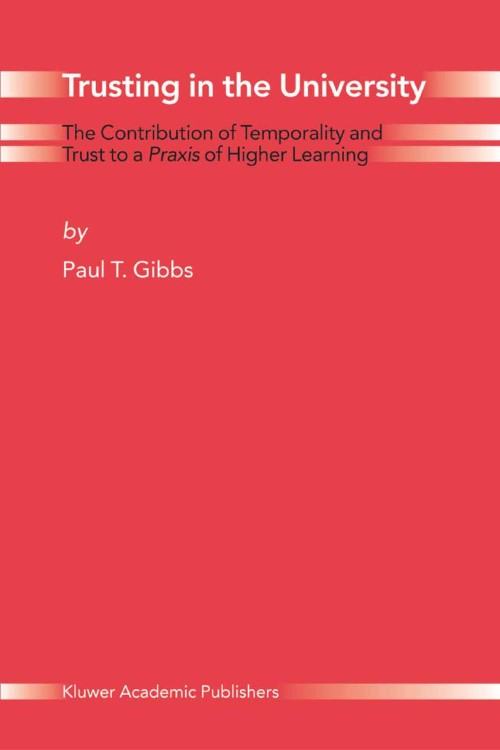
245 10|aTrusting in the University|h[electronic resource] :|bThe Contribution of Temporality and Trust to a Praxis of Higher Learning /|cby Paul T. Gibbs.
250 |a1st ed. 2004.
264 1|aDordrecht :|bSpringer Netherlands :|bImprint: Springer,|c2004.
300 |aXII, 216 p.|bonline resource.
336 |atext|btxt|2rdacontent
337 |acomputer|bc|2rdamedia
338 |aonline resource|bcr|2rdacarrier
347 |atext file|bPDF|2rda
505 0 |aLiberalism, Mass Education and a Loss of Academic Trust -- The Market Metaphor — A Good Basis for Trust? -- What Form of Trust Might be Appropriate for Universities to Build a Praxis of Higher Education Designed to Encourage Authenticity? -- Education in a Culture of Suspicion? -- If Not the Market Model, then Perhaps a Heideggerian Perspective? -- A University’s Authenticity is in its Community -- Trusting in Thinking about Knowing -- Trusting in Teaching to Let Learn -- A Trusting Praxis for Higher Education Institutions -- Reflections.
520 |aThe world in which we learn is changing rapidly. That rapidity is driven by a range of influences, conveniently, but inadequately, clustered under the rubric of globalisation. . The context in which globalisation and education is often linked is that of progression, progression realisable through technology, the free movement of finances and the optimum utilisation of human capital. To fuel this progression, formal educational institutions have grown, adapted and changed to provide highly skilled ‘outputs’ to satisfy demand. Along the way, I will argue, the questioning, learning, reflecting and worthiness of formal education has been sacrificed for instrumentality, compliance and self-interest. This is seen throughout the educational system but this book concentrates on higher education and, more importantly, higher educational institutions that are known as universities. I will try to argue for a distinctive place for universities that does not resist progression but defines it differently from that allowable by the market. I propose a university system where students and faculty are together allowed to ‘let learn’ who they might become, rather than realise their being as the artefact of economic imperatives. I accept from the very beginning that this might be incompatible with universities being in the world of commerce and industry, in fact, I demand that they are not! However, my text is not a polemic against the capitalist entrapment of education per se but for the development of centres that question whilst engaging with the realities of our existence.
650 0|aEducation, Higher.
650 0|aEducation.
650 14|aHigher Education.
650 24|aEducation.
710 2 |aSpringerLink (Online service)
773 0 |tSpringer Nature eBook
776 08|iPrinted edition:|z9781402023439
776 08|iPrinted edition:|z9789048166428
776 08|iPrinted edition:|z9789401743181
856 40|uhttps://doi.org/10.1007/1-4020-2344-8
912 |aZDB-2-SHU
912 |aZDB-2-SXED
912 |aZDB-2-BAE
950 |aHumanities, Social Sciences and Law (SpringerNature-11648)
950 |aEducation (R0) (SpringerNature-43721)