LEADER 03977nam a22005895i 4500
001 810901
003 TR_AnAIT
005 20260131013213
007 cr nn 008mamaa
008 100301s2004 ne | s |||| 0|eng d
020 |a9781402025211|9978-1-4020-2521-1
024 7 |a10.1007/1-4020-2521-1|2doi
041 |aeng
049 |aTürk Tarih Kurumu Kütüphanesi
050 4|aL1-991
072 7|aJN|2bicssc
072 7|aEDU000000|2bisacsh
072 7|aJN|2thema
082 04|a370|223
090 |aDK/12167
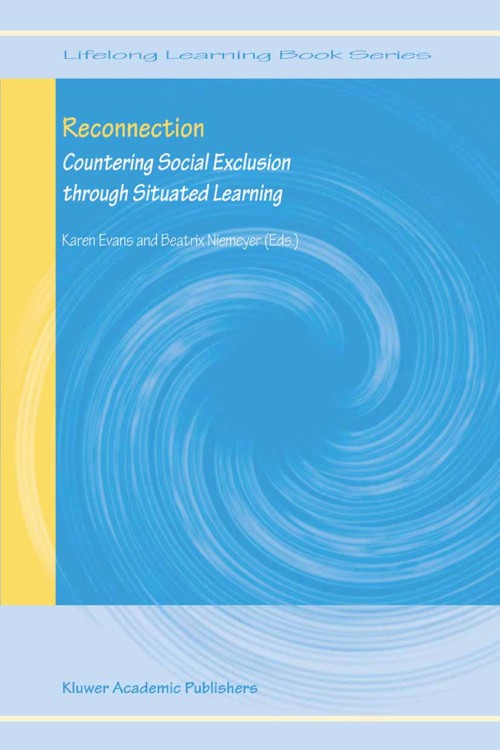
245 10|aReconnection|h[electronic resource] :|bCountering Social Exclusion through Situated Learning /|cedited by Karen Evans, Beatrix Niemeyer.
250 |a1st ed. 2004.
264 1|aDordrecht :|bSpringer Netherlands :|bImprint: Springer,|c2004.
300 |aXII, 218 p.|bonline resource.
336 |atext|btxt|2rdacontent
337 |acomputer|bc|2rdamedia
338 |aonline resource|bcr|2rdacarrier
347 |atext file|bPDF|2rda
490 1 |aLifelong Learning Book Series,|x2730-5325 ;|v2
505 0 |aRe-Enter and Reconnect-But Whose Problem is it? -- Engaging to Learn: Situated Learning and Re-Integration for Young People -- Situated Learning for Social and Vocational Integration in Germany -- Situated Learning Embedded in the Idea of Route Counselling -- Situated Learning as a Challenge for Teachers and Trainers -- Re-Enter Initiatives in the Context of Integrative Vocational Education and Training -- Re-Entering Transformable Labour Markets and the Role of VET -- Suggestions for Improving the Framework Conditions for Re-Enter Initiatives -- Summarising Conclusions and Recommendations for Practice.
520 |aThis book is based on the work of a European partnership, whose members came together from Belgium England Finland Germany Portugal and Greece with the support of funding from the EU Socrates Programme. Our goal was to work collaboratively to generate new ways of thinking about the situation of people aged between 14 and 25 who are at risk of (or experiencing) social exclusion, set in the context of a unique international analysis of policies, contexts and perspectives on the problems of social exclusion in Europe and the challenges of promoting lifelong learning among those who have rejected it early in life. We set out to examine programmes which help people to RE-ENTER pathways of education and training, but ended with approaches which are better characterised by their ability to RECONNECT people, not only to opportunities in the social structures but also to each other and to their communities We have developed new models and guidelines based on analysis of the best of European practice using the distinctive approaches of 'situated learning'. By an iterative and collaborative method of working, we have arrived at the concept and approaches of Learning Communities Centred on Practice (LCPs), which lie at the heart of this volume.
650 0|aEducation.
650 0|aInternational education .
650 0|aComparative education.
650 0|aEducational sociology.
650 0|aProfessional education.
650 0|aVocational education.
650 14|aEducation.
650 24|aInternational and Comparative Education.
650 24|aSociology of Education.
650 24|aProfessional and Vocational Education.
700 1 |aEvans, Karen.|eeditor.|4edt|4http://id.loc.gov/vocabulary/relators/edt
700 1 |aNiemeyer, Beatrix.|eeditor.|4edt|4http://id.loc.gov/vocabulary/relators/edt
710 2 |aSpringerLink (Online service)
773 0 |tSpringer Nature eBook
776 08|iPrinted edition:|z9781402025204
776 08|iPrinted edition:|z9789048100750
776 08|iPrinted edition:|z9789401742146
830 0|aLifelong Learning Book Series,|x2730-5325 ;|v2
856 40|uhttps://doi.org/10.1007/1-4020-2521-1
912 |aZDB-2-SHU
912 |aZDB-2-SXED
912 |aZDB-2-BAE
950 |aHumanities, Social Sciences and Law (SpringerNature-11648)
950 |aEducation (R0) (SpringerNature-43721)