LEADER 04261nam a22005895i 4500
001 810914
003 TR_AnAIT
005 20260131013152
007 cr nn 008mamaa
008 100301s2005 ne | s |||| 0|eng d
020 |a9781402030079|9978-1-4020-3007-9
024 7 |a10.1007/1-4020-3007-X|2doi
041 |aeng
049 |aTürk Tarih Kurumu Kütüphanesi
050 4|aK3154-3370
072 7|aLND|2bicssc
072 7|aLAW018000|2bisacsh
072 7|aLND|2thema
082 04|a342|223
090 |aDK/12180
100 1 |aSadurski, Wojciech.|eauthor.|4aut|4http://id.loc.gov/vocabulary/relators/aut
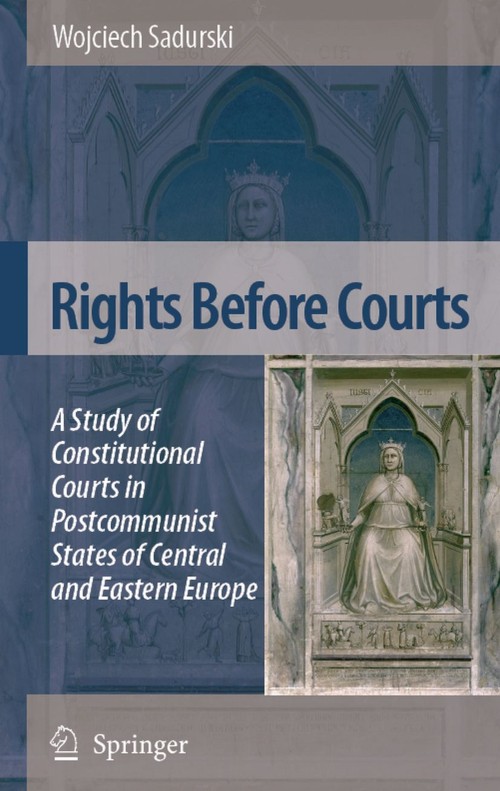
245 10|aRights Before Courts|h[electronic resource] :|bA Study of Constitutional Courts in Postcommunist States of Central and Eastern Europe /|cby Wojciech Sadurski.
250 |a1st ed. 2005.
264 1|aDordrecht :|bSpringer Netherlands :|bImprint: Springer,|c2005.
300 |aXIX, 377 p.|bonline resource.
336 |atext|btxt|2rdacontent
337 |acomputer|bc|2rdamedia
338 |aonline resource|bcr|2rdacarrier
347 |atext file|bPDF|2rda
505 0 |aI -- The Model of Constitutional Review in Central and Eastern Europe: An Overview -- Constitutional Courts in Search of Legitimacy -- The Model of Judicial Review and its Implications -- Constitutional Courts and Legislation -- II -- Judicial Review and Protection of Constitutional Rights -- Personal, Civil and Political Rights and Liberties -- Socio-Economic Rights -- Equality and Minority Rights -- “Decommunisation”, “Lustration”, and Constitutional Continuity -- Restrictions of Rights.
520 |aChallenging the conventional wisdom that constitutional courts are the best device that democratic systems have for the protection of individual rights, Wojciech Sadurski examines carefully the most recent wave of activist constitutional courts: those that have emerged after the fall of communism in Central and Eastern Europe. In contrast to most other analysts and scholars he does not take for granted that they are a "force for the good", but rather subjects them to critical scrutiny against the background of a wide-ranging comparative and theoretical analysis of constitutional judicial review in the modern world. He shows that, in the region of Central and Eastern Europe, their record in protecting constitutional rights has been mixed, and their impact upon the vibrancy of democratic participation and public discourse about controversial issues often negative. Sadurski urges us to reconsider the frequently unthinking enthusiasm for the imposition of judicial limits upon constitutional democracy. In the end, his reflections go to the very heart of the fundamental dilemma of constitutionalism and political theory: how best to find the balance between constitutionalism and democracy? The lively, if imperfect, democracies in Central and Eastern Europe provide a fascinating terrain for raising this question, and testing traditional answers. This innovative, wide-ranging and thought-provoking book will become essential reading for scholars and students alike in the fields of comparative constitutionalism and political theory, particularly for those with an interest in legal and political developments in the postcommunist world.
650 0|aConstitutional law.
650 0|aPolitical science.
650 0|aLaw|xPhilosophy.
650 0|aLaw|xHistory.
650 0|aPrivate international law.
650 0|aConflict of laws.
650 0|aInternational law.
650 0|aComparative law.
650 14|aConstitutional Law.
650 24|aPolitical Science.
650 24|aTheories of Law, Philosophy of Law, Legal History.
650 24|aPrivate International Law, International and Foreign Law, Comparative Law.
650 24|aPublic International Law.
710 2 |aSpringerLink (Online service)
773 0 |tSpringer Nature eBook
776 08|iPrinted edition:|z9781402030062
776 08|iPrinted edition:|z9781402069826
776 08|iPrinted edition:|z9789048101528
776 08|iPrinted edition:|z9789048116577
856 40|uhttps://doi.org/10.1007/1-4020-3007-X
912 |aZDB-2-SHU
912 |aZDB-2-SXLC
950 |aHumanities, Social Sciences and Law (SpringerNature-11648)
950 |aLaw and Criminology (R0) (SpringerNature-43727)