

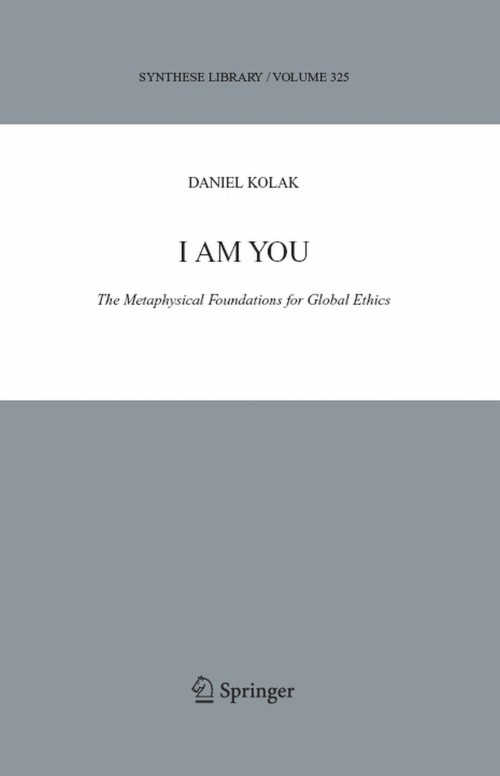
I Am You [electronic resource] : The Metaphysical Foundations for Global Ethics / by Daniel Kolak.
Erişim Adresi
ISBN
9781402030147
Dil Kodu
İngilizce
Yer Numarası
DK/12181
Yazar
Basım Bildirimi
1st ed. 2004.
Yayın Bilgisi
Dordrecht : Springer Netherlands : Imprint: Springer, 2004.
Fiziksel Niteleme
XXIII, 659 p. online resource.
Dizi
Synthese Library, Studies in Epistemology, Logic, Methodology, and Philosophy of Science, 2542-8292 ; 325
İçindekiler Notu
Personal Borders -- Border Control -- Physiological Borders -- Neurological Borders -- Spatial Borders -- Psychological Borders -- Causal Borders -- Metaphysical Borders -- Identity Borders -- Phenomenological Borders -- Transcendental Borders -- Moral Borders.
Özet, vb.
Borders enclose and separate us. We assign to them tremendous significance. Along them we draw supposedly uncrossable boundaries within which we believe our individual identities begin and end, erecting the metaphysical dividing walls that enclose each one of us into numerically identical, numerically distinct, entities: persons. Do the borders between us—physical, psychological, neurological, causal, spatial, temporal, etc.—merit the metaphysical significance ordinarily accorded them? The central thesis of I Am You is that our borders do not signify boundaries between persons. We are all the same person. Variations on this heretical theme have been voiced periodically throughout the ages (the Upanishads, Averroës, Giordano Bruno, Josiah Royce, Schrödinger, Fred Hoyle, Freeman Dyson). In presenting his arguments, the author relies on detailed analyses of recent formal work on personal identity, especially that of Derek Parfit, Sydney Shoemaker, Robert Nozick, David Wiggins, Daniel C. Dennett and Thomas Nagel, while incorporating the views of Descartes, Leibniz, Wittgenstein, Schopenhauer, Kant, Husserl and Brouwer. His development of the implied moral theory is inspired by, and draws on, Rawls, Sidgwick, Kant and again Parfit. The traditional, commonsense view that we are each a separate person numerically identical to ourselves over time, i.e., that personal identity is closed under known individuating and identifying borders—what the author calls Closed Individualism—is shown to be incoherent. The demonstration that personal identity is not closed but open points collectively in one of two new directions: either there are no continuously existing, self-identical persons over time in the sense ordinarily understood—the sort of view developed by philosophers as diverse as Buddha, Hume and most recently Derek Parfit, what the author calls Empty Individualism—or else you are everyone, i.e., personal identity is notclosed under known individuating and identifying borders, what the author calls Open Individualism. In making his case, the author: * offers a new explanation both of consciousness and of self-consciousness * constructs a new theory of Self * explains psychopathologies (e.g. multiple personality disorder, schizophrenia) * shows Open Individualism to be the best competing explanation of who we are * provides the metaphysical foundations for global ethics. The book is intended for philosophers and the philosophically inclined—physicists, mathematicians, psychiatrists, psychologists, linguists, computer scientists, economists, and communication theorists. It is accessible to graduate students and advanced undergraduates.
Konu
Philosophy.
Philosophy of mind.
Ethics.
Metaphysics.
Philosophy.
Philosophy of Mind.
Moral Philosophy and Applied Ethics.
Metaphysics.
Philosophy of mind.
Ethics.
Metaphysics.
Philosophy.
Philosophy of Mind.
Moral Philosophy and Applied Ethics.
Metaphysics.
Kurum Adı
Eseri Alıntıla
Referansları kullanmadan önce gözden geçirmeniz ve varsa gerekli düzeltmeleri yapmanız önerilir.
Dijital Kaynak
MARC Görünümü
LEADER 04944nam a22005535i 4500
001 810915
003 TR_AnAIT
005 20260131013148
007 cr nn 008mamaa
008 100301s2004 ne | s |||| 0|eng d
020 |a9781402030147|9978-1-4020-3014-7
024 7 |a10.1007/978-1-4020-3014-7|2doi
041 |aeng
049 |aTürk Tarih Kurumu Kütüphanesi
050 4|aB1-5802
072 7|aHP|2bicssc
072 7|aPHI000000|2bisacsh
072 7|aQD|2thema
082 04|a100|223
090 |aDK/12181
100 1 |aKolak, Daniel.|eauthor.|4aut|4http://id.loc.gov/vocabulary/relators/aut
245 10|aI Am You|h[electronic resource] :|bThe Metaphysical Foundations for Global Ethics /|cby Daniel Kolak.
250 |a1st ed. 2004.
264 1|aDordrecht :|bSpringer Netherlands :|bImprint: Springer,|c2004.
300 |aXXIII, 659 p.|bonline resource.
336 |atext|btxt|2rdacontent
337 |acomputer|bc|2rdamedia
338 |aonline resource|bcr|2rdacarrier
347 |atext file|bPDF|2rda
490 1 |aSynthese Library, Studies in Epistemology, Logic, Methodology, and Philosophy of Science,|x2542-8292 ;|v325
505 0 |aPersonal Borders -- Border Control -- Physiological Borders -- Neurological Borders -- Spatial Borders -- Psychological Borders -- Causal Borders -- Metaphysical Borders -- Identity Borders -- Phenomenological Borders -- Transcendental Borders -- Moral Borders.
520 |aBorders enclose and separate us. We assign to them tremendous significance. Along them we draw supposedly uncrossable boundaries within which we believe our individual identities begin and end, erecting the metaphysical dividing walls that enclose each one of us into numerically identical, numerically distinct, entities: persons. Do the borders between us—physical, psychological, neurological, causal, spatial, temporal, etc.—merit the metaphysical significance ordinarily accorded them? The central thesis of I Am You is that our borders do not signify boundaries between persons. We are all the same person. Variations on this heretical theme have been voiced periodically throughout the ages (the Upanishads, Averroës, Giordano Bruno, Josiah Royce, Schrödinger, Fred Hoyle, Freeman Dyson). In presenting his arguments, the author relies on detailed analyses of recent formal work on personal identity, especially that of Derek Parfit, Sydney Shoemaker, Robert Nozick, David Wiggins, Daniel C. Dennett and Thomas Nagel, while incorporating the views of Descartes, Leibniz, Wittgenstein, Schopenhauer, Kant, Husserl and Brouwer. His development of the implied moral theory is inspired by, and draws on, Rawls, Sidgwick, Kant and again Parfit. The traditional, commonsense view that we are each a separate person numerically identical to ourselves over time, i.e., that personal identity is closed under known individuating and identifying borders—what the author calls Closed Individualism—is shown to be incoherent. The demonstration that personal identity is not closed but open points collectively in one of two new directions: either there are no continuously existing, self-identical persons over time in the sense ordinarily understood—the sort of view developed by philosophers as diverse as Buddha, Hume and most recently Derek Parfit, what the author calls Empty Individualism—or else you are everyone, i.e., personal identity is notclosed under known individuating and identifying borders, what the author calls Open Individualism. In making his case, the author: * offers a new explanation both of consciousness and of self-consciousness * constructs a new theory of Self * explains psychopathologies (e.g. multiple personality disorder, schizophrenia) * shows Open Individualism to be the best competing explanation of who we are * provides the metaphysical foundations for global ethics. The book is intended for philosophers and the philosophically inclined—physicists, mathematicians, psychiatrists, psychologists, linguists, computer scientists, economists, and communication theorists. It is accessible to graduate students and advanced undergraduates.
650 0|aPhilosophy.
650 0|aPhilosophy of mind.
650 0|aEthics.
650 0|aMetaphysics.
650 14|aPhilosophy.
650 24|aPhilosophy of Mind.
650 24|aMoral Philosophy and Applied Ethics.
650 24|aMetaphysics.
710 2 |aSpringerLink (Online service)
773 0 |tSpringer Nature eBook
776 08|iPrinted edition:|z9781402029998
776 08|iPrinted edition:|z9789048167647
776 08|iPrinted edition:|z9789401751001
830 0|aSynthese Library, Studies in Epistemology, Logic, Methodology, and Philosophy of Science,|x2542-8292 ;|v325
856 40|uhttps://doi.org/10.1007/978-1-4020-3014-7
912 |aZDB-2-SHU
912 |aZDB-2-SXPR
912 |aZDB-2-BAE
950 |aHumanities, Social Sciences and Law (SpringerNature-11648)
950 |aPhilosophy and Religion (R0) (SpringerNature-43725)
001 810915
003 TR_AnAIT
005 20260131013148
007 cr nn 008mamaa
008 100301s2004 ne | s |||| 0|eng d
020 |a9781402030147|9978-1-4020-3014-7
024 7 |a10.1007/978-1-4020-3014-7|2doi
041 |aeng
049 |aTürk Tarih Kurumu Kütüphanesi
050 4|aB1-5802
072 7|aHP|2bicssc
072 7|aPHI000000|2bisacsh
072 7|aQD|2thema
082 04|a100|223
090 |aDK/12181
100 1 |aKolak, Daniel.|eauthor.|4aut|4http://id.loc.gov/vocabulary/relators/aut
245 10|aI Am You|h[electronic resource] :|bThe Metaphysical Foundations for Global Ethics /|cby Daniel Kolak.
250 |a1st ed. 2004.
264 1|aDordrecht :|bSpringer Netherlands :|bImprint: Springer,|c2004.
300 |aXXIII, 659 p.|bonline resource.
336 |atext|btxt|2rdacontent
337 |acomputer|bc|2rdamedia
338 |aonline resource|bcr|2rdacarrier
347 |atext file|bPDF|2rda
490 1 |aSynthese Library, Studies in Epistemology, Logic, Methodology, and Philosophy of Science,|x2542-8292 ;|v325
505 0 |aPersonal Borders -- Border Control -- Physiological Borders -- Neurological Borders -- Spatial Borders -- Psychological Borders -- Causal Borders -- Metaphysical Borders -- Identity Borders -- Phenomenological Borders -- Transcendental Borders -- Moral Borders.
520 |aBorders enclose and separate us. We assign to them tremendous significance. Along them we draw supposedly uncrossable boundaries within which we believe our individual identities begin and end, erecting the metaphysical dividing walls that enclose each one of us into numerically identical, numerically distinct, entities: persons. Do the borders between us—physical, psychological, neurological, causal, spatial, temporal, etc.—merit the metaphysical significance ordinarily accorded them? The central thesis of I Am You is that our borders do not signify boundaries between persons. We are all the same person. Variations on this heretical theme have been voiced periodically throughout the ages (the Upanishads, Averroës, Giordano Bruno, Josiah Royce, Schrödinger, Fred Hoyle, Freeman Dyson). In presenting his arguments, the author relies on detailed analyses of recent formal work on personal identity, especially that of Derek Parfit, Sydney Shoemaker, Robert Nozick, David Wiggins, Daniel C. Dennett and Thomas Nagel, while incorporating the views of Descartes, Leibniz, Wittgenstein, Schopenhauer, Kant, Husserl and Brouwer. His development of the implied moral theory is inspired by, and draws on, Rawls, Sidgwick, Kant and again Parfit. The traditional, commonsense view that we are each a separate person numerically identical to ourselves over time, i.e., that personal identity is closed under known individuating and identifying borders—what the author calls Closed Individualism—is shown to be incoherent. The demonstration that personal identity is not closed but open points collectively in one of two new directions: either there are no continuously existing, self-identical persons over time in the sense ordinarily understood—the sort of view developed by philosophers as diverse as Buddha, Hume and most recently Derek Parfit, what the author calls Empty Individualism—or else you are everyone, i.e., personal identity is notclosed under known individuating and identifying borders, what the author calls Open Individualism. In making his case, the author: * offers a new explanation both of consciousness and of self-consciousness * constructs a new theory of Self * explains psychopathologies (e.g. multiple personality disorder, schizophrenia) * shows Open Individualism to be the best competing explanation of who we are * provides the metaphysical foundations for global ethics. The book is intended for philosophers and the philosophically inclined—physicists, mathematicians, psychiatrists, psychologists, linguists, computer scientists, economists, and communication theorists. It is accessible to graduate students and advanced undergraduates.
650 0|aPhilosophy.
650 0|aPhilosophy of mind.
650 0|aEthics.
650 0|aMetaphysics.
650 14|aPhilosophy.
650 24|aPhilosophy of Mind.
650 24|aMoral Philosophy and Applied Ethics.
650 24|aMetaphysics.
710 2 |aSpringerLink (Online service)
773 0 |tSpringer Nature eBook
776 08|iPrinted edition:|z9781402029998
776 08|iPrinted edition:|z9789048167647
776 08|iPrinted edition:|z9789401751001
830 0|aSynthese Library, Studies in Epistemology, Logic, Methodology, and Philosophy of Science,|x2542-8292 ;|v325
856 40|uhttps://doi.org/10.1007/978-1-4020-3014-7
912 |aZDB-2-SHU
912 |aZDB-2-SXPR
912 |aZDB-2-BAE
950 |aHumanities, Social Sciences and Law (SpringerNature-11648)
950 |aPhilosophy and Religion (R0) (SpringerNature-43725)
Materyaller
Depodan talep edilen materyal sadece kütüphane içerisinde kullanılmaktadır.
Materyal dışarıya ödünç verilmemektedir.
Materyal dışarıya ödünç verilmemektedir.
