

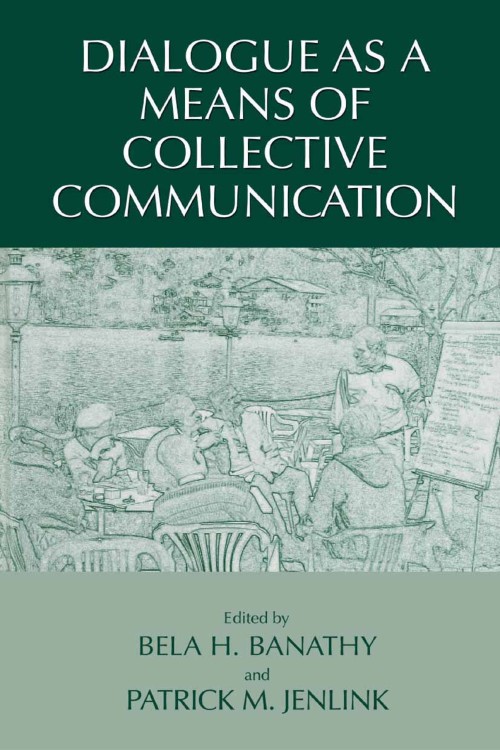
Dialogue as a Means of Collective Communication [electronic resource] / edited by Bela H. Banathy, Patrick M. Jenlink.
Erişim Adresi
ISBN
9780306486906
Dil Kodu
İngilizce
Yer Numarası
DK/12191
Basım Bildirimi
1st ed. 2005.
Yayın Bilgisi
New York, NY : Springer US : Imprint: Springer, 2005.
Fiziksel Niteleme
XIV, 440 p. online resource.
İçindekiler Notu
Dialogue -- Historical and Cultural Perspectives of Conversation -- Wholeness Regained -- Martin Buber and Mikhail Bakhtin -- Designing Communities of Ideas for the Well-Being -- Dialogue and Spirituality -- Transforming Communities -- My Dialogue with Dialogue -- Perspectives on Dialogue Conversation -- The Five Dimensions of Bohm’s Dialogue -- Facilitating a Global Conversation Through the Universal Demosophia Facility -- Becoming Aware -- Doing and Talking -- Bohm’s Journey to Dialogue -- Carnival and Dialogue -- Modalities of Conversation -- Post-Formal Conversation -- Future Search Conversation -- Creating New Connections -- The Conditions for Thriving Conversations -- Practical Applications of Conversation -- A Community Round Table -- Corporate Conversation -- Conversation and the Development of Learning Communities -- Reflections on Searching Together for the Future -- Dialogue in Socio-Cultural Evolution.
Özet, vb.
Dialogue as a Means of Collective Communication offers a cross-disciplinary approach to examining dialogue as a communicative medium. Presented in five parts, the book takes the reader on a journey of exploring the power and potential of dialogue as a means for communication. In particular, this volume comes at a time when the global society's attention has been directed to creating more productive conversations in the name of world peace and harmony. It provides a unique new work on dialogue that brings the reader into a "dialogue with dialogue", offering an opportunity to understand the communicative potential of dialogue. In the book, readers are introduced to five sections: Section I examines the historical and cultural perspectives of conversation. This examination helps to create a foundation for a deeper study of the emergent and salient aspects of conversation as it relates to cultural creativity and human systems design. Sections II offers the reader an examination of dialogue through different philosophical and theoretical perspectives as well as methodological ideas related to conversation. Section III explores different modalities of conversation and the application of design conversation within and across various types of design settings and human experiences. Section IV examines the field of practice as related to use of different forms of conversation. Here various authors will share their different approaches to conversation and their reflections and insights in using conversation in a variety of settings. Concluding the book, Section V reflectively examines the authors' contributions to the book and provides the reader with a focus on the future.
Konu
Social sciences.
Educational sociology.
Industrial organization.
Society.
Sociology of Education.
Organization.
Educational sociology.
Industrial organization.
Society.
Sociology of Education.
Organization.
Diğer Yazarlar
Kurum Adı
Eseri Alıntıla
Referansları kullanmadan önce gözden geçirmeniz ve varsa gerekli düzeltmeleri yapmanız önerilir.
Dijital Kaynak
MARC Görünümü
LEADER 04418nam a22005295i 4500
001 810925
003 TR_AnAIT
005 20260131013136
007 cr nn 008mamaa
008 100301s2005 xxu| s |||| 0|eng d
020 |a9780306486906|9978-0-306-48690-6
024 7 |a10.1007/b110207|2doi
041 |aeng
049 |aTürk Tarih Kurumu Kütüphanesi
050 4|aH1-970.9
072 7|aJ|2bicssc
072 7|aJHB|2bicssc
072 7|aSOC000000|2bisacsh
072 7|aJ|2thema
072 7|aJHB|2thema
082 04|a300|223
090 |aDK/12191
245 10|aDialogue as a Means of Collective Communication|h[electronic resource] /|cedited by Bela H. Banathy, Patrick M. Jenlink.
250 |a1st ed. 2005.
264 1|aNew York, NY :|bSpringer US :|bImprint: Springer,|c2005.
300 |aXIV, 440 p.|bonline resource.
336 |atext|btxt|2rdacontent
337 |acomputer|bc|2rdamedia
338 |aonline resource|bcr|2rdacarrier
347 |atext file|bPDF|2rda
505 0 |aDialogue -- Historical and Cultural Perspectives of Conversation -- Wholeness Regained -- Martin Buber and Mikhail Bakhtin -- Designing Communities of Ideas for the Well-Being -- Dialogue and Spirituality -- Transforming Communities -- My Dialogue with Dialogue -- Perspectives on Dialogue Conversation -- The Five Dimensions of Bohm’s Dialogue -- Facilitating a Global Conversation Through the Universal Demosophia Facility -- Becoming Aware -- Doing and Talking -- Bohm’s Journey to Dialogue -- Carnival and Dialogue -- Modalities of Conversation -- Post-Formal Conversation -- Future Search Conversation -- Creating New Connections -- The Conditions for Thriving Conversations -- Practical Applications of Conversation -- A Community Round Table -- Corporate Conversation -- Conversation and the Development of Learning Communities -- Reflections on Searching Together for the Future -- Dialogue in Socio-Cultural Evolution.
520 |aDialogue as a Means of Collective Communication offers a cross-disciplinary approach to examining dialogue as a communicative medium. Presented in five parts, the book takes the reader on a journey of exploring the power and potential of dialogue as a means for communication. In particular, this volume comes at a time when the global society's attention has been directed to creating more productive conversations in the name of world peace and harmony. It provides a unique new work on dialogue that brings the reader into a "dialogue with dialogue", offering an opportunity to understand the communicative potential of dialogue. In the book, readers are introduced to five sections: Section I examines the historical and cultural perspectives of conversation. This examination helps to create a foundation for a deeper study of the emergent and salient aspects of conversation as it relates to cultural creativity and human systems design. Sections II offers the reader an examination of dialogue through different philosophical and theoretical perspectives as well as methodological ideas related to conversation. Section III explores different modalities of conversation and the application of design conversation within and across various types of design settings and human experiences. Section IV examines the field of practice as related to use of different forms of conversation. Here various authors will share their different approaches to conversation and their reflections and insights in using conversation in a variety of settings. Concluding the book, Section V reflectively examines the authors' contributions to the book and provides the reader with a focus on the future.
650 0|aSocial sciences.
650 0|aEducational sociology.
650 0|aIndustrial organization.
650 14|aSociety.
650 24|aSociology of Education.
650 24|aOrganization.
700 1 |aBanathy, Bela H.|eeditor.|4edt|4http://id.loc.gov/vocabulary/relators/edt
700 1 |aJenlink, Patrick M.|eeditor.|4edt|4http://id.loc.gov/vocabulary/relators/edt
710 2 |aSpringerLink (Online service)
773 0 |tSpringer Nature eBook
776 08|iPrinted edition:|z9780306486890
776 08|iPrinted edition:|z9780387500652
776 08|iPrinted edition:|z9781475787542
856 40|uhttps://doi.org/10.1007/b110207
912 |aZDB-2-SHU
912 |aZDB-2-SXS
950 |aHumanities, Social Sciences and Law (SpringerNature-11648)
950 |aSocial Sciences (R0) (SpringerNature-43726)
001 810925
003 TR_AnAIT
005 20260131013136
007 cr nn 008mamaa
008 100301s2005 xxu| s |||| 0|eng d
020 |a9780306486906|9978-0-306-48690-6
024 7 |a10.1007/b110207|2doi
041 |aeng
049 |aTürk Tarih Kurumu Kütüphanesi
050 4|aH1-970.9
072 7|aJ|2bicssc
072 7|aJHB|2bicssc
072 7|aSOC000000|2bisacsh
072 7|aJ|2thema
072 7|aJHB|2thema
082 04|a300|223
090 |aDK/12191
245 10|aDialogue as a Means of Collective Communication|h[electronic resource] /|cedited by Bela H. Banathy, Patrick M. Jenlink.
250 |a1st ed. 2005.
264 1|aNew York, NY :|bSpringer US :|bImprint: Springer,|c2005.
300 |aXIV, 440 p.|bonline resource.
336 |atext|btxt|2rdacontent
337 |acomputer|bc|2rdamedia
338 |aonline resource|bcr|2rdacarrier
347 |atext file|bPDF|2rda
505 0 |aDialogue -- Historical and Cultural Perspectives of Conversation -- Wholeness Regained -- Martin Buber and Mikhail Bakhtin -- Designing Communities of Ideas for the Well-Being -- Dialogue and Spirituality -- Transforming Communities -- My Dialogue with Dialogue -- Perspectives on Dialogue Conversation -- The Five Dimensions of Bohm’s Dialogue -- Facilitating a Global Conversation Through the Universal Demosophia Facility -- Becoming Aware -- Doing and Talking -- Bohm’s Journey to Dialogue -- Carnival and Dialogue -- Modalities of Conversation -- Post-Formal Conversation -- Future Search Conversation -- Creating New Connections -- The Conditions for Thriving Conversations -- Practical Applications of Conversation -- A Community Round Table -- Corporate Conversation -- Conversation and the Development of Learning Communities -- Reflections on Searching Together for the Future -- Dialogue in Socio-Cultural Evolution.
520 |aDialogue as a Means of Collective Communication offers a cross-disciplinary approach to examining dialogue as a communicative medium. Presented in five parts, the book takes the reader on a journey of exploring the power and potential of dialogue as a means for communication. In particular, this volume comes at a time when the global society's attention has been directed to creating more productive conversations in the name of world peace and harmony. It provides a unique new work on dialogue that brings the reader into a "dialogue with dialogue", offering an opportunity to understand the communicative potential of dialogue. In the book, readers are introduced to five sections: Section I examines the historical and cultural perspectives of conversation. This examination helps to create a foundation for a deeper study of the emergent and salient aspects of conversation as it relates to cultural creativity and human systems design. Sections II offers the reader an examination of dialogue through different philosophical and theoretical perspectives as well as methodological ideas related to conversation. Section III explores different modalities of conversation and the application of design conversation within and across various types of design settings and human experiences. Section IV examines the field of practice as related to use of different forms of conversation. Here various authors will share their different approaches to conversation and their reflections and insights in using conversation in a variety of settings. Concluding the book, Section V reflectively examines the authors' contributions to the book and provides the reader with a focus on the future.
650 0|aSocial sciences.
650 0|aEducational sociology.
650 0|aIndustrial organization.
650 14|aSociety.
650 24|aSociology of Education.
650 24|aOrganization.
700 1 |aBanathy, Bela H.|eeditor.|4edt|4http://id.loc.gov/vocabulary/relators/edt
700 1 |aJenlink, Patrick M.|eeditor.|4edt|4http://id.loc.gov/vocabulary/relators/edt
710 2 |aSpringerLink (Online service)
773 0 |tSpringer Nature eBook
776 08|iPrinted edition:|z9780306486890
776 08|iPrinted edition:|z9780387500652
776 08|iPrinted edition:|z9781475787542
856 40|uhttps://doi.org/10.1007/b110207
912 |aZDB-2-SHU
912 |aZDB-2-SXS
950 |aHumanities, Social Sciences and Law (SpringerNature-11648)
950 |aSocial Sciences (R0) (SpringerNature-43726)
Materyaller
Depodan talep edilen materyal sadece kütüphane içerisinde kullanılmaktadır.
Materyal dışarıya ödünç verilmemektedir.
Materyal dışarıya ödünç verilmemektedir.
