

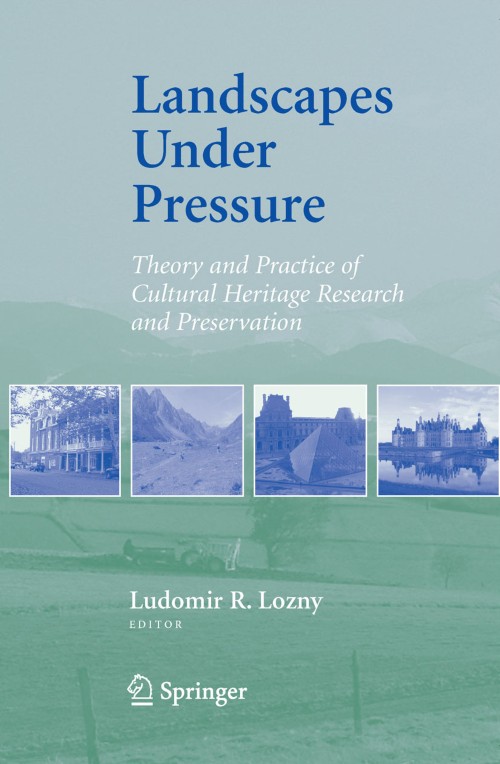
Landscapes under Pressure [electronic resource] : Theory and Practice of Cultural Heritage Research and Preservation / edited by Ludomir R. Lozny.
Erişim Adresi
ISBN
9780387284613
Dil Kodu
İngilizce
Yer Numarası
DK/12216
Basım Bildirimi
1st ed. 2006.
Yayın Bilgisi
New York, NY : Springer US : Imprint: Springer, 2006.
Fiziksel Niteleme
XX, 259 p. online resource.
İçindekiler Notu
Theory -- Place, Problem, and People: Issues in Interdisciplinary Cooperation -- Place, Historical Ecology and Cultural Landscape: New Directions for Applied Archaeology -- The Colonial Southwest: Pueblo Landscapes and Spanish Shared and Separate Landscapes -- A New Landscape for Cultural Heritage Management: Characterisation as a Management Tool -- The Idea of the Site: History, Heritage, and Locality in Community Archaeology -- Methodology and Practice -- Changing Places: A Cultural Geography of Nineteenth-Century Zuni, New Mexico -- Envisioning Future Landscapes in the Environmentally Sensitive Areas of Scotland: An Introduction -- Critical Data for Understanding Early Central European Farmers -- Alternative Archaeologies of the Cold War: The Preliminary Results of Fieldwork at the Greenham and Nevada Peace Camps -- Archaeological Practice in Large Transportation-Related Corridors: The I-270 Archaeological Mitigation Project -- Legal, Economic and Political Constrains of Cultural Heritage Preservation Programs -- Private Sector Archaeology: Part of the Problem or Part of the Solution? -- Protection, Maintenance and Enhancement of Cultural Landscapes in Changing Social, Political and Economical Reality in Poland -- Cultural Heritage Preservation and the Legal System With Specific Reference to Landscapes.
Özet, vb.
There is a growing realization that human intent and activity are not easily separated from natural forces in the shaping of landscapes. The pervasive Western dichotomy of culture and nature has proved to be a poor basis for scientific research and long-term environmental management. Humans have been major factors in environmental change for thousands of years using fire, intensive hunting and a wide range of agricultural strategies to transform most ecosystems on the earth long before the Industrial Revolution. All these activites contribute to the making of cultural landscapes which incorporate elements generally classified in two groups: tangible empirical evidence of human behavior, and intangible, symbolic meanings. This book investigates the newly emerging scope of interests and project agendas to investigate and preserve cultural landscapes. It presents the historic, archaeological, ethnographic, and environmental traditions of cultural landscape study and the attempts to reconstruct and analyze the complex processes of cultural changes through prehistoric and historic times. The "guiding light" of the book is that the fullest understanding of a cultural landscape will materialize through interdisciplinary cooperation, which should involve an ecological approach with historical ecology as the guiding tool, applied archaeology, and environmental planning. The book addresses issues of interest to policymakers-makers and planners and those who investigate cultural landscapes.
Konu
Cultural property.
Archaeology.
Landscape ecology.
Cultural Heritage.
Archaeology.
Landscape Ecology.
Archaeology.
Landscape ecology.
Cultural Heritage.
Archaeology.
Landscape Ecology.
Diğer Yazarlar
Kurum Adı
Eseri Alıntıla
Referansları kullanmadan önce gözden geçirmeniz ve varsa gerekli düzeltmeleri yapmanız önerilir.
Dijital Kaynak
MARC Görünümü
LEADER 04642nam a22005295i 4500
001 810950
003 TR_AnAIT
005 20260131012946
007 cr nn 008mamaa
008 100301s2006 xxu| s |||| 0|eng d
020 |a9780387284613|9978-0-387-28461-3
024 7 |a10.1007/0-387-28461-3|2doi
041 |aeng
049 |aTürk Tarih Kurumu Kütüphanesi
050 4|aD1-2027
072 7|aJFC|2bicssc
072 7|aGM|2bicssc
072 7|aSOC002010|2bisacsh
072 7|aJBCC|2thema
072 7|aGLZ|2thema
082 04|a363.69|223
090 |aDK/12216
245 10|aLandscapes under Pressure|h[electronic resource] :|bTheory and Practice of Cultural Heritage Research and Preservation /|cedited by Ludomir R. Lozny.
250 |a1st ed. 2006.
264 1|aNew York, NY :|bSpringer US :|bImprint: Springer,|c2006.
300 |aXX, 259 p.|bonline resource.
336 |atext|btxt|2rdacontent
337 |acomputer|bc|2rdamedia
338 |aonline resource|bcr|2rdacarrier
347 |atext file|bPDF|2rda
505 0 |aTheory -- Place, Problem, and People: Issues in Interdisciplinary Cooperation -- Place, Historical Ecology and Cultural Landscape: New Directions for Applied Archaeology -- The Colonial Southwest: Pueblo Landscapes and Spanish Shared and Separate Landscapes -- A New Landscape for Cultural Heritage Management: Characterisation as a Management Tool -- The Idea of the Site: History, Heritage, and Locality in Community Archaeology -- Methodology and Practice -- Changing Places: A Cultural Geography of Nineteenth-Century Zuni, New Mexico -- Envisioning Future Landscapes in the Environmentally Sensitive Areas of Scotland: An Introduction -- Critical Data for Understanding Early Central European Farmers -- Alternative Archaeologies of the Cold War: The Preliminary Results of Fieldwork at the Greenham and Nevada Peace Camps -- Archaeological Practice in Large Transportation-Related Corridors: The I-270 Archaeological Mitigation Project -- Legal, Economic and Political Constrains of Cultural Heritage Preservation Programs -- Private Sector Archaeology: Part of the Problem or Part of the Solution? -- Protection, Maintenance and Enhancement of Cultural Landscapes in Changing Social, Political and Economical Reality in Poland -- Cultural Heritage Preservation and the Legal System With Specific Reference to Landscapes.
520 |aThere is a growing realization that human intent and activity are not easily separated from natural forces in the shaping of landscapes. The pervasive Western dichotomy of culture and nature has proved to be a poor basis for scientific research and long-term environmental management. Humans have been major factors in environmental change for thousands of years using fire, intensive hunting and a wide range of agricultural strategies to transform most ecosystems on the earth long before the Industrial Revolution. All these activites contribute to the making of cultural landscapes which incorporate elements generally classified in two groups: tangible empirical evidence of human behavior, and intangible, symbolic meanings. This book investigates the newly emerging scope of interests and project agendas to investigate and preserve cultural landscapes. It presents the historic, archaeological, ethnographic, and environmental traditions of cultural landscape study and the attempts to reconstruct and analyze the complex processes of cultural changes through prehistoric and historic times. The "guiding light" of the book is that the fullest understanding of a cultural landscape will materialize through interdisciplinary cooperation, which should involve an ecological approach with historical ecology as the guiding tool, applied archaeology, and environmental planning. The book addresses issues of interest to policymakers-makers and planners and those who investigate cultural landscapes.
650 0|aCultural property.
650 0|aArchaeology.
650 0|aLandscape ecology.
650 14|aCultural Heritage.
650 24|aArchaeology.
650 24|aLandscape Ecology.
700 1 |aLozny, Ludomir R.|eeditor.|4edt|4http://id.loc.gov/vocabulary/relators/edt
710 2 |aSpringerLink (Online service)
773 0 |tSpringer Nature eBook
776 08|iPrinted edition:|z9780387284606
776 08|iPrinted edition:|z9780387757209
776 08|iPrinted edition:|z9780387509143
776 08|iPrinted edition:|z9780387521473
856 40|uhttps://doi.org/10.1007/0-387-28461-3
912 |aZDB-2-SHU
912 |aZDB-2-SXL
950 |aHumanities, Social Sciences and Law (SpringerNature-11648)
950 |aLiterature, Cultural and Media Studies (R0) (SpringerNature-43723)
001 810950
003 TR_AnAIT
005 20260131012946
007 cr nn 008mamaa
008 100301s2006 xxu| s |||| 0|eng d
020 |a9780387284613|9978-0-387-28461-3
024 7 |a10.1007/0-387-28461-3|2doi
041 |aeng
049 |aTürk Tarih Kurumu Kütüphanesi
050 4|aD1-2027
072 7|aJFC|2bicssc
072 7|aGM|2bicssc
072 7|aSOC002010|2bisacsh
072 7|aJBCC|2thema
072 7|aGLZ|2thema
082 04|a363.69|223
090 |aDK/12216
245 10|aLandscapes under Pressure|h[electronic resource] :|bTheory and Practice of Cultural Heritage Research and Preservation /|cedited by Ludomir R. Lozny.
250 |a1st ed. 2006.
264 1|aNew York, NY :|bSpringer US :|bImprint: Springer,|c2006.
300 |aXX, 259 p.|bonline resource.
336 |atext|btxt|2rdacontent
337 |acomputer|bc|2rdamedia
338 |aonline resource|bcr|2rdacarrier
347 |atext file|bPDF|2rda
505 0 |aTheory -- Place, Problem, and People: Issues in Interdisciplinary Cooperation -- Place, Historical Ecology and Cultural Landscape: New Directions for Applied Archaeology -- The Colonial Southwest: Pueblo Landscapes and Spanish Shared and Separate Landscapes -- A New Landscape for Cultural Heritage Management: Characterisation as a Management Tool -- The Idea of the Site: History, Heritage, and Locality in Community Archaeology -- Methodology and Practice -- Changing Places: A Cultural Geography of Nineteenth-Century Zuni, New Mexico -- Envisioning Future Landscapes in the Environmentally Sensitive Areas of Scotland: An Introduction -- Critical Data for Understanding Early Central European Farmers -- Alternative Archaeologies of the Cold War: The Preliminary Results of Fieldwork at the Greenham and Nevada Peace Camps -- Archaeological Practice in Large Transportation-Related Corridors: The I-270 Archaeological Mitigation Project -- Legal, Economic and Political Constrains of Cultural Heritage Preservation Programs -- Private Sector Archaeology: Part of the Problem or Part of the Solution? -- Protection, Maintenance and Enhancement of Cultural Landscapes in Changing Social, Political and Economical Reality in Poland -- Cultural Heritage Preservation and the Legal System With Specific Reference to Landscapes.
520 |aThere is a growing realization that human intent and activity are not easily separated from natural forces in the shaping of landscapes. The pervasive Western dichotomy of culture and nature has proved to be a poor basis for scientific research and long-term environmental management. Humans have been major factors in environmental change for thousands of years using fire, intensive hunting and a wide range of agricultural strategies to transform most ecosystems on the earth long before the Industrial Revolution. All these activites contribute to the making of cultural landscapes which incorporate elements generally classified in two groups: tangible empirical evidence of human behavior, and intangible, symbolic meanings. This book investigates the newly emerging scope of interests and project agendas to investigate and preserve cultural landscapes. It presents the historic, archaeological, ethnographic, and environmental traditions of cultural landscape study and the attempts to reconstruct and analyze the complex processes of cultural changes through prehistoric and historic times. The "guiding light" of the book is that the fullest understanding of a cultural landscape will materialize through interdisciplinary cooperation, which should involve an ecological approach with historical ecology as the guiding tool, applied archaeology, and environmental planning. The book addresses issues of interest to policymakers-makers and planners and those who investigate cultural landscapes.
650 0|aCultural property.
650 0|aArchaeology.
650 0|aLandscape ecology.
650 14|aCultural Heritage.
650 24|aArchaeology.
650 24|aLandscape Ecology.
700 1 |aLozny, Ludomir R.|eeditor.|4edt|4http://id.loc.gov/vocabulary/relators/edt
710 2 |aSpringerLink (Online service)
773 0 |tSpringer Nature eBook
776 08|iPrinted edition:|z9780387284606
776 08|iPrinted edition:|z9780387757209
776 08|iPrinted edition:|z9780387509143
776 08|iPrinted edition:|z9780387521473
856 40|uhttps://doi.org/10.1007/0-387-28461-3
912 |aZDB-2-SHU
912 |aZDB-2-SXL
950 |aHumanities, Social Sciences and Law (SpringerNature-11648)
950 |aLiterature, Cultural and Media Studies (R0) (SpringerNature-43723)
Materyaller
Depodan talep edilen materyal sadece kütüphane içerisinde kullanılmaktadır.
Materyal dışarıya ödünç verilmemektedir.
Materyal dışarıya ödünç verilmemektedir.
