LEADER 03433nam a22005055i 4500
001 810951
003 TR_AnAIT
005 20260131012945
007 cr nn 008mamaa
008 100301s2006 xxu| s |||| 0|eng d
020 |a9780387289403|9978-0-387-28940-3
024 7 |a10.1007/0-387-28940-2|2doi
041 |aeng
049 |aTürk Tarih Kurumu Kütüphanesi
050 4|aCC1-960
072 7|aHD|2bicssc
072 7|aSOC003000|2bisacsh
072 7|aNK|2thema
082 04|a930.1|223
090 |aDK/12217
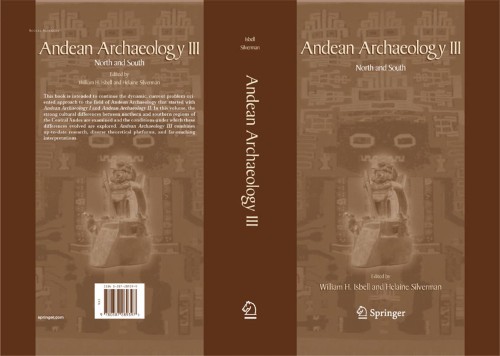
245 10|aAndean Archaeology III|h[electronic resource] :|bNorth and South /|cedited by William Isbell, Helaine Silverman.
250 |a1st ed. 2006.
264 1|aNew York, NY :|bSpringer US :|bImprint: Springer,|c2006.
300 |aXI, 523 p.|bonline resource.
336 |atext|btxt|2rdacontent
337 |acomputer|bc|2rdamedia
338 |aonline resource|bcr|2rdacarrier
347 |atext file|bPDF|2rda
505 0 |aRegional Patterns -- The North -- America’s First City? The Case of Late Archaic Caral -- Religious Warfare at Chankillo -- The Vicús-Mochica Relationship -- Competitive Feasting, Religious Pluralism and Decentralized Power in the Late Moche Period -- Northern Exposures: Recuay-Cajamarca Boundaries and Interaction -- Chimu Craft Specialization and Political Economy: A View from the Provinces -- The South -- Early Village Society in the Formative Period in the Southern Lake Titicaca Basin -- The Emergence of Complex Society in the Titicaca Basin: The View from the North -- Redefining Plant Use at the Formative Site of Chiripa in the Southern Titicaca Basin -- Ritual and Society in Early Intermediate Period Ayacucho: A View From the Site of Ñawinpukyo -- Missing Links, Imaginary Links: Staff God Imagery in the South Andean Past -- Water, Blood and Semen: Signs of Life and Fertility in Nasca Art -- Burial Patterns and Sociopolitical Organization in Nasca 5 Society -- When and Where Did the Nasca Proliferous Style Emerge? -- Violence and Rural Lifeways at Two Peripheral Wari Sites in the Majes Valley of Southern Peru -- Suspension Bridges of the Inca Empire -- Conclusion -- Rethinking the Central Andean Co-Tradition.
520 |aThis book is intended to continue the dynamic, current problem-oriented approach to the field of Andean Archaeology that started with Andean Archaeology I and Andean Archaeology II. In this volume, the strong cultural differences between northern and southern regions of the Central Andes are examined and the conditions under which these differences evolved are explored. Andean Archaeology III combines up-to-date research, diverse theoretical platforms, and far-reaching interpretations.
650 0|aArchaeology.
650 0|aAnthropology.
650 0|aHistory.
650 14|aArchaeology.
650 24|aAnthropology.
650 24|aHistory.
700 1 |aIsbell, William.|eeditor.|4edt|4http://id.loc.gov/vocabulary/relators/edt
700 1 |aSilverman, Helaine.|eeditor.|4edt|4http://id.loc.gov/vocabulary/relators/edt
710 2 |aSpringerLink (Online service)
773 0 |tSpringer Nature eBook
776 08|iPrinted edition:|z9780387289397
776 08|iPrinted edition:|z9780387757308
776 08|iPrinted edition:|z9780387509648
856 40|uhttps://doi.org/10.1007/0-387-28940-2
912 |aZDB-2-SHU
912 |aZDB-2-SXS
950 |aHumanities, Social Sciences and Law (SpringerNature-11648)
950 |aSocial Sciences (R0) (SpringerNature-43726)