

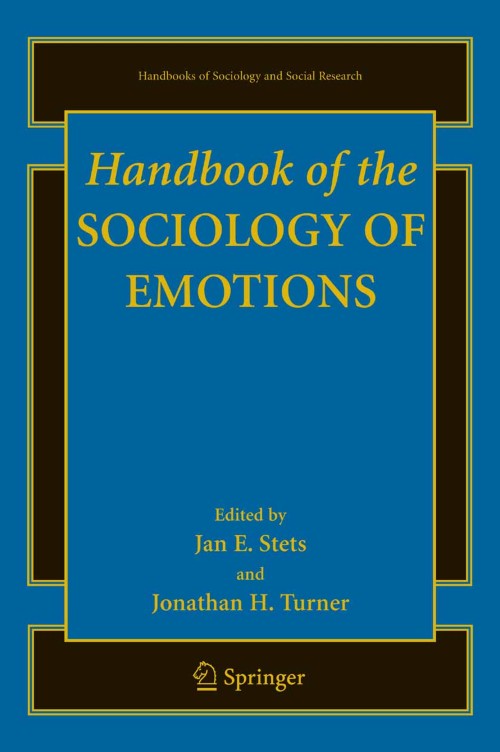
Handbook of the Sociology of Emotions [electronic resource] / edited by Jan Stets, Jonathan H. Turner.
Erişim Adresi
ISBN
9780387307152
Dil Kodu
İngilizce
Yer Numarası
DK/12221
Basım Bildirimi
1st ed. 2006.
Yayın Bilgisi
New York, NY : Springer US : Imprint: Springer, 2006.
Fiziksel Niteleme
XIII, 657 p. online resource.
Dizi
Handbooks of Sociology and Social Research, 2542-839X
İçindekiler Notu
Basic Processes -- The Classification of Emotions -- The Neuroscience of Emotions -- Gender and Emotion -- Theories -- Power and Status and the Power-Status Theory of Emotions -- Cultural Theory and Emotions -- Ritual Theory -- Symbolic Interactionism, Inequality, and Emotions -- Affect Control Theory -- Identity Theory and Emotions -- Self Theory and Emotions -- Emotion-Based Self Theory -- Psychoanalytic Sociological Theories and Emotions -- Social Exchange Theory of Emotions -- Emotion in Justice Processes -- Expectation States Theory and Emotion -- Evolutionary Theory and Emotions -- Select Emotions -- Love -- Jealousy and Envy -- Empathy -- Sympathy -- Anger -- Grief -- Moral Emotions -- Emotions in Social Life -- Emotions in the Workplace -- Emotions and Health -- Emotions and Social Movements.
Özet, vb.
For almost thirty years, sociologists have increasingly theorized about and conducted research on human emotions. Surprisingly, it was not until the 1970s that the sociology of emotions emerged as a coherent field of inquiry. What makes this late date surprising is that it is now obvious that human behavior, interaction, and organization are driven by emotions. It was an immense oversight for emotions to be de-emphasized in sociological theorizing and research for most of its 175 year history. Since the 1970s, however, the study of emotions has accelerated and is now at the forefront of sociological analysis. This book is designed to bring the reader up to date on the theory and research traditions that have proliferated in the analysis of human emotions. Key figures who have carried the sociology of emotions to its current level of prominence review their own work and the work of others who have made contributions to a particular approach to the study of emotions. The outcome is a comprehensive book that serves as a primer on the cutting edge of sociological work in what is obviously a key dynamic in human affairs. The first section of the book addresses the range of emotions and how they can be classified, the neurological underpinnings of emotions, and the effect of gender on emotions. The second section reviews the prominent sociological theories of emotions, including theories emphasizing power and status, rituals, identity and self, psychoanalytic dynamics, exchange, expectation states, and evolution.While there is little integration among these theories, this state of affairs will not last forever. The third section addresses theory and research on specific emotions such as love, jealousy and envy, empathy, sympathy, anger, grief, and the moral emotions. While this list does not exhaust the range of human feeling, they are central emotions that drive human behavior, interaction, and social organization. The last section explores howthe study of emotions has added new insight into other subfields within sociology such as the study of the workplace, health, and social movements. These chapters illustrate how the sociology of emotions can provide new research and theory for the large numbers of specialties within sociology. Although no book can completely cover a field, even a relatively new one like the sociology of emotions, this Handbook of the Sociology of Emotions comes close to being comprehensive. The reader will come away with a greater appreciation for how far the sociology of emotions has developed and prospered over the last thirty years.
Konu
Sociology.
Personality.
Difference (Psychology).
Sociology.
Personality and Differential Psychology.
Personality.
Difference (Psychology).
Sociology.
Personality and Differential Psychology.
Diğer Yazarlar
Kurum Adı
Eseri Alıntıla
Referansları kullanmadan önce gözden geçirmeniz ve varsa gerekli düzeltmeleri yapmanız önerilir.
Dijital Kaynak
MARC Görünümü
LEADER 06079nam a22005895i 4500
001 810955
003 TR_AnAIT
005 20260131012927
007 cr nn 008mamaa
008 100301s2006 xxu| s |||| 0|eng d
020 |a9780387307152|9978-0-387-30715-2
024 7 |a10.1007/978-0-387-30715-2|2doi
041 |aeng
049 |aTürk Tarih Kurumu Kütüphanesi
050 4|aHM
072 7|aJHB|2bicssc
072 7|aJHB|2bicssc
072 7|aSOC026000|2bisacsh
072 7|aJHB|2thema
072 7|aJHB|2thema
082 04|a301|223
090 |aDK/12221
245 10|aHandbook of the Sociology of Emotions|h[electronic resource] /|cedited by Jan Stets, Jonathan H. Turner.
250 |a1st ed. 2006.
264 1|aNew York, NY :|bSpringer US :|bImprint: Springer,|c2006.
300 |aXIII, 657 p.|bonline resource.
336 |atext|btxt|2rdacontent
337 |acomputer|bc|2rdamedia
338 |aonline resource|bcr|2rdacarrier
347 |atext file|bPDF|2rda
490 1 |aHandbooks of Sociology and Social Research,|x2542-839X
505 0 |aBasic Processes -- The Classification of Emotions -- The Neuroscience of Emotions -- Gender and Emotion -- Theories -- Power and Status and the Power-Status Theory of Emotions -- Cultural Theory and Emotions -- Ritual Theory -- Symbolic Interactionism, Inequality, and Emotions -- Affect Control Theory -- Identity Theory and Emotions -- Self Theory and Emotions -- Emotion-Based Self Theory -- Psychoanalytic Sociological Theories and Emotions -- Social Exchange Theory of Emotions -- Emotion in Justice Processes -- Expectation States Theory and Emotion -- Evolutionary Theory and Emotions -- Select Emotions -- Love -- Jealousy and Envy -- Empathy -- Sympathy -- Anger -- Grief -- Moral Emotions -- Emotions in Social Life -- Emotions in the Workplace -- Emotions and Health -- Emotions and Social Movements.
520 |aFor almost thirty years, sociologists have increasingly theorized about and conducted research on human emotions. Surprisingly, it was not until the 1970s that the sociology of emotions emerged as a coherent field of inquiry. What makes this late date surprising is that it is now obvious that human behavior, interaction, and organization are driven by emotions. It was an immense oversight for emotions to be de-emphasized in sociological theorizing and research for most of its 175 year history. Since the 1970s, however, the study of emotions has accelerated and is now at the forefront of sociological analysis. This book is designed to bring the reader up to date on the theory and research traditions that have proliferated in the analysis of human emotions. Key figures who have carried the sociology of emotions to its current level of prominence review their own work and the work of others who have made contributions to a particular approach to the study of emotions. The outcome is a comprehensive book that serves as a primer on the cutting edge of sociological work in what is obviously a key dynamic in human affairs. The first section of the book addresses the range of emotions and how they can be classified, the neurological underpinnings of emotions, and the effect of gender on emotions. The second section reviews the prominent sociological theories of emotions, including theories emphasizing power and status, rituals, identity and self, psychoanalytic dynamics, exchange, expectation states, and evolution.While there is little integration among these theories, this state of affairs will not last forever. The third section addresses theory and research on specific emotions such as love, jealousy and envy, empathy, sympathy, anger, grief, and the moral emotions. While this list does not exhaust the range of human feeling, they are central emotions that drive human behavior, interaction, and social organization. The last section explores howthe study of emotions has added new insight into other subfields within sociology such as the study of the workplace, health, and social movements. These chapters illustrate how the sociology of emotions can provide new research and theory for the large numbers of specialties within sociology. Although no book can completely cover a field, even a relatively new one like the sociology of emotions, this Handbook of the Sociology of Emotions comes close to being comprehensive. The reader will come away with a greater appreciation for how far the sociology of emotions has developed and prospered over the last thirty years.
532 8 |aAccessibility summary: This PDF is not accessible. It is based on scanned pages and does not support features such as screen reader compatibility or described non-text content (images, graphs etc). However, it likely supports searchable and selectable text based on OCR (Optical Character Recognition). Users with accessibility needs may not be able to use this content effectively. Please contact us at accessibilitysupport@springernature.com if you require assistance or an alternative format.
532 8 |aInaccessible, or known limited accessibility
532 8 |aNo reading system accessibility options actively disabled
532 8 |aPublisher contact for further accessibility information: accessibilitysupport@springernature.com
650 0|aSociology.
650 0|aPersonality.
650 0|aDifference (Psychology).
650 14|aSociology.
650 24|aPersonality and Differential Psychology.
700 1 |aStets, Jan.|eeditor.|4edt|4http://id.loc.gov/vocabulary/relators/edt
700 1 |aTurner, Jonathan H.|eeditor.|4edt|4http://id.loc.gov/vocabulary/relators/edt
710 2 |aSpringerLink (Online service)
773 0 |tSpringer Nature eBook
776 08|iPrinted edition:|z9780387307138
776 08|iPrinted edition:|z9780387511191
776 08|iPrinted edition:|z9781489979360
830 0|aHandbooks of Sociology and Social Research,|x2542-839X
856 40|uhttps://doi.org/10.1007/978-0-387-30715-2
912 |aZDB-2-SHU
912 |aZDB-2-SXS
950 |aHumanities, Social Sciences and Law (SpringerNature-11648)
950 |aSocial Sciences (R0) (SpringerNature-43726)
001 810955
003 TR_AnAIT
005 20260131012927
007 cr nn 008mamaa
008 100301s2006 xxu| s |||| 0|eng d
020 |a9780387307152|9978-0-387-30715-2
024 7 |a10.1007/978-0-387-30715-2|2doi
041 |aeng
049 |aTürk Tarih Kurumu Kütüphanesi
050 4|aHM
072 7|aJHB|2bicssc
072 7|aJHB|2bicssc
072 7|aSOC026000|2bisacsh
072 7|aJHB|2thema
072 7|aJHB|2thema
082 04|a301|223
090 |aDK/12221
245 10|aHandbook of the Sociology of Emotions|h[electronic resource] /|cedited by Jan Stets, Jonathan H. Turner.
250 |a1st ed. 2006.
264 1|aNew York, NY :|bSpringer US :|bImprint: Springer,|c2006.
300 |aXIII, 657 p.|bonline resource.
336 |atext|btxt|2rdacontent
337 |acomputer|bc|2rdamedia
338 |aonline resource|bcr|2rdacarrier
347 |atext file|bPDF|2rda
490 1 |aHandbooks of Sociology and Social Research,|x2542-839X
505 0 |aBasic Processes -- The Classification of Emotions -- The Neuroscience of Emotions -- Gender and Emotion -- Theories -- Power and Status and the Power-Status Theory of Emotions -- Cultural Theory and Emotions -- Ritual Theory -- Symbolic Interactionism, Inequality, and Emotions -- Affect Control Theory -- Identity Theory and Emotions -- Self Theory and Emotions -- Emotion-Based Self Theory -- Psychoanalytic Sociological Theories and Emotions -- Social Exchange Theory of Emotions -- Emotion in Justice Processes -- Expectation States Theory and Emotion -- Evolutionary Theory and Emotions -- Select Emotions -- Love -- Jealousy and Envy -- Empathy -- Sympathy -- Anger -- Grief -- Moral Emotions -- Emotions in Social Life -- Emotions in the Workplace -- Emotions and Health -- Emotions and Social Movements.
520 |aFor almost thirty years, sociologists have increasingly theorized about and conducted research on human emotions. Surprisingly, it was not until the 1970s that the sociology of emotions emerged as a coherent field of inquiry. What makes this late date surprising is that it is now obvious that human behavior, interaction, and organization are driven by emotions. It was an immense oversight for emotions to be de-emphasized in sociological theorizing and research for most of its 175 year history. Since the 1970s, however, the study of emotions has accelerated and is now at the forefront of sociological analysis. This book is designed to bring the reader up to date on the theory and research traditions that have proliferated in the analysis of human emotions. Key figures who have carried the sociology of emotions to its current level of prominence review their own work and the work of others who have made contributions to a particular approach to the study of emotions. The outcome is a comprehensive book that serves as a primer on the cutting edge of sociological work in what is obviously a key dynamic in human affairs. The first section of the book addresses the range of emotions and how they can be classified, the neurological underpinnings of emotions, and the effect of gender on emotions. The second section reviews the prominent sociological theories of emotions, including theories emphasizing power and status, rituals, identity and self, psychoanalytic dynamics, exchange, expectation states, and evolution.While there is little integration among these theories, this state of affairs will not last forever. The third section addresses theory and research on specific emotions such as love, jealousy and envy, empathy, sympathy, anger, grief, and the moral emotions. While this list does not exhaust the range of human feeling, they are central emotions that drive human behavior, interaction, and social organization. The last section explores howthe study of emotions has added new insight into other subfields within sociology such as the study of the workplace, health, and social movements. These chapters illustrate how the sociology of emotions can provide new research and theory for the large numbers of specialties within sociology. Although no book can completely cover a field, even a relatively new one like the sociology of emotions, this Handbook of the Sociology of Emotions comes close to being comprehensive. The reader will come away with a greater appreciation for how far the sociology of emotions has developed and prospered over the last thirty years.
532 8 |aAccessibility summary: This PDF is not accessible. It is based on scanned pages and does not support features such as screen reader compatibility or described non-text content (images, graphs etc). However, it likely supports searchable and selectable text based on OCR (Optical Character Recognition). Users with accessibility needs may not be able to use this content effectively. Please contact us at accessibilitysupport@springernature.com if you require assistance or an alternative format.
532 8 |aInaccessible, or known limited accessibility
532 8 |aNo reading system accessibility options actively disabled
532 8 |aPublisher contact for further accessibility information: accessibilitysupport@springernature.com
650 0|aSociology.
650 0|aPersonality.
650 0|aDifference (Psychology).
650 14|aSociology.
650 24|aPersonality and Differential Psychology.
700 1 |aStets, Jan.|eeditor.|4edt|4http://id.loc.gov/vocabulary/relators/edt
700 1 |aTurner, Jonathan H.|eeditor.|4edt|4http://id.loc.gov/vocabulary/relators/edt
710 2 |aSpringerLink (Online service)
773 0 |tSpringer Nature eBook
776 08|iPrinted edition:|z9780387307138
776 08|iPrinted edition:|z9780387511191
776 08|iPrinted edition:|z9781489979360
830 0|aHandbooks of Sociology and Social Research,|x2542-839X
856 40|uhttps://doi.org/10.1007/978-0-387-30715-2
912 |aZDB-2-SHU
912 |aZDB-2-SXS
950 |aHumanities, Social Sciences and Law (SpringerNature-11648)
950 |aSocial Sciences (R0) (SpringerNature-43726)
Materyaller
Depodan talep edilen materyal sadece kütüphane içerisinde kullanılmaktadır.
Materyal dışarıya ödünç verilmemektedir.
Materyal dışarıya ödünç verilmemektedir.
