LEADER 03526nam a22004455i 4500
001 810969
003 TR_AnAIT
005 20260131012903
007 cr nn 008mamaa
008 100715s2007 xxu| s |||| 0|eng d
020 |a9780387691695|9978-0-387-69169-5
024 7 |a10.1007/978-0-387-69169-5|2doi
041 |aeng
049 |aTürk Tarih Kurumu Kütüphanesi
050 4|aHV6001-7220.5
072 7|aJKV|2bicssc
072 7|aSOC004000|2bisacsh
072 7|aJKV|2thema
082 04|a364|223
090 |aDK/12235
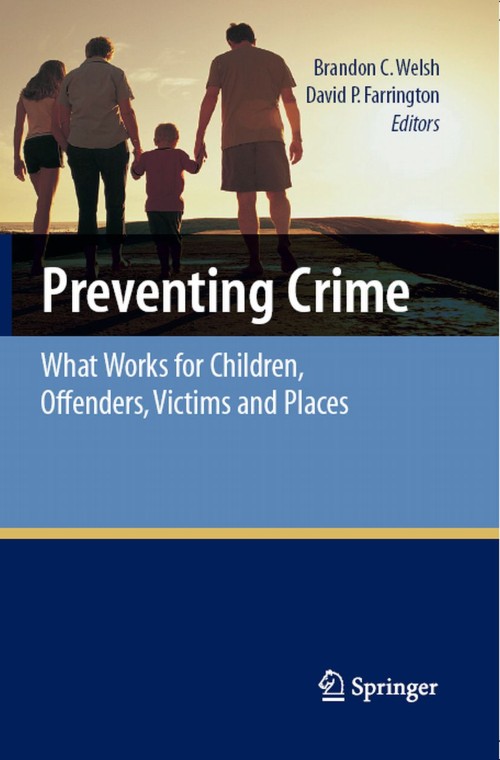
245 10|aPreventing Crime|h[electronic resource] :|bWhat Works for Children, Offenders, Victims and Places /|cedited by Brandon C. Welsh, David P. Farrington.
250 |a1st ed. 2007.
264 1|aNew York, NY :|bSpringer New York :|bImprint: Springer,|c2007.
300 |aX, 244 p. 14 illus.|bonline resource.
336 |atext|btxt|2rdacontent
337 |acomputer|bc|2rdamedia
338 |aonline resource|bcr|2rdacarrier
347 |atext file|bPDF|2rda
505 0 |aWhat Works for Children -- Evidence-Based Crime Prevention -- Early Parent Training -- Child Social Skills Training -- What Works for Offenders -- Cognitive-Behavioral Interventions -- Boot Camps -- Scared Straight and Other Juvenile Awareness Programs -- Incarceration-Based Drug Treatment -- Costs and Benefits of Sentencing -- What Works for Victims -- Mandated Batterer Intervention Programs to Reduce Domestic Violence -- Restorative Justice to Reduce Victimization -- Preventing Repeat Residential Burglary Victimization -- What Works for Places -- Policing Crime Hot Spots -- Closed-Circuit Television Surveillance -- Improved Street Lighting -- Policy Choices for A Safer Society -- Conclusions and Directions From Evidence-Based Crime Prevention.
520 |aCrime prevention should be rational and should be based on the best possible evidence. Decision-makers should weigh heavily any available evidence on what works best. How can a program that has produced no discernable evidence of effectiveness, as shown through numerous evaluations, be considered for implementation? Unfortunately, this happens all the time. Evidence-based crime prevention attempts to overcome this and other obstacles by ensuring that the best available evidence is considered in any decision to implement a program designed to prevent crime. This book is about evidence-based crime prevention. A project of the Campbell Collaboration Crime and Justice Group, Preventing Crime brings together the leading scientific evidence on what works best for a wide range of interventions organized around four important domains in criminology: at-risk children, offenders, victims, and places. It is the first book to assess the effectiveness of criminological interventions using the most rigorous review methodology of the systematic review. It is an indispensable guide to the leading scientific evidence on what works best to prevent crime.
650 0|aCriminology.
650 14|aCriminology.
700 1 |aWelsh, Brandon C.|eeditor.|4edt|4http://id.loc.gov/vocabulary/relators/edt
700 1 |aFarrington, David P.|eeditor.|4edt|4http://id.loc.gov/vocabulary/relators/edt
710 2 |aSpringerLink (Online service)
773 0 |tSpringer Nature eBook
776 08|iPrinted edition:|z9780387691688
776 08|iPrinted edition:|z9780387517575
856 40|uhttps://doi.org/10.1007/978-0-387-69169-5
912 |aZDB-2-SHU
912 |aZDB-2-SXS
950 |aHumanities, Social Sciences and Law (SpringerNature-11648)
950 |aSocial Sciences (R0) (SpringerNature-43726)