

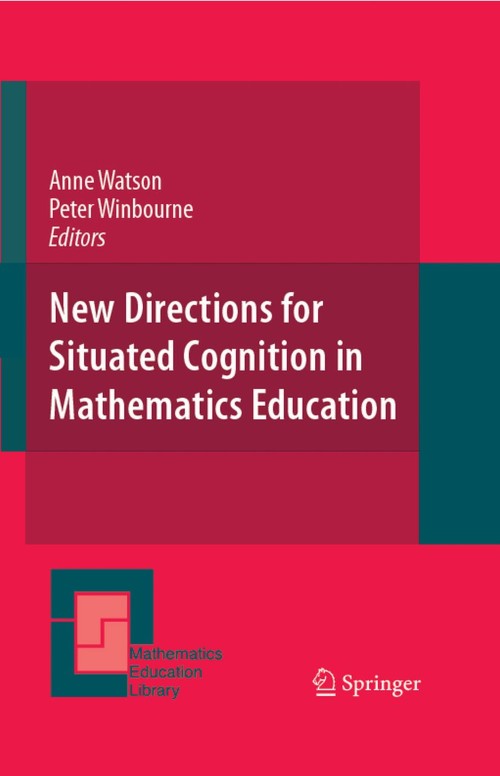
New Directions for Situated Cognition in Mathematics Education [electronic resource] / edited by Anne Watson, Peter Winbourne.
Erişim Adresi
ISBN
9780387715797
Dil Kodu
İngilizce
Yer Numarası
DK/12240
Basım Bildirimi
1st ed. 2008.
Yayın Bilgisi
New York, NY : Springer US : Imprint: Springer, 2008.
Fiziksel Niteleme
XII, 360 p. online resource.
Dizi
Mathematics Education Library, 2214-983X ; 45
İçindekiler Notu
School Mathematics As A Developmental Activity -- Participating In What? Using Situated Cognition Theory To Illuminate Differences In Classroom Practices -- Social Identities As Learners And Teachers Of Mathematics -- Looking For Learning In Practice: How Can This Inform Teaching -- Are Mathematical Abstractions Situated? -- ‘We Do It A Different Way At My School’ -- Situated Intuition And Activity Theory Fill The Gap -- The Role Of Artefacts In Mathematical Thinking: A Situated Learning Perspective -- Exploring Connections Between Tacit Knowing And Situated Learning Perspectives In The Context Of Mathematics Education -- Cognition And Institutional Setting -- School Practices With The Mathematical Notion Of Tangent Line -- Learning Mathematically As Social Practice In A Workplace Setting -- Analysing Concepts of Community of Practice -- ‘No Way is Can’t’: A Situated Account of One Woman’s Uses and Experiences of Mathematics.
Özet, vb.
New Directions for Situated Cognition in Mathematics Education Edited by Anne Watson, University of Oxford Peter Winbourne, London South Bank University New Directions for Situated Cognition in Mathematics Education gathers current situated cognition theories as applied to the teaching and learning of mathematics by major thinkers in the field. Arranged to be read cover to cover or by the individual chapter, this unique volume examines situated cognition in all levels and contexts of math instruction, in traditional school settings, in adult education, at home, on the job, or on the street. Well-known authorities explore beyond traditional concepts of good practice and the relationship between knowledge and the learner while synthesizing insights from related perspectives, including semiotics, activity theory, ardinas practice, and Moll’s concept of funds of knowledge. The emphasis is not merely on achieving standards or even gaining skills, but on learning as a lifelong activity as chapter authors address such questions as: What can math teachers do to make learning vital to children’s identity? How does situated cognition relate to tacit knowledge? In what ways are mathematical abstractions situated? Can vocational math skills be learned away from the workplace? How is mathematics knowledge transferred from the class to the home environment? New Directions for Situated Cognition in Mathematics Education provides a diverse, well-organized resource for educators, researchers, and students to approach this powerful theoretical strand.
Konu
Mathematics __ Study and teaching .
Early childhood education.
Learning, Psychology of.
Mathematics Education.
Early Childhood Education.
Instructional Psychology.
Early childhood education.
Learning, Psychology of.
Mathematics Education.
Early Childhood Education.
Instructional Psychology.
Diğer Yazarlar
Kurum Adı
Eseri Alıntıla
Referansları kullanmadan önce gözden geçirmeniz ve varsa gerekli düzeltmeleri yapmanız önerilir.
Dijital Kaynak
MARC Görünümü
LEADER 04514nam a22005535i 4500
001 810974
003 TR_AnAIT
005 20260131012833
007 cr nn 008mamaa
008 100301s2008 xxu| s |||| 0|eng d
020 |a9780387715797|9978-0-387-71579-7
024 7 |a10.1007/978-0-387-71579-7|2doi
041 |aeng
049 |aTürk Tarih Kurumu Kütüphanesi
050 4|aQA10.92-20
072 7|aJNU|2bicssc
072 7|aPB|2bicssc
072 7|aEDU029010|2bisacsh
072 7|aJNU|2thema
072 7|aPB|2thema
082 04|a510.71|223
090 |aDK/12240
245 10|aNew Directions for Situated Cognition in Mathematics Education|h[electronic resource] /|cedited by Anne Watson, Peter Winbourne.
250 |a1st ed. 2008.
264 1|aNew York, NY :|bSpringer US :|bImprint: Springer,|c2008.
300 |aXII, 360 p.|bonline resource.
336 |atext|btxt|2rdacontent
337 |acomputer|bc|2rdamedia
338 |aonline resource|bcr|2rdacarrier
347 |atext file|bPDF|2rda
490 1 |aMathematics Education Library,|x2214-983X ;|v45
505 0 |aSchool Mathematics As A Developmental Activity -- Participating In What? Using Situated Cognition Theory To Illuminate Differences In Classroom Practices -- Social Identities As Learners And Teachers Of Mathematics -- Looking For Learning In Practice: How Can This Inform Teaching -- Are Mathematical Abstractions Situated? -- ‘We Do It A Different Way At My School’ -- Situated Intuition And Activity Theory Fill The Gap -- The Role Of Artefacts In Mathematical Thinking: A Situated Learning Perspective -- Exploring Connections Between Tacit Knowing And Situated Learning Perspectives In The Context Of Mathematics Education -- Cognition And Institutional Setting -- School Practices With The Mathematical Notion Of Tangent Line -- Learning Mathematically As Social Practice In A Workplace Setting -- Analysing Concepts of Community of Practice -- ‘No Way is Can’t’: A Situated Account of One Woman’s Uses and Experiences of Mathematics.
520 |aNew Directions for Situated Cognition in Mathematics Education Edited by Anne Watson, University of Oxford Peter Winbourne, London South Bank University New Directions for Situated Cognition in Mathematics Education gathers current situated cognition theories as applied to the teaching and learning of mathematics by major thinkers in the field. Arranged to be read cover to cover or by the individual chapter, this unique volume examines situated cognition in all levels and contexts of math instruction, in traditional school settings, in adult education, at home, on the job, or on the street. Well-known authorities explore beyond traditional concepts of good practice and the relationship between knowledge and the learner while synthesizing insights from related perspectives, including semiotics, activity theory, ardinas practice, and Moll’s concept of funds of knowledge. The emphasis is not merely on achieving standards or even gaining skills, but on learning as a lifelong activity as chapter authors address such questions as: What can math teachers do to make learning vital to children’s identity? How does situated cognition relate to tacit knowledge? In what ways are mathematical abstractions situated? Can vocational math skills be learned away from the workplace? How is mathematics knowledge transferred from the class to the home environment? New Directions for Situated Cognition in Mathematics Education provides a diverse, well-organized resource for educators, researchers, and students to approach this powerful theoretical strand.
650 0|aMathematics|xStudy and teaching .
650 0|aEarly childhood education.
650 0|aLearning, Psychology of.
650 14|aMathematics Education.
650 24|aEarly Childhood Education.
650 24|aInstructional Psychology.
700 1 |aWatson, Anne.|eeditor.|4edt|4http://id.loc.gov/vocabulary/relators/edt
700 1 |aWinbourne, Peter.|eeditor.|4edt|4http://id.loc.gov/vocabulary/relators/edt
710 2 |aSpringerLink (Online service)
773 0 |tSpringer Nature eBook
776 08|iPrinted edition:|z9780387715773
776 08|iPrinted edition:|z9780387518626
776 08|iPrinted edition:|z9781441943989
830 0|aMathematics Education Library,|x2214-983X ;|v45
856 40|uhttps://doi.org/10.1007/978-0-387-71579-7
912 |aZDB-2-SHU
912 |aZDB-2-SXED
950 |aHumanities, Social Sciences and Law (SpringerNature-11648)
950 |aEducation (R0) (SpringerNature-43721)
001 810974
003 TR_AnAIT
005 20260131012833
007 cr nn 008mamaa
008 100301s2008 xxu| s |||| 0|eng d
020 |a9780387715797|9978-0-387-71579-7
024 7 |a10.1007/978-0-387-71579-7|2doi
041 |aeng
049 |aTürk Tarih Kurumu Kütüphanesi
050 4|aQA10.92-20
072 7|aJNU|2bicssc
072 7|aPB|2bicssc
072 7|aEDU029010|2bisacsh
072 7|aJNU|2thema
072 7|aPB|2thema
082 04|a510.71|223
090 |aDK/12240
245 10|aNew Directions for Situated Cognition in Mathematics Education|h[electronic resource] /|cedited by Anne Watson, Peter Winbourne.
250 |a1st ed. 2008.
264 1|aNew York, NY :|bSpringer US :|bImprint: Springer,|c2008.
300 |aXII, 360 p.|bonline resource.
336 |atext|btxt|2rdacontent
337 |acomputer|bc|2rdamedia
338 |aonline resource|bcr|2rdacarrier
347 |atext file|bPDF|2rda
490 1 |aMathematics Education Library,|x2214-983X ;|v45
505 0 |aSchool Mathematics As A Developmental Activity -- Participating In What? Using Situated Cognition Theory To Illuminate Differences In Classroom Practices -- Social Identities As Learners And Teachers Of Mathematics -- Looking For Learning In Practice: How Can This Inform Teaching -- Are Mathematical Abstractions Situated? -- ‘We Do It A Different Way At My School’ -- Situated Intuition And Activity Theory Fill The Gap -- The Role Of Artefacts In Mathematical Thinking: A Situated Learning Perspective -- Exploring Connections Between Tacit Knowing And Situated Learning Perspectives In The Context Of Mathematics Education -- Cognition And Institutional Setting -- School Practices With The Mathematical Notion Of Tangent Line -- Learning Mathematically As Social Practice In A Workplace Setting -- Analysing Concepts of Community of Practice -- ‘No Way is Can’t’: A Situated Account of One Woman’s Uses and Experiences of Mathematics.
520 |aNew Directions for Situated Cognition in Mathematics Education Edited by Anne Watson, University of Oxford Peter Winbourne, London South Bank University New Directions for Situated Cognition in Mathematics Education gathers current situated cognition theories as applied to the teaching and learning of mathematics by major thinkers in the field. Arranged to be read cover to cover or by the individual chapter, this unique volume examines situated cognition in all levels and contexts of math instruction, in traditional school settings, in adult education, at home, on the job, or on the street. Well-known authorities explore beyond traditional concepts of good practice and the relationship between knowledge and the learner while synthesizing insights from related perspectives, including semiotics, activity theory, ardinas practice, and Moll’s concept of funds of knowledge. The emphasis is not merely on achieving standards or even gaining skills, but on learning as a lifelong activity as chapter authors address such questions as: What can math teachers do to make learning vital to children’s identity? How does situated cognition relate to tacit knowledge? In what ways are mathematical abstractions situated? Can vocational math skills be learned away from the workplace? How is mathematics knowledge transferred from the class to the home environment? New Directions for Situated Cognition in Mathematics Education provides a diverse, well-organized resource for educators, researchers, and students to approach this powerful theoretical strand.
650 0|aMathematics|xStudy and teaching .
650 0|aEarly childhood education.
650 0|aLearning, Psychology of.
650 14|aMathematics Education.
650 24|aEarly Childhood Education.
650 24|aInstructional Psychology.
700 1 |aWatson, Anne.|eeditor.|4edt|4http://id.loc.gov/vocabulary/relators/edt
700 1 |aWinbourne, Peter.|eeditor.|4edt|4http://id.loc.gov/vocabulary/relators/edt
710 2 |aSpringerLink (Online service)
773 0 |tSpringer Nature eBook
776 08|iPrinted edition:|z9780387715773
776 08|iPrinted edition:|z9780387518626
776 08|iPrinted edition:|z9781441943989
830 0|aMathematics Education Library,|x2214-983X ;|v45
856 40|uhttps://doi.org/10.1007/978-0-387-71579-7
912 |aZDB-2-SHU
912 |aZDB-2-SXED
950 |aHumanities, Social Sciences and Law (SpringerNature-11648)
950 |aEducation (R0) (SpringerNature-43721)
Materyaller
Depodan talep edilen materyal sadece kütüphane içerisinde kullanılmaktadır.
Materyal dışarıya ödünç verilmemektedir.
Materyal dışarıya ödünç verilmemektedir.
