LEADER 03805nam a22005415i 4500
001 810978
003 TR_AnAIT
005 20260131012821
007 cr nn 008mamaa
008 100301s2008 xxu| s |||| 0|eng d
020 |a9780387747118|9978-0-387-74711-8
024 7 |a10.1007/978-0-387-74711-8|2doi
041 |aeng
049 |aTürk Tarih Kurumu Kütüphanesi
050 4|aQ174-175.3
050 4|aB67
072 7|aPDA|2bicssc
072 7|aSCI075000|2bisacsh
072 7|aPDA|2thema
082 04|a501|223
090 |aDK/12244
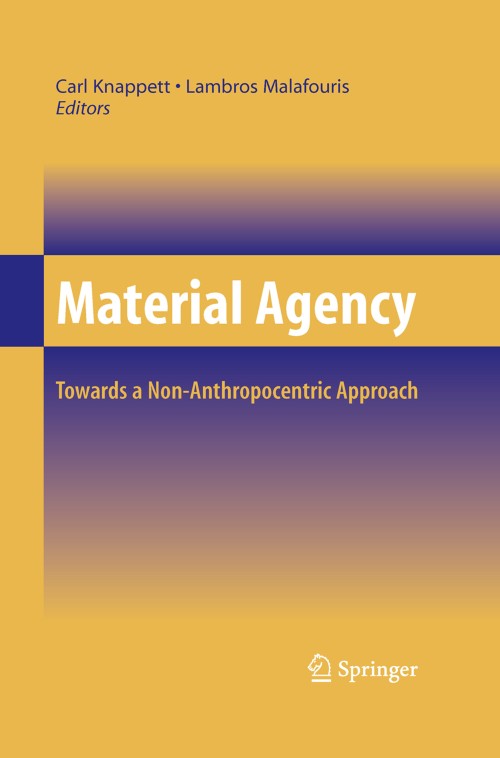
245 10|aMaterial Agency|h[electronic resource] :|bTowards a Non-Anthropocentric Approach /|cedited by Carl Knappett, Lambros Malafouris.
250 |a1st ed. 2008.
264 1|aNew York, NY :|bSpringer US :|bImprint: Springer,|c2008.
300 |aXX, 256 p. 49 illus.|bonline resource.
336 |atext|btxt|2rdacontent
337 |acomputer|bc|2rdamedia
338 |aonline resource|bcr|2rdacarrier
347 |atext file|bPDF|2rda
505 0 |aWhere Brain, Body and World Collide -- At the Potter’s Wheel : An Argument for Material Agency -- Material Agency, Skills and History: Distributed Cognition and the Archaeology of Memory -- The Actor-Enacted: Cumbrian Sheep in 2001 -- Non-Human Agencies: Trees in Place and Time -- Intelligent Artefacts at Home in the 21st Century -- In Context: Meaning, Materiality and Agency in the Process of Archaeological Recording -- The Neglected Networks of Material Agency: Artefacts, Pictures and Texts -- Some Stimulating Solutions -- On Mediation and Material Agency in the Peircean Semeiotic -- When ANT meets SPIDER: Social theory for arthropods -- Agency, Networks, Past and Future.
520 |aAgency is a key theme that cross-cuts a wide raft of disciplines in the humanities, social sciences and beyond; yet it is invariably discussed separately behind closed disciplinary doors. Within archaeology, agency has been characterized as a uniquely human attribute, and a means of incorporating individual intentionality into theoretical discourse. In other domains, however, notions of non-human and ‘material’ agency have been finding currency, and it is our aim to introduce some of these themes into archaeology and develop a non-anthropocentric approach to agency. It is anticipated that such a perspective will not only help us achieve more convincing interpretations of the past, giving a more active role to material culture, but also throw new light on the changing role of artifacts in the present and the future. This book is a groundbreaking attempt to address questions of non-human and material agency from a wide range of perspectives and disciplines: archaeology, anthropology, sociology, cognitive science, philosophy, and economics. The editors and authors demostrate that a distributed, relational approach to agency, incorporating both humans and artifacts, has important ramifications for how we understand material culture.
650 0|aScience|xPhilosophy.
650 0|aArchaeology.
650 0|aAnthropology.
650 0|aCultural property.
650 14|aPhilosophy of Science.
650 24|aArchaeology.
650 24|aAnthropology.
650 24|aCultural Heritage.
700 1 |aKnappett, Carl.|eeditor.|4edt|4http://id.loc.gov/vocabulary/relators/edt
700 1 |aMalafouris, Lambros.|eeditor.|4edt|4http://id.loc.gov/vocabulary/relators/edt
710 2 |aSpringerLink (Online service)
773 0 |tSpringer Nature eBook
776 08|iPrinted edition:|z9780387747101
776 08|iPrinted edition:|z9780387567037
776 08|iPrinted edition:|z9781441945129
856 40|uhttps://doi.org/10.1007/978-0-387-74711-8
912 |aZDB-2-SHU
912 |aZDB-2-SXPR
950 |aHumanities, Social Sciences and Law (SpringerNature-11648)
950 |aPhilosophy and Religion (R0) (SpringerNature-43725)