

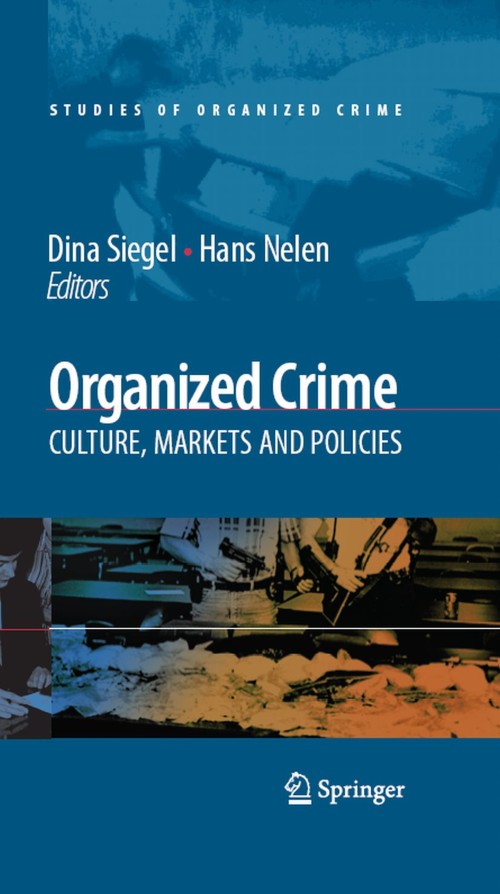
Organized Crime: Culture, Markets and Policies [electronic resource] / edited by Dina Siegel, Hans Nelen.
Erişim Adresi
ISBN
9780387747330
Dil Kodu
İngilizce
Yer Numarası
DK/12245
Basım Bildirimi
1st ed. 2008.
Yayın Bilgisi
New York, NY : Springer New York : Imprint: Springer, 2008.
Fiziksel Niteleme
VIII, 230 p. online resource.
Dizi
Studies of Organized Crime ; 7
İçindekiler Notu
Criminal Groups and Activities -- Reflections on the Sicilian Mafia: Peripheries and Their Impact on Centres -- The Decline of the Italian Mafia -- Hashish Smuggling by Bedouin in South Sinai -- Corruption as a Causal Factor in Human Trafficking -- New Players in an Old Game: The Sex Market in Italy -- The Vehicle Theft Market in Bulgaria -- Diamonds and Organized Crime:The Case of Antwerp -- Eco-Crime: The Tropical Timber Trade -- The Role of Hawala Bankers in the Transfer of Proceeds from Organised Crime -- Facilitating Organized Crime: The Role of Lawyers and Notaries -- Law Enforcement -- Criminal Conflicts and Collective Violence: Biker-Related Account Settlements in Quebec, 1994–2001 -- Controlling Human Smuggling in the Netherlands: How the Smuggling of Human Beings Was Transformed into a Serious Criminal Offence -- The Civil RICO Law as the Decisive Weapon in Combating Labour Racketeering -- Recent Anti-Mafi a Strategies: The Italian Experience -- Breaking the Power of Organized Crime? The Administrative Approach in Amsterdam.
Özet, vb.
Complex interactions of economic, technological, political, and cultural factors have fed the rise of criminal networks worldwide. At the same time, global illegal activities depend on a world of social realities to function. Organized Crime moves beyond traditional concepts of "evil forces" corrupting their host societies, instead analyzing local, national, and international manifestations of organized crime in the situational contexts that aid in its development. The contributors provide up-to-date understanding of various aspects of organized crime, in both classic areas of research (drugs, sex trafficking, labor racketeering) and emerging areas of interest (diamond smuggling, money laundering, eco-crime), in locales as varied as Italy, Quebec, the Sinai, Bulgaria, and the world’s tropical rain forests. Topics are explored from a variety of perspectives, including sociology, criminology, political science, and anthropology, giving this book empirical breadth and depth rarely seen in the literature. A sampling of the topics: Symbolic and economic meanings of crime to cultures. The symbiotic relationships between legitimate and criminal activities. Ethical dilemmas of legitimate businesses with criminal clients. Marketing, problem-solving, recruitment: organizational models of criminal enterprises. Innovative law enforcement/administrative strategies for containing and preventing crime in the U.S. and across Europe. Scholars and researchers of organized crime as well as advanced students of criminology will welcome Organized Crime for coverage that is wide-ranging, comparative, and specific enough to match their interests.
Konu
Criminology.
Political science.
Criminology.
Political Science.
Political science.
Criminology.
Political Science.
Diğer Yazarlar
Kurum Adı
Eseri Alıntıla
Referansları kullanmadan önce gözden geçirmeniz ve varsa gerekli düzeltmeleri yapmanız önerilir.
Dijital Kaynak
MARC Görünümü
LEADER 04475nam a22005055i 4500
001 810979
003 TR_AnAIT
005 20260131012820
007 cr nn 008mamaa
008 100301s2008 xxu| s |||| 0|eng d
020 |a9780387747330|9978-0-387-74733-0
024 7 |a10.1007/978-0-387-74733-0|2doi
041 |aeng
049 |aTürk Tarih Kurumu Kütüphanesi
050 4|aHV6001-7220.5
072 7|aJKV|2bicssc
072 7|aSOC004000|2bisacsh
072 7|aJKV|2thema
082 04|a364|223
090 |aDK/12245
245 10|aOrganized Crime: Culture, Markets and Policies|h[electronic resource] /|cedited by Dina Siegel, Hans Nelen.
250 |a1st ed. 2008.
264 1|aNew York, NY :|bSpringer New York :|bImprint: Springer,|c2008.
300 |aVIII, 230 p.|bonline resource.
336 |atext|btxt|2rdacontent
337 |acomputer|bc|2rdamedia
338 |aonline resource|bcr|2rdacarrier
347 |atext file|bPDF|2rda
490 1 |aStudies of Organized Crime ;|v7
505 0 |aCriminal Groups and Activities -- Reflections on the Sicilian Mafia: Peripheries and Their Impact on Centres -- The Decline of the Italian Mafia -- Hashish Smuggling by Bedouin in South Sinai -- Corruption as a Causal Factor in Human Trafficking -- New Players in an Old Game: The Sex Market in Italy -- The Vehicle Theft Market in Bulgaria -- Diamonds and Organized Crime:The Case of Antwerp -- Eco-Crime: The Tropical Timber Trade -- The Role of Hawala Bankers in the Transfer of Proceeds from Organised Crime -- Facilitating Organized Crime: The Role of Lawyers and Notaries -- Law Enforcement -- Criminal Conflicts and Collective Violence: Biker-Related Account Settlements in Quebec, 1994–2001 -- Controlling Human Smuggling in the Netherlands: How the Smuggling of Human Beings Was Transformed into a Serious Criminal Offence -- The Civil RICO Law as the Decisive Weapon in Combating Labour Racketeering -- Recent Anti-Mafi a Strategies: The Italian Experience -- Breaking the Power of Organized Crime? The Administrative Approach in Amsterdam.
520 |aComplex interactions of economic, technological, political, and cultural factors have fed the rise of criminal networks worldwide. At the same time, global illegal activities depend on a world of social realities to function. Organized Crime moves beyond traditional concepts of "evil forces" corrupting their host societies, instead analyzing local, national, and international manifestations of organized crime in the situational contexts that aid in its development. The contributors provide up-to-date understanding of various aspects of organized crime, in both classic areas of research (drugs, sex trafficking, labor racketeering) and emerging areas of interest (diamond smuggling, money laundering, eco-crime), in locales as varied as Italy, Quebec, the Sinai, Bulgaria, and the world’s tropical rain forests. Topics are explored from a variety of perspectives, including sociology, criminology, political science, and anthropology, giving this book empirical breadth and depth rarely seen in the literature. A sampling of the topics: Symbolic and economic meanings of crime to cultures. The symbiotic relationships between legitimate and criminal activities. Ethical dilemmas of legitimate businesses with criminal clients. Marketing, problem-solving, recruitment: organizational models of criminal enterprises. Innovative law enforcement/administrative strategies for containing and preventing crime in the U.S. and across Europe. Scholars and researchers of organized crime as well as advanced students of criminology will welcome Organized Crime for coverage that is wide-ranging, comparative, and specific enough to match their interests.
650 0|aCriminology.
650 0|aPolitical science.
650 14|aCriminology.
650 24|aPolitical Science.
700 1 |aSiegel, Dina.|eeditor.|4edt|4http://id.loc.gov/vocabulary/relators/edt
700 1 |aNelen, Hans.|eeditor.|4edt|4http://id.loc.gov/vocabulary/relators/edt
710 2 |aSpringerLink (Online service)
773 0 |tSpringer Nature eBook
776 08|iPrinted edition:|z9780387747323
776 08|iPrinted edition:|z9780387097107
776 08|iPrinted edition:|z9780387520971
830 0|aStudies of Organized Crime ;|v7
856 40|uhttps://doi.org/10.1007/978-0-387-74733-0
912 |aZDB-2-SHU
912 |aZDB-2-SXS
950 |aHumanities, Social Sciences and Law (SpringerNature-11648)
950 |aSocial Sciences (R0) (SpringerNature-43726)
001 810979
003 TR_AnAIT
005 20260131012820
007 cr nn 008mamaa
008 100301s2008 xxu| s |||| 0|eng d
020 |a9780387747330|9978-0-387-74733-0
024 7 |a10.1007/978-0-387-74733-0|2doi
041 |aeng
049 |aTürk Tarih Kurumu Kütüphanesi
050 4|aHV6001-7220.5
072 7|aJKV|2bicssc
072 7|aSOC004000|2bisacsh
072 7|aJKV|2thema
082 04|a364|223
090 |aDK/12245
245 10|aOrganized Crime: Culture, Markets and Policies|h[electronic resource] /|cedited by Dina Siegel, Hans Nelen.
250 |a1st ed. 2008.
264 1|aNew York, NY :|bSpringer New York :|bImprint: Springer,|c2008.
300 |aVIII, 230 p.|bonline resource.
336 |atext|btxt|2rdacontent
337 |acomputer|bc|2rdamedia
338 |aonline resource|bcr|2rdacarrier
347 |atext file|bPDF|2rda
490 1 |aStudies of Organized Crime ;|v7
505 0 |aCriminal Groups and Activities -- Reflections on the Sicilian Mafia: Peripheries and Their Impact on Centres -- The Decline of the Italian Mafia -- Hashish Smuggling by Bedouin in South Sinai -- Corruption as a Causal Factor in Human Trafficking -- New Players in an Old Game: The Sex Market in Italy -- The Vehicle Theft Market in Bulgaria -- Diamonds and Organized Crime:The Case of Antwerp -- Eco-Crime: The Tropical Timber Trade -- The Role of Hawala Bankers in the Transfer of Proceeds from Organised Crime -- Facilitating Organized Crime: The Role of Lawyers and Notaries -- Law Enforcement -- Criminal Conflicts and Collective Violence: Biker-Related Account Settlements in Quebec, 1994–2001 -- Controlling Human Smuggling in the Netherlands: How the Smuggling of Human Beings Was Transformed into a Serious Criminal Offence -- The Civil RICO Law as the Decisive Weapon in Combating Labour Racketeering -- Recent Anti-Mafi a Strategies: The Italian Experience -- Breaking the Power of Organized Crime? The Administrative Approach in Amsterdam.
520 |aComplex interactions of economic, technological, political, and cultural factors have fed the rise of criminal networks worldwide. At the same time, global illegal activities depend on a world of social realities to function. Organized Crime moves beyond traditional concepts of "evil forces" corrupting their host societies, instead analyzing local, national, and international manifestations of organized crime in the situational contexts that aid in its development. The contributors provide up-to-date understanding of various aspects of organized crime, in both classic areas of research (drugs, sex trafficking, labor racketeering) and emerging areas of interest (diamond smuggling, money laundering, eco-crime), in locales as varied as Italy, Quebec, the Sinai, Bulgaria, and the world’s tropical rain forests. Topics are explored from a variety of perspectives, including sociology, criminology, political science, and anthropology, giving this book empirical breadth and depth rarely seen in the literature. A sampling of the topics: Symbolic and economic meanings of crime to cultures. The symbiotic relationships between legitimate and criminal activities. Ethical dilemmas of legitimate businesses with criminal clients. Marketing, problem-solving, recruitment: organizational models of criminal enterprises. Innovative law enforcement/administrative strategies for containing and preventing crime in the U.S. and across Europe. Scholars and researchers of organized crime as well as advanced students of criminology will welcome Organized Crime for coverage that is wide-ranging, comparative, and specific enough to match their interests.
650 0|aCriminology.
650 0|aPolitical science.
650 14|aCriminology.
650 24|aPolitical Science.
700 1 |aSiegel, Dina.|eeditor.|4edt|4http://id.loc.gov/vocabulary/relators/edt
700 1 |aNelen, Hans.|eeditor.|4edt|4http://id.loc.gov/vocabulary/relators/edt
710 2 |aSpringerLink (Online service)
773 0 |tSpringer Nature eBook
776 08|iPrinted edition:|z9780387747323
776 08|iPrinted edition:|z9780387097107
776 08|iPrinted edition:|z9780387520971
830 0|aStudies of Organized Crime ;|v7
856 40|uhttps://doi.org/10.1007/978-0-387-74733-0
912 |aZDB-2-SHU
912 |aZDB-2-SXS
950 |aHumanities, Social Sciences and Law (SpringerNature-11648)
950 |aSocial Sciences (R0) (SpringerNature-43726)
Materyaller
Depodan talep edilen materyal sadece kütüphane içerisinde kullanılmaktadır.
Materyal dışarıya ödünç verilmemektedir.
Materyal dışarıya ödünç verilmemektedir.
