LEADER 03259nam a22004575i 4500
001 810989
003 TR_AnAIT
005 20260131012809
007 cr nn 008mamaa
008 140802s2009 xxu| s |||| 0|eng d
020 |a9780387875019|9978-0-387-87501-9
024 7 |a10.1007/b105519|2doi
041 |aeng
049 |aTürk Tarih Kurumu Kütüphanesi
050 4|aK201-487
072 7|aLA|2bicssc
072 7|aLAW000000|2bisacsh
072 7|aLA|2thema
082 04|a340.1|223
090 |aDK/12254
100 1 |aFinkelstein, Michael O.|eauthor.|4aut|4http://id.loc.gov/vocabulary/relators/aut
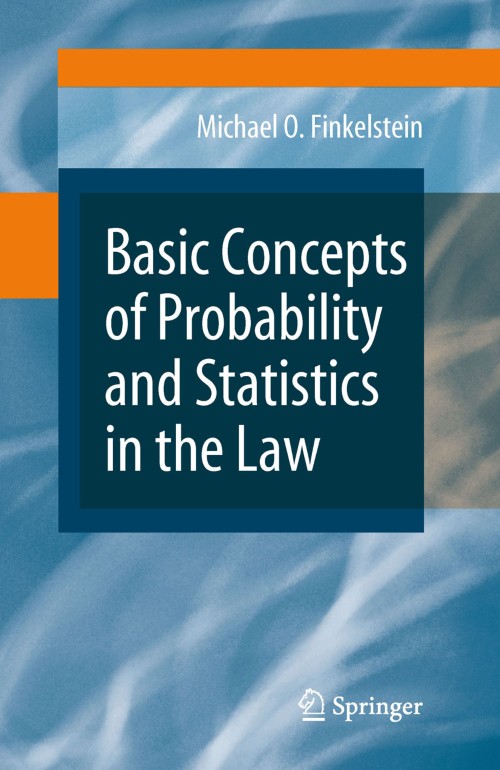
245 10|aBasic Concepts of Probability and Statistics in the Law|h[electronic resource] /|cby Michael O. Finkelstein.
250 |a1st ed. 2009.
264 1|aNew York, NY :|bSpringer New York :|bImprint: Springer,|c2009.
300 |aXII, 174 p.|bonline resource.
336 |atext|btxt|2rdacontent
337 |acomputer|bc|2rdamedia
338 |aonline resource|bcr|2rdacarrier
347 |atext file|bPDF|2rda
505 0 |aProbability -- Descriptive Tools -- Compound Events -- Significance -- Random Variables and Their Distributions -- Confidence -- Power -- Sampling -- Epidemiology -- Combining the Evidence -- Regression Models -- Regression Models – Further Considerations.
520 |aThis book sets out basic statistical tools as they have been applied in actual legal disputes. Examples range over diverse fields of law, such as identification evidence, mass torts, securities law, environmental regulation, and capital punishment, among many others. In some notable cases, such as the U.S. Supreme Court’s decision in Bush v. Gore, the book explores aspects of the statistical evidence that were unrecognized or misconceived by the parties or the court. For the statistics student, the book will give a deeper appreciation of foundation concepts and provide a wealth of real life applications. For the lawyer, or law student, the book will introduce a subject that has become increasingly important both in litigation and in studies of the legal system. The book is self-contained and may be read without background in probability or statistics. Michael O. Finkelstein is a lawyer and has been described as a pioneer in the use of statistics in law. He has for many years taught Statistics for Lawyers at Columbia Law School, and has also taught this subject at Harvard, Yale, and the University of Pennsylvania law schools. In addition to numerous articles, he is the author of Quantitative Methods in Law, published in 1978, and is the co-author with Professor Bruce Levin of Statistics for Lawyers, first published in 1990 and now in its second edition.
650 0|aLaw.
650 0|aSocial sciences|xStatistical methods.
650 14|aFundamentals of Law.
650 24|aStatistics in Social Sciences, Humanities, Law, Education, Behavorial Sciences, Public Policy.
710 2 |aSpringerLink (Online service)
773 0 |tSpringer Nature eBook
776 08|iPrinted edition:|z9780387875002
776 08|iPrinted edition:|z9780387875538
856 40|uhttps://doi.org/10.1007/b105519
912 |aZDB-2-SHU
912 |aZDB-2-SXLC
950 |aHumanities, Social Sciences and Law (SpringerNature-11648)
950 |aLaw and Criminology (R0) (SpringerNature-43727)