LEADER 04017nam a22005895i 4500
001 810997
003 TR_AnAIT
005 20260131012755
007 cr nn 008mamaa
008 100301s1991 ne | s |||| 0|eng d
020 |a9780585271811|9978-0-585-27181-1
024 7 |a10.1007/978-0-585-27181-1|2doi
041 |aeng
049 |aTürk Tarih Kurumu Kütüphanesi
050 4|aBJ1-1725
072 7|aHPQ|2bicssc
072 7|aPHI005000|2bisacsh
072 7|aQDTQ|2thema
082 04|a170|223
090 |aDK/12262
100 1 |aMathieu, D.|eauthor.|4aut|4http://id.loc.gov/vocabulary/relators/aut
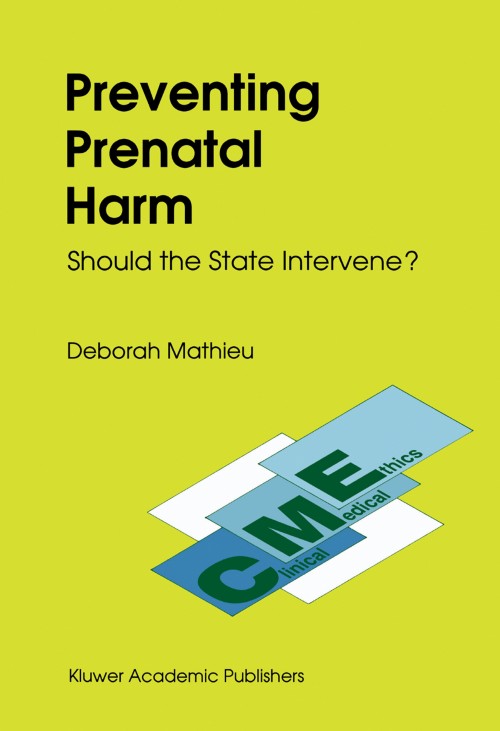
245 10|aPreventing Prenatal Harm|h[electronic resource] :|bShould the State Intervene? /|cby D. Mathieu, E. Haavi Morreim.
250 |a1st ed. 1991.
264 1|aDordrecht :|bSpringer Netherlands :|bImprint: Springer,|c1991.
300 |aVIII, 156 p.|bonline resource.
336 |atext|btxt|2rdacontent
337 |acomputer|bc|2rdamedia
338 |aonline resource|bcr|2rdacarrier
347 |atext file|bPDF|2rda
490 1 |aClinical Medical Ethics ;|v3
505 0 |aArguments in Favor of Coercing a Pregnant Woman to Act in the Interests of her Future Child -- Arguments against Legally Requiring a Pregnant Woman to Act in the Interests of her Future Child -- Practical Applications.
520 |aThe issues explored in this book have unfortunately come to be known as 'maternal-fetal conflicts'. The phrase is unsatisfactory because it is misleading: It places the emphasis on the well-being of the fetus instead of on the born child (who will bear the burden of any harm done prenatally); it assumes a conflict between a pregnant women and her offspring (while the issue is usually more complex and more broadly based); and it incorrectly implies that all pregnant women are appropriately regarded as mothers. For these reasons, I have chosen to avoid the phrase 'matern- fetal conflict' altogether, and will instead speak in terms of 'preventable prenatal harm'. I mention this at the outset, for those of you familiar with 'maternal-fetal conflicts' who might be wondering if I am addressing the same issues. Yes. But I am trying to look at them in a new - and I hope more fruitful - way. I would like to thank the other participants in the Hastings Center's maternal-fetal project - especially those who disageed with me - for being so thought-provoking. And I owe a lasting debt of gratitude to Henry Ruth and Allen Buchanan for their invaluable counsel.
532 8 |aAccessibility summary: This PDF is not accessible. It is based on scanned pages and does not support features such as screen reader compatibility or described non-text content (images, graphs etc). However, it likely supports searchable and selectable text based on OCR (Optical Character Recognition). Users with accessibility needs may not be able to use this content effectively. Please contact us at accessibilitysupport@springernature.com if you require assistance or an alternative format.
532 8 |aInaccessible, or known limited accessibility
532 8 |aNo reading system accessibility options actively disabled
532 8 |aPublisher contact for further accessibility information: accessibilitysupport@springernature.com
650 0|aEthics.
650 0|aMedical sciences.
650 0|aEconomics.
650 14|aMoral Philosophy and Applied Ethics.
650 24|aHealth Sciences.
650 24|aEconomics.
700 1 |aMorreim, E. Haavi.|eauthor.|4aut|4http://id.loc.gov/vocabulary/relators/aut
710 2 |aSpringerLink (Online service)
773 0 |tSpringer Nature eBook
776 08|iPrinted edition:|z9780792309840
776 08|iPrinted edition:|z9789401737449
776 08|iPrinted edition:|z9789401737456
830 0|aClinical Medical Ethics ;|v3
856 40|uhttps://doi.org/10.1007/978-0-585-27181-1
912 |aZDB-2-SHU
912 |aZDB-2-SXPR
912 |aZDB-2-BAE
950 |aHumanities, Social Sciences and Law (SpringerNature-11648)
950 |aPhilosophy and Religion (R0) (SpringerNature-43725)