

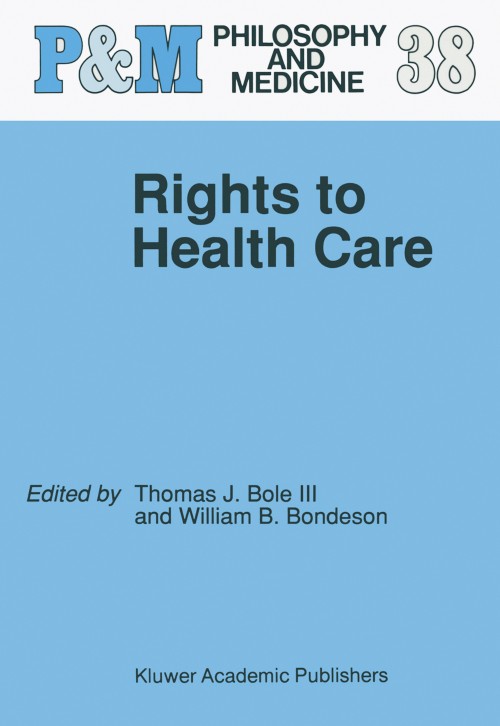
Rights to Health Care [electronic resource] / by Thomas J. Bole III, W.B. Bondeson.
Erişim Adresi
ISBN
9780585282954
Dil Kodu
İngilizce
Yer Numarası
DK/12263
Yazar
Basım Bildirimi
1st ed. 1991.
Yayın Bilgisi
Dordrecht : Springer Netherlands : Imprint: Springer, 1991.
Fiziksel Niteleme
IX, 382 p. online resource.
Dizi
Philosophy and Medicine, 2215-0080 ; 38
İçindekiler Notu
The Rhetoric of Rights and Justice in Health Care -- The Rhetoric of Rights and Justice in Health Care -- Rights to Health Care: The Development of the Concept -- The Right to Health Care: Reflections on Its History and Politics -- The Right to Health Care: Presentation and Critique -- The Right to Health Care in a Capitalistic Democracy -- Justice and the Right to Health Care: An Egalitarian Account -- Rights to Health Care: Created, Not Discovered -- Why the Right to Health Care is Not a Useful Concept for Policy Debates -- A Qualified Right to Health Care: Toward a Notion of a Decent Minimum -- Rights, Reforms, and the Health Care Crisis: Problems and Prospects -- Rights, Obligations, and the Special Importance of Health Care -- Access to Health Care: Charity and Rights -- Equality, Free Markets, and the Elderly -- Equal Opportunity and Health Care Rights for the Elderly -- Free Markets, Consumer Choice, and the Poor: Some Reasons for Caution -- My Right to Care for my Health — And What About the Needy and the Elderly? -- Health Care as a Commodity -- Should Medicine be a Commodity? An Economist’s Perspective -- The Profit Motive in Kant and Hegel -- Virtue for Hire: Some Reflections on Free Choice and the Profit Motive in the Delivery of Health Care -- Rights, Public Policy, and the State.
Özet, vb.
Human existence is marked by pain, limitation, disability, disease, suffering, and death. These facts of life and of death give ample grounds for characterizing much of the human condition as unfortunate. A core philosophical question is whether the circumstances are in addition unfair or unjust in the sense of justifying claims on the resources, time, and abilities of others. The temptation to use the languages of rights and of justice is und- standable. Faced with pain, disability, and death, it seems natural to complain that "someone should do something", "this is unfair", or "it just isn't fight that people should suffer this way". Yet it is one thing to complain about the unfairness of another's actions, and another thing to complain about the unfairness of biological or physical processes. If no one is to blame for one's illness, disability, or death, in what sense are one's unfortunate circumstances unfair or unjust? How can claims against others for aid and support arise if no one has caused the unfortunate state of affairs? To justify the languages of fights to health care or justice in health care requires showing why particular unfortunate circumstances are also unfair, in the sense of demanding the labors of others. It requires understanding as well the limits of property claims. After all, claims regarding justice in health care or about fights to health care limit the property fights of those whose resources will be used to provide care.
Konu
Medicine __ Philosophy.
Economics.
Bioethics.
Philosophy of Medicine.
Economics.
Bioethics.
Economics.
Bioethics.
Philosophy of Medicine.
Economics.
Bioethics.
Diğer Yazarlar
Kurum Adı
Eseri Alıntıla
Referansları kullanmadan önce gözden geçirmeniz ve varsa gerekli düzeltmeleri yapmanız önerilir.
Dijital Kaynak
MARC Görünümü
LEADER 04714nam a22005655i 4500
001 810998
003 TR_AnAIT
005 20260131012754
007 cr nn 008mamaa
008 100301s1991 ne | s |||| 0|eng d
020 |a9780585282954|9978-0-585-28295-4
024 7 |a10.1007/978-0-585-28295-4|2doi
041 |aeng
049 |aTürk Tarih Kurumu Kütüphanesi
050 4|aR723-723.7
072 7|aHP|2bicssc
072 7|aMBDC|2bicssc
072 7|aMED050000|2bisacsh
072 7|aQD|2thema
072 7|aMBDC|2thema
082 04|a610.1|223
090 |aDK/12263
100 1 |aBole III, Thomas J.|eauthor.|4aut|4http://id.loc.gov/vocabulary/relators/aut
245 10|aRights to Health Care|h[electronic resource] /|cby Thomas J. Bole III, W.B. Bondeson.
250 |a1st ed. 1991.
264 1|aDordrecht :|bSpringer Netherlands :|bImprint: Springer,|c1991.
300 |aIX, 382 p.|bonline resource.
336 |atext|btxt|2rdacontent
337 |acomputer|bc|2rdamedia
338 |aonline resource|bcr|2rdacarrier
347 |atext file|bPDF|2rda
490 1 |aPhilosophy and Medicine,|x2215-0080 ;|v38
505 0 |aThe Rhetoric of Rights and Justice in Health Care -- The Rhetoric of Rights and Justice in Health Care -- Rights to Health Care: The Development of the Concept -- The Right to Health Care: Reflections on Its History and Politics -- The Right to Health Care: Presentation and Critique -- The Right to Health Care in a Capitalistic Democracy -- Justice and the Right to Health Care: An Egalitarian Account -- Rights to Health Care: Created, Not Discovered -- Why the Right to Health Care is Not a Useful Concept for Policy Debates -- A Qualified Right to Health Care: Toward a Notion of a Decent Minimum -- Rights, Reforms, and the Health Care Crisis: Problems and Prospects -- Rights, Obligations, and the Special Importance of Health Care -- Access to Health Care: Charity and Rights -- Equality, Free Markets, and the Elderly -- Equal Opportunity and Health Care Rights for the Elderly -- Free Markets, Consumer Choice, and the Poor: Some Reasons for Caution -- My Right to Care for my Health — And What About the Needy and the Elderly? -- Health Care as a Commodity -- Should Medicine be a Commodity? An Economist’s Perspective -- The Profit Motive in Kant and Hegel -- Virtue for Hire: Some Reflections on Free Choice and the Profit Motive in the Delivery of Health Care -- Rights, Public Policy, and the State.
520 |aHuman existence is marked by pain, limitation, disability, disease, suffering, and death. These facts of life and of death give ample grounds for characterizing much of the human condition as unfortunate. A core philosophical question is whether the circumstances are in addition unfair or unjust in the sense of justifying claims on the resources, time, and abilities of others. The temptation to use the languages of rights and of justice is und- standable. Faced with pain, disability, and death, it seems natural to complain that "someone should do something", "this is unfair", or "it just isn't fight that people should suffer this way". Yet it is one thing to complain about the unfairness of another's actions, and another thing to complain about the unfairness of biological or physical processes. If no one is to blame for one's illness, disability, or death, in what sense are one's unfortunate circumstances unfair or unjust? How can claims against others for aid and support arise if no one has caused the unfortunate state of affairs? To justify the languages of fights to health care or justice in health care requires showing why particular unfortunate circumstances are also unfair, in the sense of demanding the labors of others. It requires understanding as well the limits of property claims. After all, claims regarding justice in health care or about fights to health care limit the property fights of those whose resources will be used to provide care.
650 0|aMedicine|xPhilosophy.
650 0|aEconomics.
650 0|aBioethics.
650 14|aPhilosophy of Medicine.
650 24|aEconomics.
650 24|aBioethics.
700 1 |aBondeson, W.B.|eauthor.|4aut|4http://id.loc.gov/vocabulary/relators/aut
710 2 |aSpringerLink (Online service)
773 0 |tSpringer Nature eBook
776 08|iPrinted edition:|z9780792311379
776 08|iPrinted edition:|z9789401740913
776 08|iPrinted edition:|z9789401740920
830 0|aPhilosophy and Medicine,|x2215-0080 ;|v38
856 40|uhttps://doi.org/10.1007/978-0-585-28295-4
912 |aZDB-2-SHU
912 |aZDB-2-SXPR
912 |aZDB-2-BAE
950 |aHumanities, Social Sciences and Law (SpringerNature-11648)
950 |aPhilosophy and Religion (R0) (SpringerNature-43725)
001 810998
003 TR_AnAIT
005 20260131012754
007 cr nn 008mamaa
008 100301s1991 ne | s |||| 0|eng d
020 |a9780585282954|9978-0-585-28295-4
024 7 |a10.1007/978-0-585-28295-4|2doi
041 |aeng
049 |aTürk Tarih Kurumu Kütüphanesi
050 4|aR723-723.7
072 7|aHP|2bicssc
072 7|aMBDC|2bicssc
072 7|aMED050000|2bisacsh
072 7|aQD|2thema
072 7|aMBDC|2thema
082 04|a610.1|223
090 |aDK/12263
100 1 |aBole III, Thomas J.|eauthor.|4aut|4http://id.loc.gov/vocabulary/relators/aut
245 10|aRights to Health Care|h[electronic resource] /|cby Thomas J. Bole III, W.B. Bondeson.
250 |a1st ed. 1991.
264 1|aDordrecht :|bSpringer Netherlands :|bImprint: Springer,|c1991.
300 |aIX, 382 p.|bonline resource.
336 |atext|btxt|2rdacontent
337 |acomputer|bc|2rdamedia
338 |aonline resource|bcr|2rdacarrier
347 |atext file|bPDF|2rda
490 1 |aPhilosophy and Medicine,|x2215-0080 ;|v38
505 0 |aThe Rhetoric of Rights and Justice in Health Care -- The Rhetoric of Rights and Justice in Health Care -- Rights to Health Care: The Development of the Concept -- The Right to Health Care: Reflections on Its History and Politics -- The Right to Health Care: Presentation and Critique -- The Right to Health Care in a Capitalistic Democracy -- Justice and the Right to Health Care: An Egalitarian Account -- Rights to Health Care: Created, Not Discovered -- Why the Right to Health Care is Not a Useful Concept for Policy Debates -- A Qualified Right to Health Care: Toward a Notion of a Decent Minimum -- Rights, Reforms, and the Health Care Crisis: Problems and Prospects -- Rights, Obligations, and the Special Importance of Health Care -- Access to Health Care: Charity and Rights -- Equality, Free Markets, and the Elderly -- Equal Opportunity and Health Care Rights for the Elderly -- Free Markets, Consumer Choice, and the Poor: Some Reasons for Caution -- My Right to Care for my Health — And What About the Needy and the Elderly? -- Health Care as a Commodity -- Should Medicine be a Commodity? An Economist’s Perspective -- The Profit Motive in Kant and Hegel -- Virtue for Hire: Some Reflections on Free Choice and the Profit Motive in the Delivery of Health Care -- Rights, Public Policy, and the State.
520 |aHuman existence is marked by pain, limitation, disability, disease, suffering, and death. These facts of life and of death give ample grounds for characterizing much of the human condition as unfortunate. A core philosophical question is whether the circumstances are in addition unfair or unjust in the sense of justifying claims on the resources, time, and abilities of others. The temptation to use the languages of rights and of justice is und- standable. Faced with pain, disability, and death, it seems natural to complain that "someone should do something", "this is unfair", or "it just isn't fight that people should suffer this way". Yet it is one thing to complain about the unfairness of another's actions, and another thing to complain about the unfairness of biological or physical processes. If no one is to blame for one's illness, disability, or death, in what sense are one's unfortunate circumstances unfair or unjust? How can claims against others for aid and support arise if no one has caused the unfortunate state of affairs? To justify the languages of fights to health care or justice in health care requires showing why particular unfortunate circumstances are also unfair, in the sense of demanding the labors of others. It requires understanding as well the limits of property claims. After all, claims regarding justice in health care or about fights to health care limit the property fights of those whose resources will be used to provide care.
650 0|aMedicine|xPhilosophy.
650 0|aEconomics.
650 0|aBioethics.
650 14|aPhilosophy of Medicine.
650 24|aEconomics.
650 24|aBioethics.
700 1 |aBondeson, W.B.|eauthor.|4aut|4http://id.loc.gov/vocabulary/relators/aut
710 2 |aSpringerLink (Online service)
773 0 |tSpringer Nature eBook
776 08|iPrinted edition:|z9780792311379
776 08|iPrinted edition:|z9789401740913
776 08|iPrinted edition:|z9789401740920
830 0|aPhilosophy and Medicine,|x2215-0080 ;|v38
856 40|uhttps://doi.org/10.1007/978-0-585-28295-4
912 |aZDB-2-SHU
912 |aZDB-2-SXPR
912 |aZDB-2-BAE
950 |aHumanities, Social Sciences and Law (SpringerNature-11648)
950 |aPhilosophy and Religion (R0) (SpringerNature-43725)
Materyaller
Depodan talep edilen materyal sadece kütüphane içerisinde kullanılmaktadır.
Materyal dışarıya ödünç verilmemektedir.
Materyal dışarıya ödünç verilmemektedir.
