LEADER 03594nam a22005295i 4500
001 811025
003 TR_AnAIT
005 20260131012619
007 cr nn 008mamaa
008 100301s2005 ne | s |||| 0|eng d
020 |a9781402026379|9978-1-4020-2637-9
024 7 |a10.1007/1-4020-2637-4|2doi
041 |aeng
049 |aTürk Tarih Kurumu Kütüphanesi
050 4|aP98-98.5
072 7|aCFX|2bicssc
072 7|aCOM073000|2bisacsh
072 7|aCFX|2thema
082 04|a410.285|223
090 |aDK/12290
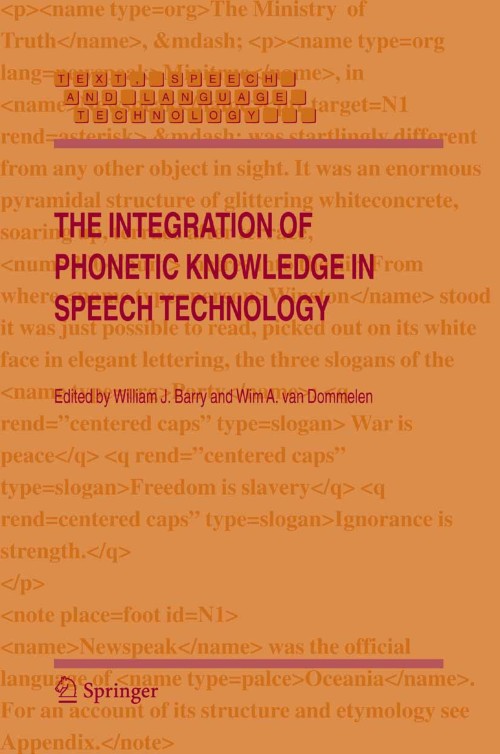
245 14|aThe Integration of Phonetic Knowledge in Speech Technology|h[electronic resource] /|cedited by William J. Barry, Wim A. van Dommelen.
250 |a1st ed. 2005.
264 1|aDordrecht :|bSpringer Netherlands :|bImprint: Springer,|c2005.
300 |aVIII, 182 p.|bonline resource.
336 |atext|btxt|2rdacontent
337 |acomputer|bc|2rdamedia
338 |aonline resource|bcr|2rdacarrier
347 |atext file|bPDF|2rda
490 1 |aText, Speech and Language Technology,|x2542-9388 ;|v25
505 0 |aPhonetic Knowledge in Speech Technology -- Can Phonetic Knowledge be Used to Improve the Performance of Speech Recognisers and Synthesisers? -- Prosodic Models, Automatic Speech Understanding, and Speech Synthesis: Towards the Common Ground? -- Phonetic Time Maps -- Introducing Phonetically Motivated, Heterogeneous Information into Automatic Speech Recognition -- Introducing Contextual Transcription Rules in Large Vocabulary Speech Recognition -- From Here to Utility -- Pronunciation Modeling -- Phonetic Knowledge in Text-to-Speech Synthesis -- Is Phonetic Knowledge of Any Use for Speech Technology?.
520 |aContinued progress in Speech Technology in the face of ever-increasing demands on the performance levels of applications is a challenge to the whole speech and language science community. Robust recognition and understanding of spontaneous speech in varied environments, good comprehensibility and naturalness of expressive speech synthesis are goals that cannot be achieved without a change of paradigm. This book argues for interdisciplinary communication and cooperation in problem-solving in general, and discusses the interaction between speech and language engineering and phonetics in particular. With a number of reports on innovative speech technology research as well as more theoretical discussions, it addresses the practical, scientific and sometimes the philosophical problems that stand in the way of cross-disciplinary collaboration and illuminates some of the many possible ways forward. Audience: Researchers and professionals in speech technology and computational linguists.
650 0|aComputational linguistics.
650 0|aNatural language processing (Computer science).
650 0|aApplied linguistics.
650 14|aComputational Linguistics.
650 24|aNatural Language Processing (NLP).
650 24|aApplied Linguistics.
700 1 |aBarry, William J.|eeditor.|4edt|4http://id.loc.gov/vocabulary/relators/edt
700 1 |aDommelen, Wim A. van.|eeditor.|4edt|4http://id.loc.gov/vocabulary/relators/edt
710 2 |aSpringerLink (Online service)
773 0 |tSpringer Nature eBook
776 08|iPrinted edition:|z9781402026355
776 08|iPrinted edition:|z9781402026362
776 08|iPrinted edition:|z9789048100927
830 0|aText, Speech and Language Technology,|x2542-9388 ;|v25
856 40|uhttps://doi.org/10.1007/1-4020-2637-4
912 |aZDB-2-SHU
912 |aZDB-2-SXS
950 |aHumanities, Social Sciences and Law (SpringerNature-11648)
950 |aSocial Sciences (R0) (SpringerNature-43726)