

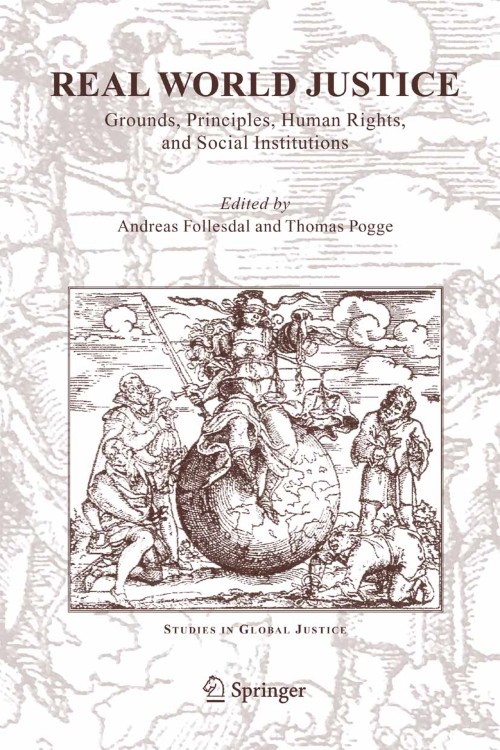
Real World Justice [electronic resource] : Grounds, Principles, Human Rights, and Social Institutions / edited by A. Follesdal, T. Pogge.
Erişim Adresi
ISBN
9781402031427
Dil Kodu
İngilizce
Yer Numarası
DK/12318
Basım Bildirimi
1st ed. 2005.
Yayın Bilgisi
Dordrecht : Springer Netherlands : Imprint: Springer, 2005.
Fiziksel Niteleme
VI, 408 p. online resource.
Dizi
Studies in Global Justice, 1871-1456 ; 1
İçindekiler Notu
Poverty and Global Justice: Some Challenges Ahead -- Justice, Morality and Power in the Global Context -- “Saving Amina”: Global Justice for Women and Intercultural Dialogue -- Poverty as a Human Rights Violation and the Limits of Nationalism -- International or Global Justice? Evaluating the Cosmopolitan Approach -- Understanding and Evaluating the Contribution Principle -- World Poverty and Moral Responsibility -- The Principle of Subsidiarity -- “It's the Power, Stupid!” On the Unmentioned Precondition of Social Justice -- Egalitarian Global Distributive Justice or Minimal Standard? Pogge's Position -- Responsibility and International Distributive Justice -- From Natural Law to Human Rights — Some Reflections on Thomas Pogge and Global Justice -- Deliberation or Negotiation? Remarks on the Justice of Global and Regional Human Rights Agreements -- Human Rights and Relativism -- The Nature of Human Rights -- Severe Poverty as a Human Rights Violation — Weak and Strong -- The First UN Millennium Development Goal: A Cause for Celebration? -- Can Global Distributive Justice be Minimalist and Consensual? — Reflections on Thomas Pogge's Global Tax on Natural Resources -- Redistributing Responsibilities — The UN Global Compact with Corporations.
Özet, vb.
The concept of global justice makes visible how we citizens of affluent countries are potentially implicated in the horrors so many must endure in the so-called less developed countries. Distinct conceptions of global justice differ in their specific criteria of global justice. However, they agree that the touchstone is how well our global institutional order is doing, compared to its feasible alternatives, in regard to the fundamental human interests that matter from a moral point of view. We are responsible for global regimes such as the global trading system and the rules governing military interventions. These institutional arrangements affect human beings worldwide, for instance by shaping the options and incentives of governments and corporations. Alternative paths of globalization would have differed in how much violence, oppression, and extreme poverty they engender. And global institutional reforms could greatly enhance human rights fullfillment in the future. The importance of this global justice approach reaches well beyond philosophy. It enables ordinary citizens to understand their options and responsibility for global institutional factors, and it challenges social scientists to address the causes of poverty and hunger that act across borders. The present volume addresses four main topics regarding global justice: The normative grounds for claims regarding the global institutional order, the substantive normative principles for a legitimate global order, the roles of legal human rights standards, and some institutional arrangements that may make the present world order less unjust. All royalties from this book have been assigned to Oxfam.
Konu
Law.
Philosophy and social sciences.
Ethics.
Political science __ Philosophy.
Political science.
Social sciences.
Fundamentals of Law.
Philosophy of the Social Sciences.
Moral Philosophy and Applied Ethics.
Political Philosophy.
Political Science.
Society.
Philosophy and social sciences.
Ethics.
Political science __ Philosophy.
Political science.
Social sciences.
Fundamentals of Law.
Philosophy of the Social Sciences.
Moral Philosophy and Applied Ethics.
Political Philosophy.
Political Science.
Society.
Diğer Yazarlar
Kurum Adı
Eseri Alıntıla
Referansları kullanmadan önce gözden geçirmeniz ve varsa gerekli düzeltmeleri yapmanız önerilir.
Dijital Kaynak
MARC Görünümü
LEADER 05087nam a22006015i 4500
001 811053
003 TR_AnAIT
005 20260131012429
007 cr nn 008mamaa
008 100301s2005 ne | s |||| 0|eng d
020 |a9781402031427|9978-1-4020-3142-7
024 7 |a10.1007/1-4020-3142-4|2doi
041 |aeng
049 |aTürk Tarih Kurumu Kütüphanesi
050 4|aK201-487
072 7|aLA|2bicssc
072 7|aLAW000000|2bisacsh
072 7|aLA|2thema
082 04|a340.1|223
090 |aDK/12318
245 10|aReal World Justice|h[electronic resource] :|bGrounds, Principles, Human Rights, and Social Institutions /|cedited by A. Follesdal, T. Pogge.
250 |a1st ed. 2005.
264 1|aDordrecht :|bSpringer Netherlands :|bImprint: Springer,|c2005.
300 |aVI, 408 p.|bonline resource.
336 |atext|btxt|2rdacontent
337 |acomputer|bc|2rdamedia
338 |aonline resource|bcr|2rdacarrier
347 |atext file|bPDF|2rda
490 1 |aStudies in Global Justice,|x1871-1456 ;|v1
505 0 |aPoverty and Global Justice: Some Challenges Ahead -- Justice, Morality and Power in the Global Context -- “Saving Amina”: Global Justice for Women and Intercultural Dialogue -- Poverty as a Human Rights Violation and the Limits of Nationalism -- International or Global Justice? Evaluating the Cosmopolitan Approach -- Understanding and Evaluating the Contribution Principle -- World Poverty and Moral Responsibility -- The Principle of Subsidiarity -- “It's the Power, Stupid!” On the Unmentioned Precondition of Social Justice -- Egalitarian Global Distributive Justice or Minimal Standard? Pogge's Position -- Responsibility and International Distributive Justice -- From Natural Law to Human Rights — Some Reflections on Thomas Pogge and Global Justice -- Deliberation or Negotiation? Remarks on the Justice of Global and Regional Human Rights Agreements -- Human Rights and Relativism -- The Nature of Human Rights -- Severe Poverty as a Human Rights Violation — Weak and Strong -- The First UN Millennium Development Goal: A Cause for Celebration? -- Can Global Distributive Justice be Minimalist and Consensual? — Reflections on Thomas Pogge's Global Tax on Natural Resources -- Redistributing Responsibilities — The UN Global Compact with Corporations.
520 |aThe concept of global justice makes visible how we citizens of affluent countries are potentially implicated in the horrors so many must endure in the so-called less developed countries. Distinct conceptions of global justice differ in their specific criteria of global justice. However, they agree that the touchstone is how well our global institutional order is doing, compared to its feasible alternatives, in regard to the fundamental human interests that matter from a moral point of view. We are responsible for global regimes such as the global trading system and the rules governing military interventions. These institutional arrangements affect human beings worldwide, for instance by shaping the options and incentives of governments and corporations. Alternative paths of globalization would have differed in how much violence, oppression, and extreme poverty they engender. And global institutional reforms could greatly enhance human rights fullfillment in the future. The importance of this global justice approach reaches well beyond philosophy. It enables ordinary citizens to understand their options and responsibility for global institutional factors, and it challenges social scientists to address the causes of poverty and hunger that act across borders. The present volume addresses four main topics regarding global justice: The normative grounds for claims regarding the global institutional order, the substantive normative principles for a legitimate global order, the roles of legal human rights standards, and some institutional arrangements that may make the present world order less unjust. All royalties from this book have been assigned to Oxfam.
650 0|aLaw.
650 0|aPhilosophy and social sciences.
650 0|aEthics.
650 0|aPolitical science|xPhilosophy.
650 0|aPolitical science.
650 0|aSocial sciences.
650 14|aFundamentals of Law.
650 24|aPhilosophy of the Social Sciences.
650 24|aMoral Philosophy and Applied Ethics.
650 24|aPolitical Philosophy.
650 24|aPolitical Science.
650 24|aSociety.
700 1 |aFollesdal, A.|eeditor.|4edt|4http://id.loc.gov/vocabulary/relators/edt
700 1 |aPogge, T.|eeditor.|4edt|4http://id.loc.gov/vocabulary/relators/edt
710 2 |aSpringerLink (Online service)
773 0 |tSpringer Nature eBook
776 08|iPrinted edition:|z9781402031410
776 08|iPrinted edition:|z9781402031496
776 08|iPrinted edition:|z9789048101993
830 0|aStudies in Global Justice,|x1871-1456 ;|v1
856 40|uhttps://doi.org/10.1007/1-4020-3142-4
912 |aZDB-2-SHU
912 |aZDB-2-SXLC
950 |aHumanities, Social Sciences and Law (SpringerNature-11648)
950 |aLaw and Criminology (R0) (SpringerNature-43727)
001 811053
003 TR_AnAIT
005 20260131012429
007 cr nn 008mamaa
008 100301s2005 ne | s |||| 0|eng d
020 |a9781402031427|9978-1-4020-3142-7
024 7 |a10.1007/1-4020-3142-4|2doi
041 |aeng
049 |aTürk Tarih Kurumu Kütüphanesi
050 4|aK201-487
072 7|aLA|2bicssc
072 7|aLAW000000|2bisacsh
072 7|aLA|2thema
082 04|a340.1|223
090 |aDK/12318
245 10|aReal World Justice|h[electronic resource] :|bGrounds, Principles, Human Rights, and Social Institutions /|cedited by A. Follesdal, T. Pogge.
250 |a1st ed. 2005.
264 1|aDordrecht :|bSpringer Netherlands :|bImprint: Springer,|c2005.
300 |aVI, 408 p.|bonline resource.
336 |atext|btxt|2rdacontent
337 |acomputer|bc|2rdamedia
338 |aonline resource|bcr|2rdacarrier
347 |atext file|bPDF|2rda
490 1 |aStudies in Global Justice,|x1871-1456 ;|v1
505 0 |aPoverty and Global Justice: Some Challenges Ahead -- Justice, Morality and Power in the Global Context -- “Saving Amina”: Global Justice for Women and Intercultural Dialogue -- Poverty as a Human Rights Violation and the Limits of Nationalism -- International or Global Justice? Evaluating the Cosmopolitan Approach -- Understanding and Evaluating the Contribution Principle -- World Poverty and Moral Responsibility -- The Principle of Subsidiarity -- “It's the Power, Stupid!” On the Unmentioned Precondition of Social Justice -- Egalitarian Global Distributive Justice or Minimal Standard? Pogge's Position -- Responsibility and International Distributive Justice -- From Natural Law to Human Rights — Some Reflections on Thomas Pogge and Global Justice -- Deliberation or Negotiation? Remarks on the Justice of Global and Regional Human Rights Agreements -- Human Rights and Relativism -- The Nature of Human Rights -- Severe Poverty as a Human Rights Violation — Weak and Strong -- The First UN Millennium Development Goal: A Cause for Celebration? -- Can Global Distributive Justice be Minimalist and Consensual? — Reflections on Thomas Pogge's Global Tax on Natural Resources -- Redistributing Responsibilities — The UN Global Compact with Corporations.
520 |aThe concept of global justice makes visible how we citizens of affluent countries are potentially implicated in the horrors so many must endure in the so-called less developed countries. Distinct conceptions of global justice differ in their specific criteria of global justice. However, they agree that the touchstone is how well our global institutional order is doing, compared to its feasible alternatives, in regard to the fundamental human interests that matter from a moral point of view. We are responsible for global regimes such as the global trading system and the rules governing military interventions. These institutional arrangements affect human beings worldwide, for instance by shaping the options and incentives of governments and corporations. Alternative paths of globalization would have differed in how much violence, oppression, and extreme poverty they engender. And global institutional reforms could greatly enhance human rights fullfillment in the future. The importance of this global justice approach reaches well beyond philosophy. It enables ordinary citizens to understand their options and responsibility for global institutional factors, and it challenges social scientists to address the causes of poverty and hunger that act across borders. The present volume addresses four main topics regarding global justice: The normative grounds for claims regarding the global institutional order, the substantive normative principles for a legitimate global order, the roles of legal human rights standards, and some institutional arrangements that may make the present world order less unjust. All royalties from this book have been assigned to Oxfam.
650 0|aLaw.
650 0|aPhilosophy and social sciences.
650 0|aEthics.
650 0|aPolitical science|xPhilosophy.
650 0|aPolitical science.
650 0|aSocial sciences.
650 14|aFundamentals of Law.
650 24|aPhilosophy of the Social Sciences.
650 24|aMoral Philosophy and Applied Ethics.
650 24|aPolitical Philosophy.
650 24|aPolitical Science.
650 24|aSociety.
700 1 |aFollesdal, A.|eeditor.|4edt|4http://id.loc.gov/vocabulary/relators/edt
700 1 |aPogge, T.|eeditor.|4edt|4http://id.loc.gov/vocabulary/relators/edt
710 2 |aSpringerLink (Online service)
773 0 |tSpringer Nature eBook
776 08|iPrinted edition:|z9781402031410
776 08|iPrinted edition:|z9781402031496
776 08|iPrinted edition:|z9789048101993
830 0|aStudies in Global Justice,|x1871-1456 ;|v1
856 40|uhttps://doi.org/10.1007/1-4020-3142-4
912 |aZDB-2-SHU
912 |aZDB-2-SXLC
950 |aHumanities, Social Sciences and Law (SpringerNature-11648)
950 |aLaw and Criminology (R0) (SpringerNature-43727)
Materyaller
Depodan talep edilen materyal sadece kütüphane içerisinde kullanılmaktadır.
Materyal dışarıya ödünç verilmemektedir.
Materyal dışarıya ödünç verilmemektedir.
