

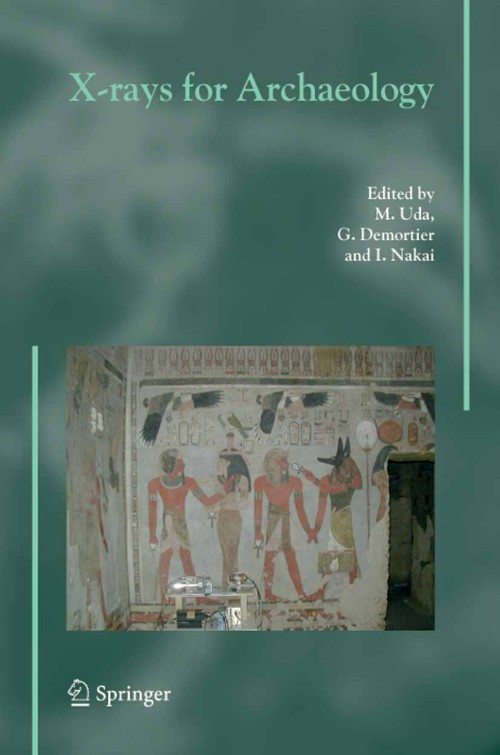
X-rays for Archaeology [electronic resource] / edited by M. Uda, G. Demortier, I. Nakai.
Erişim Adresi
ISBN
9781402035814
Dil Kodu
İngilizce
Yer Numarası
DK/12328
Basım Bildirimi
1st ed. 2005.
Yayın Bilgisi
Dordrecht : Springer Netherlands : Imprint: Springer, 2005.
Fiziksel Niteleme
IX, 308 p. online resource.
İçindekiler Notu
In-situ Measurements -- Characterization of Pigments Used in Ancient Egypt -- Importance of in-situ EDXRF Measurements in the Preservation and Conservation of Material Culture -- Scientific Field Research in Egypt -- Use of Ion Beam -- Ion Beam Techniques for the Non-destructive Analysis of Archaelogical Materials -- The Origin of Ancient Gemstones Unveiled by PIXE, PIGE and ?-Raman Spectrometry -- Investigations of Medieval Glass by a Combined PIXE/PIGE Method -- PIXE Analysis of Pre-Hispanic Items from Ancient America -- PIXE Study on Chinese Underglaze-Red Porcelain Made in Yuan Dynasty -- Glassmaking in the Venetian Manner -- Studies on Pigments for Ancient Ceramics and Glass Using X-ray Methods -- Compositional Differences of Blue and White Porcelain Analyzed by External Beam PIXE -- Use of Synchroton Radiation -- New Trend in Application of Synchrotron Radiation-Induced X-ray Fluorescence Analysis to Archaeology -- Synchrotron Radiation in Archaeological and Cultural Heritage Science -- Study of the Elemental Distribution in Ancient Chinese Porcelain Using Synchrotron Radiation X-ray Fluorescence -- Study on the Compositional Differences among Different Kilns’ Tang Sancai by SRXRF -- Study of Chemical Composition in Ancient Celadon of Yue Kiln -- Radiography -- The Use of Medical Computed Tomography (CT) Imaging in the Study of Ceramic and Clay Archaeological Artifacts from the Ancient Near East -- The Radiographic Examinations of the “Guardian Statues” from the Tomb of Tutankhamen -- Analytical Study of Paintings by X-ray Radiography and Spectroscopy -- Radiographic Findings in Ancient Egyptian Mummies -- Interdisciplinary Field between Art and Science -- X-ray Application on on Post-Amarna Objects from Dahshur -- Decorative Program at Malqata Palace, Egypt -- X-ray Archaeology inChina -- The Relationship between Arts and Sciences in the Field of Archaeology: from Cooperation to a Truly Equal Partnership -- Color Plates.
Özet, vb.
The application of X-rays to archaeological objects with the goal of gaining insight into both their construction and chemical composition, in a non-destructive manner, dates back to the discovery of radiation. Nowadays, X-ray techniques, such as X-ray fluorescense and diffraction are standard tools. This book offers physicists, art historians, archaeologists, curators, and conservators a detailed overview via contributions written by leading scientists in the field. The book contains scientific data, i.e. in situ measurement data taken with portable XRF and XRD, and fine data taken with accelerating ion beams and synchrotron radiations, together with their explanations. Results obtained by traditional scientific methods are also reviewed. The broad data collection spans experimental data taken both from monuments in the field and exhibits in museums, for example: ancient Egyptian wall-painting pigments ancient Egyptian wooden statues and mummies ancient Greek funerary monuments Cypriot ceramics medieval, Lyubliana and Venetian glass Romanian ceramics ancient Near-Eastern clay old Japanese porcelain pre-Hispanic items from America ancient Chinese underglaze-red blue and white porcelain Chinese celadon Phoenician cosmetics Also included are data from glazes, ancient gold and silver coins, gold jewelleries, gold alloys, corroded metals, gemstones (ruby, emerald and garnet), painting pigments, pottery, bronze, obsidian, stucco, turquoise, and so on. The discussion fostered here between natural scientists and archaeologists anticipates the future direction of archaeology.
Konu
Archaeology.
Crystallography.
Atomic structure .
Molecular structure .
Particle accelerators.
Archaeology.
Crystallography and Scattering Methods.
Atomic and Molecular Structure and Properties.
Accelerator Physics.
Crystallography.
Atomic structure .
Molecular structure .
Particle accelerators.
Archaeology.
Crystallography and Scattering Methods.
Atomic and Molecular Structure and Properties.
Accelerator Physics.
Diğer Yazarlar
Kurum Adı
Eseri Alıntıla
Referansları kullanmadan önce gözden geçirmeniz ve varsa gerekli düzeltmeleri yapmanız önerilir.
Dijital Kaynak
MARC Görünümü
LEADER 05515nam a22005535i 4500
001 811063
003 TR_AnAIT
005 20260131012413
007 cr nn 008mamaa
008 100301s2005 ne | s |||| 0|eng d
020 |a9781402035814|9978-1-4020-3581-4
024 7 |a10.1007/1-4020-3581-0|2doi
041 |aeng
049 |aTürk Tarih Kurumu Kütüphanesi
050 4|aCC1-960
072 7|aHD|2bicssc
072 7|aSOC003000|2bisacsh
072 7|aNK|2thema
082 04|a930.1|223
090 |aDK/12328
245 10|aX-rays for Archaeology|h[electronic resource] /|cedited by M. Uda, G. Demortier, I. Nakai.
250 |a1st ed. 2005.
264 1|aDordrecht :|bSpringer Netherlands :|bImprint: Springer,|c2005.
300 |aIX, 308 p.|bonline resource.
336 |atext|btxt|2rdacontent
337 |acomputer|bc|2rdamedia
338 |aonline resource|bcr|2rdacarrier
347 |atext file|bPDF|2rda
505 0 |aIn-situ Measurements -- Characterization of Pigments Used in Ancient Egypt -- Importance of in-situ EDXRF Measurements in the Preservation and Conservation of Material Culture -- Scientific Field Research in Egypt -- Use of Ion Beam -- Ion Beam Techniques for the Non-destructive Analysis of Archaelogical Materials -- The Origin of Ancient Gemstones Unveiled by PIXE, PIGE and ?-Raman Spectrometry -- Investigations of Medieval Glass by a Combined PIXE/PIGE Method -- PIXE Analysis of Pre-Hispanic Items from Ancient America -- PIXE Study on Chinese Underglaze-Red Porcelain Made in Yuan Dynasty -- Glassmaking in the Venetian Manner -- Studies on Pigments for Ancient Ceramics and Glass Using X-ray Methods -- Compositional Differences of Blue and White Porcelain Analyzed by External Beam PIXE -- Use of Synchroton Radiation -- New Trend in Application of Synchrotron Radiation-Induced X-ray Fluorescence Analysis to Archaeology -- Synchrotron Radiation in Archaeological and Cultural Heritage Science -- Study of the Elemental Distribution in Ancient Chinese Porcelain Using Synchrotron Radiation X-ray Fluorescence -- Study on the Compositional Differences among Different Kilns’ Tang Sancai by SRXRF -- Study of Chemical Composition in Ancient Celadon of Yue Kiln -- Radiography -- The Use of Medical Computed Tomography (CT) Imaging in the Study of Ceramic and Clay Archaeological Artifacts from the Ancient Near East -- The Radiographic Examinations of the “Guardian Statues” from the Tomb of Tutankhamen -- Analytical Study of Paintings by X-ray Radiography and Spectroscopy -- Radiographic Findings in Ancient Egyptian Mummies -- Interdisciplinary Field between Art and Science -- X-ray Application on on Post-Amarna Objects from Dahshur -- Decorative Program at Malqata Palace, Egypt -- X-ray Archaeology inChina -- The Relationship between Arts and Sciences in the Field of Archaeology: from Cooperation to a Truly Equal Partnership -- Color Plates.
520 |aThe application of X-rays to archaeological objects with the goal of gaining insight into both their construction and chemical composition, in a non-destructive manner, dates back to the discovery of radiation. Nowadays, X-ray techniques, such as X-ray fluorescense and diffraction are standard tools. This book offers physicists, art historians, archaeologists, curators, and conservators a detailed overview via contributions written by leading scientists in the field. The book contains scientific data, i.e. in situ measurement data taken with portable XRF and XRD, and fine data taken with accelerating ion beams and synchrotron radiations, together with their explanations. Results obtained by traditional scientific methods are also reviewed. The broad data collection spans experimental data taken both from monuments in the field and exhibits in museums, for example: ancient Egyptian wall-painting pigments ancient Egyptian wooden statues and mummies ancient Greek funerary monuments Cypriot ceramics medieval, Lyubliana and Venetian glass Romanian ceramics ancient Near-Eastern clay old Japanese porcelain pre-Hispanic items from America ancient Chinese underglaze-red blue and white porcelain Chinese celadon Phoenician cosmetics Also included are data from glazes, ancient gold and silver coins, gold jewelleries, gold alloys, corroded metals, gemstones (ruby, emerald and garnet), painting pigments, pottery, bronze, obsidian, stucco, turquoise, and so on. The discussion fostered here between natural scientists and archaeologists anticipates the future direction of archaeology.
650 0|aArchaeology.
650 0|aCrystallography.
650 0|aAtomic structure .
650 0|aMolecular structure .
650 0|aParticle accelerators.
650 14|aArchaeology.
650 24|aCrystallography and Scattering Methods.
650 24|aAtomic and Molecular Structure and Properties.
650 24|aAccelerator Physics.
700 1 |aUda, M.|eeditor.|4edt|4http://id.loc.gov/vocabulary/relators/edt
700 1 |aDemortier, G.|eeditor.|4edt|4http://id.loc.gov/vocabulary/relators/edt
700 1 |aNakai, I.|eeditor.|4edt|4http://id.loc.gov/vocabulary/relators/edt
710 2 |aSpringerLink (Online service)
773 0 |tSpringer Nature eBook
776 08|iPrinted edition:|z9781402035807
776 08|iPrinted edition:|z9789048103805
776 08|iPrinted edition:|z9789400790940
856 40|uhttps://doi.org/10.1007/1-4020-3581-0
912 |aZDB-2-SHU
912 |aZDB-2-SXS
950 |aHumanities, Social Sciences and Law (SpringerNature-11648)
950 |aSocial Sciences (R0) (SpringerNature-43726)
001 811063
003 TR_AnAIT
005 20260131012413
007 cr nn 008mamaa
008 100301s2005 ne | s |||| 0|eng d
020 |a9781402035814|9978-1-4020-3581-4
024 7 |a10.1007/1-4020-3581-0|2doi
041 |aeng
049 |aTürk Tarih Kurumu Kütüphanesi
050 4|aCC1-960
072 7|aHD|2bicssc
072 7|aSOC003000|2bisacsh
072 7|aNK|2thema
082 04|a930.1|223
090 |aDK/12328
245 10|aX-rays for Archaeology|h[electronic resource] /|cedited by M. Uda, G. Demortier, I. Nakai.
250 |a1st ed. 2005.
264 1|aDordrecht :|bSpringer Netherlands :|bImprint: Springer,|c2005.
300 |aIX, 308 p.|bonline resource.
336 |atext|btxt|2rdacontent
337 |acomputer|bc|2rdamedia
338 |aonline resource|bcr|2rdacarrier
347 |atext file|bPDF|2rda
505 0 |aIn-situ Measurements -- Characterization of Pigments Used in Ancient Egypt -- Importance of in-situ EDXRF Measurements in the Preservation and Conservation of Material Culture -- Scientific Field Research in Egypt -- Use of Ion Beam -- Ion Beam Techniques for the Non-destructive Analysis of Archaelogical Materials -- The Origin of Ancient Gemstones Unveiled by PIXE, PIGE and ?-Raman Spectrometry -- Investigations of Medieval Glass by a Combined PIXE/PIGE Method -- PIXE Analysis of Pre-Hispanic Items from Ancient America -- PIXE Study on Chinese Underglaze-Red Porcelain Made in Yuan Dynasty -- Glassmaking in the Venetian Manner -- Studies on Pigments for Ancient Ceramics and Glass Using X-ray Methods -- Compositional Differences of Blue and White Porcelain Analyzed by External Beam PIXE -- Use of Synchroton Radiation -- New Trend in Application of Synchrotron Radiation-Induced X-ray Fluorescence Analysis to Archaeology -- Synchrotron Radiation in Archaeological and Cultural Heritage Science -- Study of the Elemental Distribution in Ancient Chinese Porcelain Using Synchrotron Radiation X-ray Fluorescence -- Study on the Compositional Differences among Different Kilns’ Tang Sancai by SRXRF -- Study of Chemical Composition in Ancient Celadon of Yue Kiln -- Radiography -- The Use of Medical Computed Tomography (CT) Imaging in the Study of Ceramic and Clay Archaeological Artifacts from the Ancient Near East -- The Radiographic Examinations of the “Guardian Statues” from the Tomb of Tutankhamen -- Analytical Study of Paintings by X-ray Radiography and Spectroscopy -- Radiographic Findings in Ancient Egyptian Mummies -- Interdisciplinary Field between Art and Science -- X-ray Application on on Post-Amarna Objects from Dahshur -- Decorative Program at Malqata Palace, Egypt -- X-ray Archaeology inChina -- The Relationship between Arts and Sciences in the Field of Archaeology: from Cooperation to a Truly Equal Partnership -- Color Plates.
520 |aThe application of X-rays to archaeological objects with the goal of gaining insight into both their construction and chemical composition, in a non-destructive manner, dates back to the discovery of radiation. Nowadays, X-ray techniques, such as X-ray fluorescense and diffraction are standard tools. This book offers physicists, art historians, archaeologists, curators, and conservators a detailed overview via contributions written by leading scientists in the field. The book contains scientific data, i.e. in situ measurement data taken with portable XRF and XRD, and fine data taken with accelerating ion beams and synchrotron radiations, together with their explanations. Results obtained by traditional scientific methods are also reviewed. The broad data collection spans experimental data taken both from monuments in the field and exhibits in museums, for example: ancient Egyptian wall-painting pigments ancient Egyptian wooden statues and mummies ancient Greek funerary monuments Cypriot ceramics medieval, Lyubliana and Venetian glass Romanian ceramics ancient Near-Eastern clay old Japanese porcelain pre-Hispanic items from America ancient Chinese underglaze-red blue and white porcelain Chinese celadon Phoenician cosmetics Also included are data from glazes, ancient gold and silver coins, gold jewelleries, gold alloys, corroded metals, gemstones (ruby, emerald and garnet), painting pigments, pottery, bronze, obsidian, stucco, turquoise, and so on. The discussion fostered here between natural scientists and archaeologists anticipates the future direction of archaeology.
650 0|aArchaeology.
650 0|aCrystallography.
650 0|aAtomic structure .
650 0|aMolecular structure .
650 0|aParticle accelerators.
650 14|aArchaeology.
650 24|aCrystallography and Scattering Methods.
650 24|aAtomic and Molecular Structure and Properties.
650 24|aAccelerator Physics.
700 1 |aUda, M.|eeditor.|4edt|4http://id.loc.gov/vocabulary/relators/edt
700 1 |aDemortier, G.|eeditor.|4edt|4http://id.loc.gov/vocabulary/relators/edt
700 1 |aNakai, I.|eeditor.|4edt|4http://id.loc.gov/vocabulary/relators/edt
710 2 |aSpringerLink (Online service)
773 0 |tSpringer Nature eBook
776 08|iPrinted edition:|z9781402035807
776 08|iPrinted edition:|z9789048103805
776 08|iPrinted edition:|z9789400790940
856 40|uhttps://doi.org/10.1007/1-4020-3581-0
912 |aZDB-2-SHU
912 |aZDB-2-SXS
950 |aHumanities, Social Sciences and Law (SpringerNature-11648)
950 |aSocial Sciences (R0) (SpringerNature-43726)
Materyaller
Depodan talep edilen materyal sadece kütüphane içerisinde kullanılmaktadır.
Materyal dışarıya ödünç verilmemektedir.
Materyal dışarıya ödünç verilmemektedir.
