LEADER 03657nam a22004935i 4500
001 811064
003 TR_AnAIT
005 20260131012412
007 cr nn 008mamaa
008 100301s2005 ne | s |||| 0|eng d
020 |a9781402035968|9978-1-4020-3596-8
024 7 |a10.1007/1-4020-3596-9|2doi
041 |aeng
049 |aTürk Tarih Kurumu Kütüphanesi
050 4|aP1-1091
072 7|aCF|2bicssc
072 7|aLAN009000|2bisacsh
072 7|aCF|2thema
082 04|a410.1|223
090 |aDK/12329
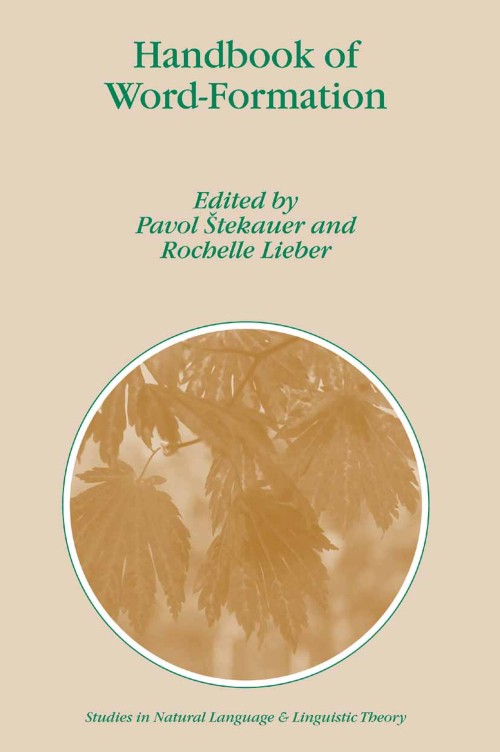
245 10|aHandbook of Word-Formation|h[electronic resource] /|cedited by Pavol Štekauer, Rochelle Lieber.
250 |a1st ed. 2005.
264 1|aDordrecht :|bSpringer Netherlands :|bImprint: Springer,|c2005.
300 |aXVIII, 470 p.|bonline resource.
336 |atext|btxt|2rdacontent
337 |acomputer|bc|2rdamedia
338 |aonline resource|bcr|2rdacarrier
347 |atext file|bPDF|2rda
490 1 |aStudies in Natural Language and Linguistic Theory,|x2215-0358 ;|v64
505 0 |aBasic Terminology -- Word-Formation and Phonology -- Word-Formation and Inflectional Morphology -- Word-Formation and Syntax -- Hans Marchand and the Marchandeans -- Chomsky’s Remarks and the Transformationalist Hypothesis -- The Lexicalist Approach to Word-Formation and the Notion of the Lexicon -- Lexeme-Morpheme Base Morphology -- Onomasiological Approach to Word-Formation -- Cognitive Approach to Word-Formation -- Word-Formation in Natural Morphology -- Word-Formation in Optimality Theory -- Productivity: Theories -- Constraints on Productivity -- Lexicalization and Institutionalization -- English Word-Formation Processes -- The Latest Trends In English Word-Formation.
520 |aThis volume, intended both for advanced students and scholars of linguistics, traces the many strands of study in the field of word formation that have developed since the seminal work of Marchand and Lees in the 1960s. In mapping the state of the art in the field of word formation, it avoids a biased approach by presenting different, but mutually complementary frameworks within which research into word formation has taken place. It covers the historical development of theories of word formation within generative grammar, and affords a solid introduction to the treatment of word formation in cognitive grammar, natural morphology, optimality theory, Lexeme Morpheme Base Morphology, onomasiological theory, and other recent frameworks. Each topic is presented by an expert who has contributed significantly to the field. In addition to surveying theoretical developments from both European and North American perspectives, it looks specifically at individual English word formation processes (derivation, compounding, conversion) and reviews some of the ways in which they have been analyzed since Marchand’s comprehensive treatment nearly five decades ago.
650 0|aLinguistics.
650 14|aTheoretical Linguistics / Grammar.
650 24|aLinguistics.
700 1 |aŠtekauer, Pavol.|eeditor.|4edt|4http://id.loc.gov/vocabulary/relators/edt
700 1 |aLieber, Rochelle.|eeditor.|4edt|4http://id.loc.gov/vocabulary/relators/edt
710 2 |aSpringerLink (Online service)
773 0 |tSpringer Nature eBook
776 08|iPrinted edition:|z9781402035951
776 08|iPrinted edition:|z9781402035975
776 08|iPrinted edition:|z9789048103874
830 0|aStudies in Natural Language and Linguistic Theory,|x2215-0358 ;|v64
856 40|uhttps://doi.org/10.1007/1-4020-3596-9
912 |aZDB-2-SHU
912 |aZDB-2-SXS
950 |aHumanities, Social Sciences and Law (SpringerNature-11648)
950 |aSocial Sciences (R0) (SpringerNature-43726)