

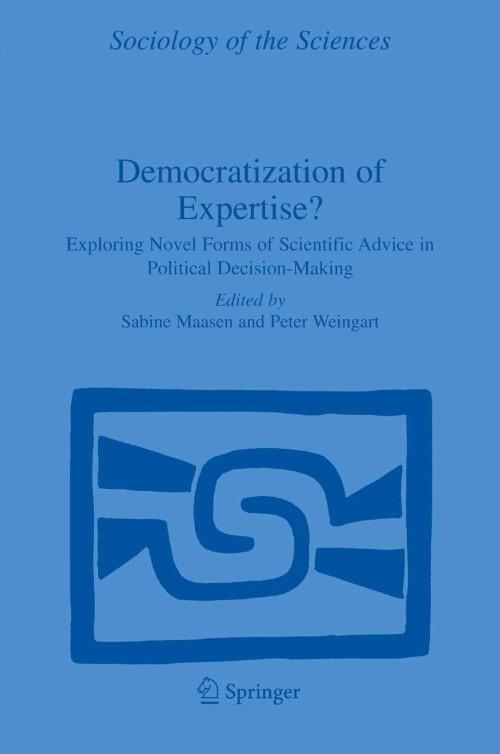
Democratization of Expertise? [electronic resource] : Exploring Novel Forms of Scientific Advice in Political Decision-Making / edited by Sabine Maasen, P. Weingart.
Erişim Adresi
ISBN
9781402037542
Dil Kodu
İngilizce
Yer Numarası
DK/12346
Basım Bildirimi
1st ed. 2005.
Yayın Bilgisi
Dordrecht : Springer Netherlands : Imprint: Springer, 2005.
Fiziksel Niteleme
VIII, 238 p. online resource.
Dizi
Sociology of the Sciences Yearbook, 2215-1796 ; 24
İçindekiler Notu
What’s New in Scientific Advice to Politics? -- Bioethical Controversies and Policy Advice: The Production of Ethical Expertise and its Role in the Substantiation of Political Decision-Making -- Advisory Systems in Pluralistic Knowledge Societies: A Criteria-Based Typology to Assess and Optimize Environmental Policy Advice -- Institutional Design for Socially Robust Knowledge: The National Toxicology Program’s Report on Carcinogens -- Representation, Expertise, and the German Parliament: A Comparison of Three Advisory Institutions -- Expertise and Political Responsibility: The Columbia Shuttle Catastrophe -- Knowledge and Decision-Making -- Science/Policy Boundaries: A Changing Division of Labour in Dutch Expert Policy Advice -- Inserting the Public Into Science -- Between Policy and Politics -- Participation as Knowledge Production and the Limits of Democracy -- Judgment Under Siege: The Three-Body Problem of Expert Legitimacy.
Özet, vb.
‘Scientific advice to politics’, the ‘nature of expertise’, and the ‘relation between experts, policymakers, and the public’ are variations of a topic that currently attracts the attention of social scientists, philosophers of science as well as practitioners in the public sphere and the media. This renewed interest in a persistent theme is initiated by the call for a democratization of expertise that has become the order of the day in the legitimation of research funding. The new significance of ‘participation’ and ‘accountability’ has motivated scholars to take a new look at the science – politics interface and to probe questions such as "What is new in the arrangement of scientific expertise and political decision-making?", "How can reliable knowledge be made useful for politics and society at large, and how can epistemically and ethically sound decisions be achieved without losing democratic legitimacy?", "How can the objective of democratization of expertise be achieved without compromising the quality and reliability of knowledge?" Scientific knowledge and the ‘experts’ that represent it no longer command the unquestioned authority and public trust that was once bestowed upon them, and yet, policy makers are more dependent on them than ever before. This collection of essays explores the relations between science and politics with the instruments of social studies of science, thereby providing new insights into their re-alignment under a new régime of governance.
Konu
Philosophy.
Science __ Philosophy.
Political science __ Philosophy.
Political science.
Sociology.
Philosophy.
Philosophy of Science.
Political Philosophy.
Political Science.
Sociology.
Science __ Philosophy.
Political science __ Philosophy.
Political science.
Sociology.
Philosophy.
Philosophy of Science.
Political Philosophy.
Political Science.
Sociology.
Diğer Yazarlar
Kurum Adı
Eseri Alıntıla
Referansları kullanmadan önce gözden geçirmeniz ve varsa gerekli düzeltmeleri yapmanız önerilir.
Dijital Kaynak
MARC Görünümü
LEADER 04546nam a22005775i 4500
001 811081
003 TR_AnAIT
005 20260131012325
007 cr nn 008mamaa
008 100301s2005 ne | s |||| 0|eng d
020 |a9781402037542|9978-1-4020-3754-2
024 7 |a10.1007/1-4020-3754-6|2doi
041 |aeng
049 |aTürk Tarih Kurumu Kütüphanesi
050 4|aB1-5802
072 7|aHP|2bicssc
072 7|aPHI000000|2bisacsh
072 7|aQD|2thema
082 04|a100|223
090 |aDK/12346
245 10|aDemocratization of Expertise?|h[electronic resource] :|bExploring Novel Forms of Scientific Advice in Political Decision-Making /|cedited by Sabine Maasen, P. Weingart.
250 |a1st ed. 2005.
264 1|aDordrecht :|bSpringer Netherlands :|bImprint: Springer,|c2005.
300 |aVIII, 238 p.|bonline resource.
336 |atext|btxt|2rdacontent
337 |acomputer|bc|2rdamedia
338 |aonline resource|bcr|2rdacarrier
347 |atext file|bPDF|2rda
490 1 |aSociology of the Sciences Yearbook,|x2215-1796 ;|v24
505 0 |aWhat’s New in Scientific Advice to Politics? -- Bioethical Controversies and Policy Advice: The Production of Ethical Expertise and its Role in the Substantiation of Political Decision-Making -- Advisory Systems in Pluralistic Knowledge Societies: A Criteria-Based Typology to Assess and Optimize Environmental Policy Advice -- Institutional Design for Socially Robust Knowledge: The National Toxicology Program’s Report on Carcinogens -- Representation, Expertise, and the German Parliament: A Comparison of Three Advisory Institutions -- Expertise and Political Responsibility: The Columbia Shuttle Catastrophe -- Knowledge and Decision-Making -- Science/Policy Boundaries: A Changing Division of Labour in Dutch Expert Policy Advice -- Inserting the Public Into Science -- Between Policy and Politics -- Participation as Knowledge Production and the Limits of Democracy -- Judgment Under Siege: The Three-Body Problem of Expert Legitimacy.
520 |a‘Scientific advice to politics’, the ‘nature of expertise’, and the ‘relation between experts, policymakers, and the public’ are variations of a topic that currently attracts the attention of social scientists, philosophers of science as well as practitioners in the public sphere and the media. This renewed interest in a persistent theme is initiated by the call for a democratization of expertise that has become the order of the day in the legitimation of research funding. The new significance of ‘participation’ and ‘accountability’ has motivated scholars to take a new look at the science – politics interface and to probe questions such as "What is new in the arrangement of scientific expertise and political decision-making?", "How can reliable knowledge be made useful for politics and society at large, and how can epistemically and ethically sound decisions be achieved without losing democratic legitimacy?", "How can the objective of democratization of expertise be achieved without compromising the quality and reliability of knowledge?" Scientific knowledge and the ‘experts’ that represent it no longer command the unquestioned authority and public trust that was once bestowed upon them, and yet, policy makers are more dependent on them than ever before. This collection of essays explores the relations between science and politics with the instruments of social studies of science, thereby providing new insights into their re-alignment under a new régime of governance.
650 0|aPhilosophy.
650 0|aScience|xPhilosophy.
650 0|aPolitical science|xPhilosophy.
650 0|aPolitical science.
650 0|aSociology.
650 14|aPhilosophy.
650 24|aPhilosophy of Science.
650 24|aPolitical Philosophy.
650 24|aPolitical Science.
650 24|aSociology.
700 1 |aMaasen, Sabine.|eeditor.|4edt|4http://id.loc.gov/vocabulary/relators/edt
700 1 |aWeingart, P.|eeditor.|4edt|4http://id.loc.gov/vocabulary/relators/edt
710 2 |aSpringerLink (Online service)
773 0 |tSpringer Nature eBook
776 08|iPrinted edition:|z9781402037535
776 08|iPrinted edition:|z9781402046988
776 08|iPrinted edition:|z9789048104543
830 0|aSociology of the Sciences Yearbook,|x2215-1796 ;|v24
856 40|uhttps://doi.org/10.1007/1-4020-3754-6
912 |aZDB-2-SHU
912 |aZDB-2-SXPR
950 |aHumanities, Social Sciences and Law (SpringerNature-11648)
950 |aPhilosophy and Religion (R0) (SpringerNature-43725)
001 811081
003 TR_AnAIT
005 20260131012325
007 cr nn 008mamaa
008 100301s2005 ne | s |||| 0|eng d
020 |a9781402037542|9978-1-4020-3754-2
024 7 |a10.1007/1-4020-3754-6|2doi
041 |aeng
049 |aTürk Tarih Kurumu Kütüphanesi
050 4|aB1-5802
072 7|aHP|2bicssc
072 7|aPHI000000|2bisacsh
072 7|aQD|2thema
082 04|a100|223
090 |aDK/12346
245 10|aDemocratization of Expertise?|h[electronic resource] :|bExploring Novel Forms of Scientific Advice in Political Decision-Making /|cedited by Sabine Maasen, P. Weingart.
250 |a1st ed. 2005.
264 1|aDordrecht :|bSpringer Netherlands :|bImprint: Springer,|c2005.
300 |aVIII, 238 p.|bonline resource.
336 |atext|btxt|2rdacontent
337 |acomputer|bc|2rdamedia
338 |aonline resource|bcr|2rdacarrier
347 |atext file|bPDF|2rda
490 1 |aSociology of the Sciences Yearbook,|x2215-1796 ;|v24
505 0 |aWhat’s New in Scientific Advice to Politics? -- Bioethical Controversies and Policy Advice: The Production of Ethical Expertise and its Role in the Substantiation of Political Decision-Making -- Advisory Systems in Pluralistic Knowledge Societies: A Criteria-Based Typology to Assess and Optimize Environmental Policy Advice -- Institutional Design for Socially Robust Knowledge: The National Toxicology Program’s Report on Carcinogens -- Representation, Expertise, and the German Parliament: A Comparison of Three Advisory Institutions -- Expertise and Political Responsibility: The Columbia Shuttle Catastrophe -- Knowledge and Decision-Making -- Science/Policy Boundaries: A Changing Division of Labour in Dutch Expert Policy Advice -- Inserting the Public Into Science -- Between Policy and Politics -- Participation as Knowledge Production and the Limits of Democracy -- Judgment Under Siege: The Three-Body Problem of Expert Legitimacy.
520 |a‘Scientific advice to politics’, the ‘nature of expertise’, and the ‘relation between experts, policymakers, and the public’ are variations of a topic that currently attracts the attention of social scientists, philosophers of science as well as practitioners in the public sphere and the media. This renewed interest in a persistent theme is initiated by the call for a democratization of expertise that has become the order of the day in the legitimation of research funding. The new significance of ‘participation’ and ‘accountability’ has motivated scholars to take a new look at the science – politics interface and to probe questions such as "What is new in the arrangement of scientific expertise and political decision-making?", "How can reliable knowledge be made useful for politics and society at large, and how can epistemically and ethically sound decisions be achieved without losing democratic legitimacy?", "How can the objective of democratization of expertise be achieved without compromising the quality and reliability of knowledge?" Scientific knowledge and the ‘experts’ that represent it no longer command the unquestioned authority and public trust that was once bestowed upon them, and yet, policy makers are more dependent on them than ever before. This collection of essays explores the relations between science and politics with the instruments of social studies of science, thereby providing new insights into their re-alignment under a new régime of governance.
650 0|aPhilosophy.
650 0|aScience|xPhilosophy.
650 0|aPolitical science|xPhilosophy.
650 0|aPolitical science.
650 0|aSociology.
650 14|aPhilosophy.
650 24|aPhilosophy of Science.
650 24|aPolitical Philosophy.
650 24|aPolitical Science.
650 24|aSociology.
700 1 |aMaasen, Sabine.|eeditor.|4edt|4http://id.loc.gov/vocabulary/relators/edt
700 1 |aWeingart, P.|eeditor.|4edt|4http://id.loc.gov/vocabulary/relators/edt
710 2 |aSpringerLink (Online service)
773 0 |tSpringer Nature eBook
776 08|iPrinted edition:|z9781402037535
776 08|iPrinted edition:|z9781402046988
776 08|iPrinted edition:|z9789048104543
830 0|aSociology of the Sciences Yearbook,|x2215-1796 ;|v24
856 40|uhttps://doi.org/10.1007/1-4020-3754-6
912 |aZDB-2-SHU
912 |aZDB-2-SXPR
950 |aHumanities, Social Sciences and Law (SpringerNature-11648)
950 |aPhilosophy and Religion (R0) (SpringerNature-43725)
Materyaller
Depodan talep edilen materyal sadece kütüphane içerisinde kullanılmaktadır.
Materyal dışarıya ödünç verilmemektedir.
Materyal dışarıya ödünç verilmemektedir.
