LEADER 03733nam a22005775i 4500
001 811085
003 TR_AnAIT
005 20260131012308
007 cr nn 008mamaa
008 100301s2006 ne | s |||| 0|eng d
020 |a9781402038907|9978-1-4020-3890-7
024 7 |a10.1007/1-4020-3890-9|2doi
041 |aeng
049 |aTürk Tarih Kurumu Kütüphanesi
050 4|aHM479.2-554
072 7|aJHB|2bicssc
072 7|aSOC026000|2bisacsh
072 7|aJHB|2thema
082 04|a301.01|223
090 |aDK/12350
100 1 |aHill, Lisa.|eauthor.|4aut|4http://id.loc.gov/vocabulary/relators/aut
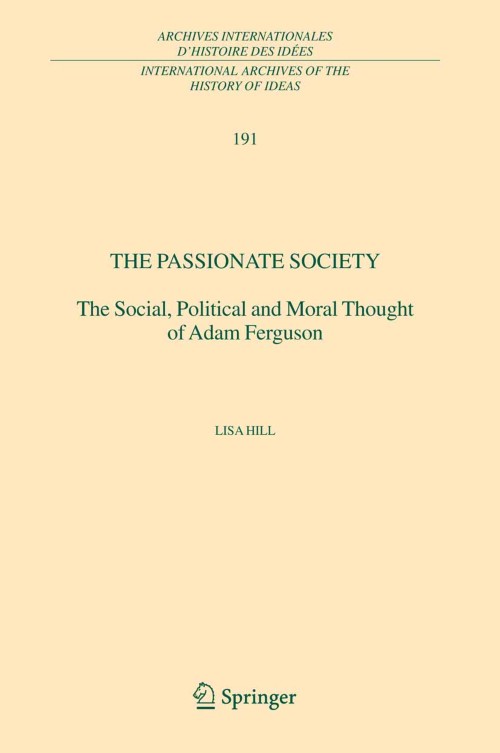
245 14|aThe Passionate Society|h[electronic resource] :|bThe Social, Political and Moral Thought of Adam Ferguson /|cby Lisa Hill.
250 |a1st ed. 2006.
264 1|aDordrecht :|bSpringer Netherlands :|bImprint: Springer,|c2006.
300 |aXII, 286 p.|bonline resource.
336 |atext|btxt|2rdacontent
337 |acomputer|bc|2rdamedia
338 |aonline resource|bcr|2rdacarrier
347 |atext file|bPDF|2rda
490 1 |aInternational Archives of the History of Ideas Archives internationales d'histoire des idées,|x2215-0307 ;|v191
505 0 |aIntroduction: The Passionate Society -- Reading Ferguson -- Ferguson’s Theology/Ontology -- Method and Historiography -- Ferguson’s Faculty and Moral Psychology -- Ferguson’s “Invisible Hand” -- Ferguson’S Early Conflict Theory -- Habit -- The Environment -- Corruption And Problems Of Modernity -- Progress and Decline -- Ferguson’s Conservatism -- Conclusion.
520 |aAdam Ferguson (1723-1816) was a major figure of the Scottish Enlightenment whose thought was, in many respects, original and distinctive. This book is a study of his ideas and of the intellectual forces that shaped them. Though somewhat overlooked in the nineteenth century, Ferguson was rescued from obscurity in the first half of the twentieth century by scholars interested in the origins of sociology and early critiques of modernity. Ferguson’s interest in the mechanics of social life and especially social change led him to many groundbreaking insights. In fact, he is sometimes identified as the 'Father of Modern Sociology'. In addition to exploring whether or not he merits this title, this study examines the whole of Ferguson’s thought as a system and includes his moral and faculty psychology, historiography, theology, politics and social science. Ferguson is distinguished by his deep appreciation of the complexity of the human condition; his study of society is based on the belief that it is not only reason, but the unseen, unplanned, sub-rational and visceral forces that keep the human universe in motion. Ferguson’s appreciation of this fact, and his ability to make social science of it, is his major achievement.
650 0|aSociology.
650 0|aHistory.
650 0|aPolitical science|xPhilosophy.
650 0|aEconomics|xHistory.
650 0|aPolitical science.
650 14|aSociological Theory.
650 24|aSociology.
650 24|aHistory.
650 24|aPolitical Philosophy.
650 24|aHistory of Economic Thought and Methodology.
650 24|aPolitical Science.
710 2 |aSpringerLink (Online service)
773 0 |tSpringer Nature eBook
776 08|iPrinted edition:|z9781402038891
776 08|iPrinted edition:|z9789048105090
776 08|iPrinted edition:|z9789048169917
830 0|aInternational Archives of the History of Ideas Archives internationales d'histoire des idées,|x2215-0307 ;|v191
856 40|uhttps://doi.org/10.1007/1-4020-3890-9
912 |aZDB-2-SHU
912 |aZDB-2-SXS
950 |aHumanities, Social Sciences and Law (SpringerNature-11648)
950 |aSocial Sciences (R0) (SpringerNature-43726)