LEADER 03970nam a22005175i 4500
001 811110
003 TR_AnAIT
005 20260131012208
007 cr nn 008mamaa
008 100301s2006 ne | s |||| 0|eng d
020 |a9781402042140|9978-1-4020-4214-0
024 7 |a10.1007/1-4020-4214-0|2doi
041 |aeng
049 |aTürk Tarih Kurumu Kütüphanesi
050 4|aB829.5.A-Z
072 7|aHPCF3|2bicssc
072 7|aPHI018000|2bisacsh
072 7|aQDHR5|2thema
082 04|a142.7|223
090 |aDK/12375
100 1 |aRodemeyer, Lanei M.|eauthor.|4aut|4http://id.loc.gov/vocabulary/relators/aut
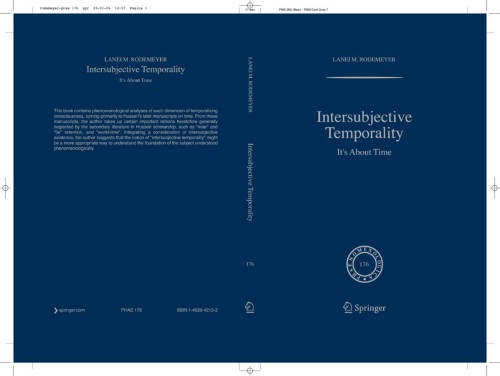
245 10|aIntersubjective Temporality|h[electronic resource] :|bIt's About Time /|cby Lanei M. Rodemeyer.
250 |a1st ed. 2006.
264 1|aDordrecht :|bSpringer Netherlands :|bImprint: Springer,|c2006.
300 |aXII, 192 p.|bonline resource.
336 |atext|btxt|2rdacontent
337 |acomputer|bc|2rdamedia
338 |aonline resource|bcr|2rdacarrier
347 |atext file|bPDF|2rda
490 1 |aPhaenomenologica, Series Founded by H. L. Van Breda and Published Under the Auspices of the Husserl-Archives,|x2215-0331 ;|v176
505 0 |aUNDERSTANDING THE PRESENT: URIMPRESSION VS. LIVING PRESENT -- THE APPRESENTATION OF PERCEIVED OBJECTS86 -- WORLD-TIME: A NEW TEMPORAL SYNTHESIS -- HUSSERL’S DEVELOPMENT OF RETENTION -- INTERSUBJECTIVE CONSTITUTION IN RETENTION -- HUSSERL’S DEVELOPMENT OF PROTENTION -- PROTENTION AS LINK TO INTERSUBJECTIVE TEMPORALITY -- INTERSUBJECTIVE TEMPORALITY.
520 |a(YET ANOTHER INTRODUCTION IN PHENOMENOLOGY) In both his published and unpublished works, Edmund Husserl, the "father of phenomenology,” struggles repeatedly with the relation of the individual subject and intersubjectivity. Since his phenomenology is based upon the temporalizing foundations of the subject, though, he is often accused of solipsism, and his efforts at integrating the subject with an intersubjective existence are registered as falling short of their goal. Important philosophers who use phenomenology as their basis, such as Martin Heidegger and Maurice Merleau-Ponty, furthermore, while implicitly criticizing his limitations, assume the existence of intersubjective foundations without 2 taking up the existence and formation of these foundations themselves. This book addresses the above problematic at several levels: First, it is a careful analysis of Husserl's understanding of inner time-consciousness. I take up each aspect of temporalizing consciousness (i. e. , Urimpression, retention, and protention), explaining it in light of Husserl's phenomenology and showing how it functions in the whole of the "living present,” i. e. , our active, constituting consciousness. These sections of the book are helpful both to the uninitiated student trying to enter the world of Husserl's "inner ti- consciousness" and to the experienced Husserl scholar who desires a closer look at Husserl's theory of temporalizing consciousness. Second, as my analyses take us to Husserl's recently published manuscripts, I provide an explanation of Husserl's later considerations of temporalizing consciousness, showing how he developed his earliest conceptions.
650 0|aPhenomenology .
650 0|aPhilosophy.
650 0|aPsychology.
650 14|aPhenomenology.
650 24|aPhilosophy.
650 24|aBehavioral Sciences and Psychology.
710 2 |aSpringerLink (Online service)
773 0 |tSpringer Nature eBook
776 08|iPrinted edition:|z9781402042133
776 08|iPrinted edition:|z9789048106424
776 08|iPrinted edition:|z9789048170753
830 0|aPhaenomenologica, Series Founded by H. L. Van Breda and Published Under the Auspices of the Husserl-Archives,|x2215-0331 ;|v176
856 40|uhttps://doi.org/10.1007/1-4020-4214-0
912 |aZDB-2-SHU
912 |aZDB-2-SXPR
950 |aHumanities, Social Sciences and Law (SpringerNature-11648)
950 |aPhilosophy and Religion (R0) (SpringerNature-43725)