

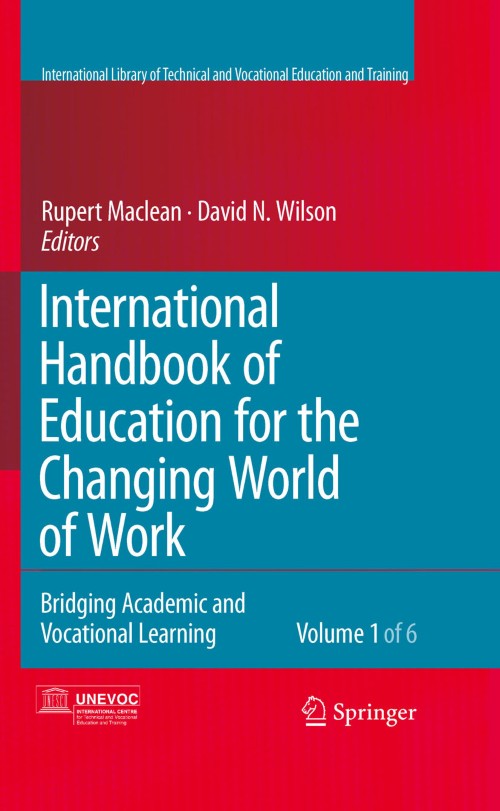
International Handbook of Education for the Changing World of Work [electronic resource] : Bridging Academic and Vocational Learning / edited by Rupert Maclean, David Wilson.
Erişim Adresi
ISBN
9781402052811
Dil Kodu
İngilizce
Yer Numarası
DK/12439
Basım Bildirimi
1st ed. 2009.
Yayın Bilgisi
Dordrecht : Springer Netherlands : Imprint: Springer, 2009.
Fiziksel Niteleme
CCL, 3036 p. online resource.
İçindekiler Notu
VOLUME 1: Part I Overview. Part II The Changing Context Of Work And Education. 1 Changing Workplace Requirements: Implication for Education. 2 Education and Training in Informal Economies -- VOLUME 2: Part III Education For The World Of Work: National And Regional Perspective. 3 Reforming National Systems of Vocational Education and Training. 4 National Initiatives for Reengineering Education for the New Economy. 5 Learning for Employment and Citizenship in Post-conflict Countries row) -- VOLUME 3: Part IV The Management Of TVET Systems. 6 Policy and Management of TVET Systems. Overview: Navigating the Policy Landscape: Education, Training and Work. The Economics and Financing of TVET. Part V Teacher Education For Vocational Education And Training. The TVET Profession -- VOLUME 4: Part VI Education For Work: Research, Curriculum Development And Delivery. Research and Innovation. Curriculum Development and Delivery. Information and Communication Technologies (ICTs) in Vocational Education and Training -- VOLUME 5: Part VII Learning For Life And Work: Bridging Academic And Vocational Education. Participation in Formal Programmes of Learning and Skills Development. Education for the Changing Demands of Youth Employment. 14 The Skills Debate in an Ageing Society -- VOLUME 6: Part VIII Lifelong Learning For Livelihoods And Citizenship. 15 Adult, Continuing and Lifelong. Part IX Assessment Of Skills And Competencies. 16 Recognition, Certification, Accreditation and Quality Assurance in TVET. Name Index. Subject Index.
Özet, vb.
This 6-volume Handbook covers in detail all of the latest practice in technical and vocational education and training (TVET). Edited by two world-leading authorities on the subject, contributions have come from more than 200 international authors, making this a totally comprehensive text on the subject. The Handbook’s aim is to review the developments that have occurred in TVET and provide pointers to improvements in the field. In this Handbook readers will find information on TVET models from all over the world, reflections on the best and most innovative practice, and dozens of telling case studies. The Handbook presents the work both of established as well as the most promising young researchers, giving it a real cutting edge and features unrivalled coverage of developments in research, policy and practice in TVET. It will assist those involved in TVET at any level in making informed decisions and further advance and improve the field and to bridge the gap between vocational and academic education in the 21st century. This Springer work is particularly relevant today as TVET faces major challenges posed by the move in many countries towards the knowledge-based economy ushered in by new information and communication technologies. Traditional occupations and apprenticeships are affected as the boundaries between manual and mental work fade. National economies are evolving rapidly as market forces take full advantage of the opportunities offered by globalization. Work, of course, has always been a major feature in people’s lives. Not only does it provide them with the means of survival—food, clothing and shelter—but it also has a major impact on their self-identity, social status, standard of living and quality of life. In this respect, the shift from the Industrial Age to the Information Age has considerable implications for education and training. Numerous questions arise from the shift in theglobal labour marketplace, questions that this volume provides answers to. How do we anticipate change in the labour market? How respond to the dilemma of providing appropriate educational and training courses in a fluid world economy? Governments need reliable mechanisms to predict economic trends and the demand for manpower. Governments, enterprises and trade unions alike must focus on the methodologies of teacher training, curriculum development, the school-to-work transition, gender, and equality and equity. They will need to offer flexible pathways to training, find new ways of moulding human capital, and work out how they cope with unemployment and an ageing workforce—to name only a few. These are just some of the topics addressed in this Handbook. It draws on international experience to identify the best answers and the best procedures to improve TVET, and provides comprehensive coverage of cutting-edge practices in research and policy as we face the vicissitudes of the twenty-first century.
Konu
Professional education.
Vocational education.
Professional and Vocational Education.
Vocational education.
Professional and Vocational Education.
Diğer Yazarlar
Kurum Adı
Eseri Alıntıla
Referansları kullanmadan önce gözden geçirmeniz ve varsa gerekli düzeltmeleri yapmanız önerilir.
Dijital Kaynak
MARC Görünümü
LEADER 06269nam a22004815i 4500
001 811175
003 TR_AnAIT
005 20260131011952
007 cr nn 008mamaa
008 100301s2009 ne | s |||| 0|eng d
020 |a9781402052811|9978-1-4020-5281-1
024 7 |a10.1007/978-1-4020-5281-1|2doi
041 |aeng
049 |aTürk Tarih Kurumu Kütüphanesi
050 4|aLC1051-1072
050 4|aLC1041-1048
072 7|aJNRV|2bicssc
072 7|aEDU046000|2bisacsh
072 7|aJNRV|2thema
082 04|a370.113|223
090 |aDK/12439
245 10|aInternational Handbook of Education for the Changing World of Work|h[electronic resource] :|bBridging Academic and Vocational Learning /|cedited by Rupert Maclean, David Wilson.
250 |a1st ed. 2009.
264 1|aDordrecht :|bSpringer Netherlands :|bImprint: Springer,|c2009.
300 |aCCL, 3036 p.|bonline resource.
336 |atext|btxt|2rdacontent
337 |acomputer|bc|2rdamedia
338 |aonline resource|bcr|2rdacarrier
347 |atext file|bPDF|2rda
505 0 |aVOLUME 1: Part I Overview. Part II The Changing Context Of Work And Education. 1 Changing Workplace Requirements: Implication for Education. 2 Education and Training in Informal Economies -- VOLUME 2: Part III Education For The World Of Work: National And Regional Perspective. 3 Reforming National Systems of Vocational Education and Training. 4 National Initiatives for Reengineering Education for the New Economy. 5 Learning for Employment and Citizenship in Post-conflict Countries row) -- VOLUME 3: Part IV The Management Of TVET Systems. 6 Policy and Management of TVET Systems. Overview: Navigating the Policy Landscape: Education, Training and Work. The Economics and Financing of TVET. Part V Teacher Education For Vocational Education And Training. The TVET Profession -- VOLUME 4: Part VI Education For Work: Research, Curriculum Development And Delivery. Research and Innovation. Curriculum Development and Delivery. Information and Communication Technologies (ICTs) in Vocational Education and Training -- VOLUME 5: Part VII Learning For Life And Work: Bridging Academic And Vocational Education. Participation in Formal Programmes of Learning and Skills Development. Education for the Changing Demands of Youth Employment. 14 The Skills Debate in an Ageing Society -- VOLUME 6: Part VIII Lifelong Learning For Livelihoods And Citizenship. 15 Adult, Continuing and Lifelong. Part IX Assessment Of Skills And Competencies. 16 Recognition, Certification, Accreditation and Quality Assurance in TVET. Name Index. Subject Index.
520 |aThis 6-volume Handbook covers in detail all of the latest practice in technical and vocational education and training (TVET). Edited by two world-leading authorities on the subject, contributions have come from more than 200 international authors, making this a totally comprehensive text on the subject. The Handbook’s aim is to review the developments that have occurred in TVET and provide pointers to improvements in the field. In this Handbook readers will find information on TVET models from all over the world, reflections on the best and most innovative practice, and dozens of telling case studies. The Handbook presents the work both of established as well as the most promising young researchers, giving it a real cutting edge and features unrivalled coverage of developments in research, policy and practice in TVET. It will assist those involved in TVET at any level in making informed decisions and further advance and improve the field and to bridge the gap between vocational and academic education in the 21st century. This Springer work is particularly relevant today as TVET faces major challenges posed by the move in many countries towards the knowledge-based economy ushered in by new information and communication technologies. Traditional occupations and apprenticeships are affected as the boundaries between manual and mental work fade. National economies are evolving rapidly as market forces take full advantage of the opportunities offered by globalization. Work, of course, has always been a major feature in people’s lives. Not only does it provide them with the means of survival—food, clothing and shelter—but it also has a major impact on their self-identity, social status, standard of living and quality of life. In this respect, the shift from the Industrial Age to the Information Age has considerable implications for education and training. Numerous questions arise from the shift in theglobal labour marketplace, questions that this volume provides answers to. How do we anticipate change in the labour market? How respond to the dilemma of providing appropriate educational and training courses in a fluid world economy? Governments need reliable mechanisms to predict economic trends and the demand for manpower. Governments, enterprises and trade unions alike must focus on the methodologies of teacher training, curriculum development, the school-to-work transition, gender, and equality and equity. They will need to offer flexible pathways to training, find new ways of moulding human capital, and work out how they cope with unemployment and an ageing workforce—to name only a few. These are just some of the topics addressed in this Handbook. It draws on international experience to identify the best answers and the best procedures to improve TVET, and provides comprehensive coverage of cutting-edge practices in research and policy as we face the vicissitudes of the twenty-first century.
650 0|aProfessional education.
650 0|aVocational education.
650 14|aProfessional and Vocational Education.
700 1 |aMaclean, Rupert.|eeditor.|4edt|4http://id.loc.gov/vocabulary/relators/edt
700 1 |aWilson, David.|eeditor.|4edt|4http://id.loc.gov/vocabulary/relators/edt
710 2 |aSpringerLink (Online service)
773 0 |tSpringer Nature eBook
776 08|iPrinted edition:|z9781402052804
776 08|iPrinted edition:|z9789048118267
776 08|iPrinted edition:|z9789402404678
856 40|uhttps://doi.org/10.1007/978-1-4020-5281-1
912 |aZDB-2-SHU
912 |aZDB-2-SXED
950 |aHumanities, Social Sciences and Law (SpringerNature-11648)
950 |aEducation (R0) (SpringerNature-43721)
001 811175
003 TR_AnAIT
005 20260131011952
007 cr nn 008mamaa
008 100301s2009 ne | s |||| 0|eng d
020 |a9781402052811|9978-1-4020-5281-1
024 7 |a10.1007/978-1-4020-5281-1|2doi
041 |aeng
049 |aTürk Tarih Kurumu Kütüphanesi
050 4|aLC1051-1072
050 4|aLC1041-1048
072 7|aJNRV|2bicssc
072 7|aEDU046000|2bisacsh
072 7|aJNRV|2thema
082 04|a370.113|223
090 |aDK/12439
245 10|aInternational Handbook of Education for the Changing World of Work|h[electronic resource] :|bBridging Academic and Vocational Learning /|cedited by Rupert Maclean, David Wilson.
250 |a1st ed. 2009.
264 1|aDordrecht :|bSpringer Netherlands :|bImprint: Springer,|c2009.
300 |aCCL, 3036 p.|bonline resource.
336 |atext|btxt|2rdacontent
337 |acomputer|bc|2rdamedia
338 |aonline resource|bcr|2rdacarrier
347 |atext file|bPDF|2rda
505 0 |aVOLUME 1: Part I Overview. Part II The Changing Context Of Work And Education. 1 Changing Workplace Requirements: Implication for Education. 2 Education and Training in Informal Economies -- VOLUME 2: Part III Education For The World Of Work: National And Regional Perspective. 3 Reforming National Systems of Vocational Education and Training. 4 National Initiatives for Reengineering Education for the New Economy. 5 Learning for Employment and Citizenship in Post-conflict Countries row) -- VOLUME 3: Part IV The Management Of TVET Systems. 6 Policy and Management of TVET Systems. Overview: Navigating the Policy Landscape: Education, Training and Work. The Economics and Financing of TVET. Part V Teacher Education For Vocational Education And Training. The TVET Profession -- VOLUME 4: Part VI Education For Work: Research, Curriculum Development And Delivery. Research and Innovation. Curriculum Development and Delivery. Information and Communication Technologies (ICTs) in Vocational Education and Training -- VOLUME 5: Part VII Learning For Life And Work: Bridging Academic And Vocational Education. Participation in Formal Programmes of Learning and Skills Development. Education for the Changing Demands of Youth Employment. 14 The Skills Debate in an Ageing Society -- VOLUME 6: Part VIII Lifelong Learning For Livelihoods And Citizenship. 15 Adult, Continuing and Lifelong. Part IX Assessment Of Skills And Competencies. 16 Recognition, Certification, Accreditation and Quality Assurance in TVET. Name Index. Subject Index.
520 |aThis 6-volume Handbook covers in detail all of the latest practice in technical and vocational education and training (TVET). Edited by two world-leading authorities on the subject, contributions have come from more than 200 international authors, making this a totally comprehensive text on the subject. The Handbook’s aim is to review the developments that have occurred in TVET and provide pointers to improvements in the field. In this Handbook readers will find information on TVET models from all over the world, reflections on the best and most innovative practice, and dozens of telling case studies. The Handbook presents the work both of established as well as the most promising young researchers, giving it a real cutting edge and features unrivalled coverage of developments in research, policy and practice in TVET. It will assist those involved in TVET at any level in making informed decisions and further advance and improve the field and to bridge the gap between vocational and academic education in the 21st century. This Springer work is particularly relevant today as TVET faces major challenges posed by the move in many countries towards the knowledge-based economy ushered in by new information and communication technologies. Traditional occupations and apprenticeships are affected as the boundaries between manual and mental work fade. National economies are evolving rapidly as market forces take full advantage of the opportunities offered by globalization. Work, of course, has always been a major feature in people’s lives. Not only does it provide them with the means of survival—food, clothing and shelter—but it also has a major impact on their self-identity, social status, standard of living and quality of life. In this respect, the shift from the Industrial Age to the Information Age has considerable implications for education and training. Numerous questions arise from the shift in theglobal labour marketplace, questions that this volume provides answers to. How do we anticipate change in the labour market? How respond to the dilemma of providing appropriate educational and training courses in a fluid world economy? Governments need reliable mechanisms to predict economic trends and the demand for manpower. Governments, enterprises and trade unions alike must focus on the methodologies of teacher training, curriculum development, the school-to-work transition, gender, and equality and equity. They will need to offer flexible pathways to training, find new ways of moulding human capital, and work out how they cope with unemployment and an ageing workforce—to name only a few. These are just some of the topics addressed in this Handbook. It draws on international experience to identify the best answers and the best procedures to improve TVET, and provides comprehensive coverage of cutting-edge practices in research and policy as we face the vicissitudes of the twenty-first century.
650 0|aProfessional education.
650 0|aVocational education.
650 14|aProfessional and Vocational Education.
700 1 |aMaclean, Rupert.|eeditor.|4edt|4http://id.loc.gov/vocabulary/relators/edt
700 1 |aWilson, David.|eeditor.|4edt|4http://id.loc.gov/vocabulary/relators/edt
710 2 |aSpringerLink (Online service)
773 0 |tSpringer Nature eBook
776 08|iPrinted edition:|z9781402052804
776 08|iPrinted edition:|z9789048118267
776 08|iPrinted edition:|z9789402404678
856 40|uhttps://doi.org/10.1007/978-1-4020-5281-1
912 |aZDB-2-SHU
912 |aZDB-2-SXED
950 |aHumanities, Social Sciences and Law (SpringerNature-11648)
950 |aEducation (R0) (SpringerNature-43721)
Materyaller
Depodan talep edilen materyal sadece kütüphane içerisinde kullanılmaktadır.
Materyal dışarıya ödünç verilmemektedir.
Materyal dışarıya ödünç verilmemektedir.
