

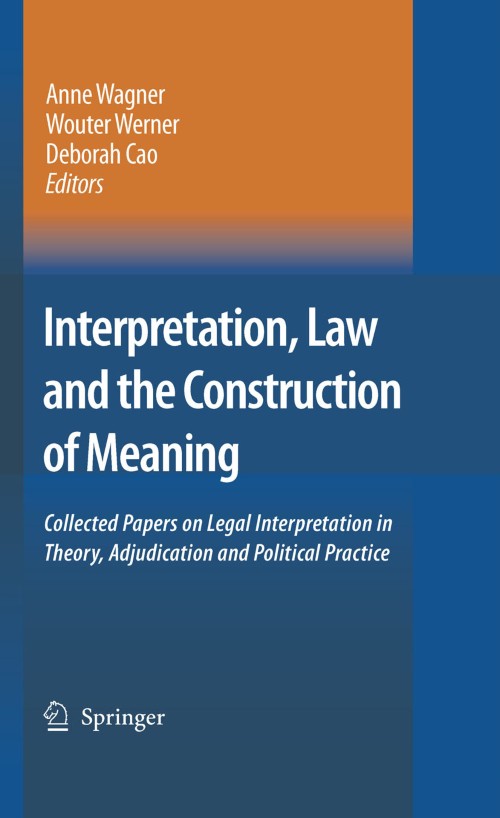
Interpretation, Law and the Construction of Meaning [electronic resource] : Collected Papers on Legal Interpretation in Theory, Adjudication and Political Practice / edited by Anne Wagner, Wouter Werner, Deborah Cao.
Erişim Adresi
ISBN
9781402053207
Dil Kodu
İngilizce
Yer Numarası
DK/12442
Basım Bildirimi
1st ed. 2007.
Yayın Bilgisi
Dordrecht : Springer Netherlands : Imprint: Springer, 2007.
Fiziksel Niteleme
XIV, 219 p. online resource.
İçindekiler Notu
Legal Theory -- Law as Fact, Law as Fiction -- Lexical Indeterminacy -- Topical Jurisprudence -- Legal Speech Acts as Intersubjective Communicative Action -- Judicial Reasoning -- Who needs Fact when you’ve got Narrative? The Case of P,C&S vs. United Kingdom -- Taking Facts Seriously -- Transforming Ambiguity into Vagueness in Legal Interpretation -- Application of Law in Political Practice -- The Inclusive/Exclusive Nation -- Global Values and Floating Borders in the Brazilian Amazon -- Landmarks for Aboriginal Law in Australia.
Özet, vb.
Legal semiotics emphasizes the contingency and fluidity of legal concepts and stresses the existence of overlapping, competing and coexisting legal discourses. In response to new problems, changing power structures, changing societal norms and new faces of injustice established doctrines are reconsidered, reformulated and partly replaced by competing doctrines and hypotheses. Given the relative indeterminacy of law, it is no surprise that the problem of interpretation has always been one of the focal points of attention for legal semiotics. Who has the power to define words and concepts? Who can successfully assume the power to speak on behalf of the legal community? Which methods are used to justify the power to define? This book discusses the questions mentioned above from three, related perspectives: Legal theory (Part I). This part discusses how more traditional approaches have dealt with the problem of legal interpretation and indeterminacy, questions the methods applied in traditional legal theory and offers new theoretical tools to understand the problem of legal interpretation. Judicial reasoning (Part II). The insights discussed in Part I are refined using legal semiotics, speech act theory and rhetorics and applied to the legal reasoning of courts and tribunals either in common law and civil law traditions. Application of law in politics and diplomatic practice (Part III). Traditionally, the study of legal reasoning has focussed on the application of law by courts and tribunals. However, legal reasoning also takes place outside the courtroom and takes up in the political and diplomatic arena. Who is included and excluded by particular conceptions of law? How does law deal with the phenomenon of interculturality? "Combining theoretical inspiration with a keen interest in case law, this volume will appeal to scholars and students of legal theory, jurisprudence, legal anthropology, postcolonial studies, indeed to anyone who’s interested in problems of interpretation in legal and political theory and practice. It should also come in very handy in the classroom." Ronnie Lippens, Professor of Criminology, Keele University.
Konu
Law.
Law __ Philosophy.
Language and languages __ Philosophy.
Fundamentals of Law.
Philosophy of Law.
Philosophy of Language.
Law __ Philosophy.
Language and languages __ Philosophy.
Fundamentals of Law.
Philosophy of Law.
Philosophy of Language.
Diğer Yazarlar
Kurum Adı
Eseri Alıntıla
Referansları kullanmadan önce gözden geçirmeniz ve varsa gerekli düzeltmeleri yapmanız önerilir.
Dijital Kaynak
MARC Görünümü
LEADER 04660nam a22005175i 4500
001 811178
003 TR_AnAIT
005 20260131011941
007 cr nn 008mamaa
008 100301s2007 ne | s |||| 0|eng d
020 |a9781402053207|9978-1-4020-5320-7
024 7 |a10.1007/1-4020-5320-7|2doi
041 |aeng
049 |aTürk Tarih Kurumu Kütüphanesi
050 4|aK201-487
072 7|aLA|2bicssc
072 7|aLAW000000|2bisacsh
072 7|aLA|2thema
082 04|a340.1|223
090 |aDK/12442
245 10|aInterpretation, Law and the Construction of Meaning|h[electronic resource] :|bCollected Papers on Legal Interpretation in Theory, Adjudication and Political Practice /|cedited by Anne Wagner, Wouter Werner, Deborah Cao.
250 |a1st ed. 2007.
264 1|aDordrecht :|bSpringer Netherlands :|bImprint: Springer,|c2007.
300 |aXIV, 219 p.|bonline resource.
336 |atext|btxt|2rdacontent
337 |acomputer|bc|2rdamedia
338 |aonline resource|bcr|2rdacarrier
347 |atext file|bPDF|2rda
505 0 |aLegal Theory -- Law as Fact, Law as Fiction -- Lexical Indeterminacy -- Topical Jurisprudence -- Legal Speech Acts as Intersubjective Communicative Action -- Judicial Reasoning -- Who needs Fact when you’ve got Narrative? The Case of P,C&S vs. United Kingdom -- Taking Facts Seriously -- Transforming Ambiguity into Vagueness in Legal Interpretation -- Application of Law in Political Practice -- The Inclusive/Exclusive Nation -- Global Values and Floating Borders in the Brazilian Amazon -- Landmarks for Aboriginal Law in Australia.
520 |aLegal semiotics emphasizes the contingency and fluidity of legal concepts and stresses the existence of overlapping, competing and coexisting legal discourses. In response to new problems, changing power structures, changing societal norms and new faces of injustice established doctrines are reconsidered, reformulated and partly replaced by competing doctrines and hypotheses. Given the relative indeterminacy of law, it is no surprise that the problem of interpretation has always been one of the focal points of attention for legal semiotics. Who has the power to define words and concepts? Who can successfully assume the power to speak on behalf of the legal community? Which methods are used to justify the power to define? This book discusses the questions mentioned above from three, related perspectives: Legal theory (Part I). This part discusses how more traditional approaches have dealt with the problem of legal interpretation and indeterminacy, questions the methods applied in traditional legal theory and offers new theoretical tools to understand the problem of legal interpretation. Judicial reasoning (Part II). The insights discussed in Part I are refined using legal semiotics, speech act theory and rhetorics and applied to the legal reasoning of courts and tribunals either in common law and civil law traditions. Application of law in politics and diplomatic practice (Part III). Traditionally, the study of legal reasoning has focussed on the application of law by courts and tribunals. However, legal reasoning also takes place outside the courtroom and takes up in the political and diplomatic arena. Who is included and excluded by particular conceptions of law? How does law deal with the phenomenon of interculturality? "Combining theoretical inspiration with a keen interest in case law, this volume will appeal to scholars and students of legal theory, jurisprudence, legal anthropology, postcolonial studies, indeed to anyone who’s interested in problems of interpretation in legal and political theory and practice. It should also come in very handy in the classroom." Ronnie Lippens, Professor of Criminology, Keele University.
650 0|aLaw.
650 0|aLaw|xPhilosophy.
650 0|aLanguage and languages|xPhilosophy.
650 14|aFundamentals of Law.
650 24|aPhilosophy of Law.
650 24|aPhilosophy of Language.
700 1 |aWagner, Anne.|eeditor.|4edt|4http://id.loc.gov/vocabulary/relators/edt
700 1 |aWerner, Wouter.|eeditor.|4edt|4http://id.loc.gov/vocabulary/relators/edt
700 1 |aCao, Deborah.|eeditor.|4edt|4http://id.loc.gov/vocabulary/relators/edt
710 2 |aSpringerLink (Online service)
773 0 |tSpringer Nature eBook
776 08|iPrinted edition:|z9781402053191
776 08|iPrinted edition:|z9789048110704
776 08|iPrinted edition:|z9789048173389
856 40|uhttps://doi.org/10.1007/1-4020-5320-7
912 |aZDB-2-SHU
912 |aZDB-2-SXLC
950 |aHumanities, Social Sciences and Law (SpringerNature-11648)
950 |aLaw and Criminology (R0) (SpringerNature-43727)
001 811178
003 TR_AnAIT
005 20260131011941
007 cr nn 008mamaa
008 100301s2007 ne | s |||| 0|eng d
020 |a9781402053207|9978-1-4020-5320-7
024 7 |a10.1007/1-4020-5320-7|2doi
041 |aeng
049 |aTürk Tarih Kurumu Kütüphanesi
050 4|aK201-487
072 7|aLA|2bicssc
072 7|aLAW000000|2bisacsh
072 7|aLA|2thema
082 04|a340.1|223
090 |aDK/12442
245 10|aInterpretation, Law and the Construction of Meaning|h[electronic resource] :|bCollected Papers on Legal Interpretation in Theory, Adjudication and Political Practice /|cedited by Anne Wagner, Wouter Werner, Deborah Cao.
250 |a1st ed. 2007.
264 1|aDordrecht :|bSpringer Netherlands :|bImprint: Springer,|c2007.
300 |aXIV, 219 p.|bonline resource.
336 |atext|btxt|2rdacontent
337 |acomputer|bc|2rdamedia
338 |aonline resource|bcr|2rdacarrier
347 |atext file|bPDF|2rda
505 0 |aLegal Theory -- Law as Fact, Law as Fiction -- Lexical Indeterminacy -- Topical Jurisprudence -- Legal Speech Acts as Intersubjective Communicative Action -- Judicial Reasoning -- Who needs Fact when you’ve got Narrative? The Case of P,C&S vs. United Kingdom -- Taking Facts Seriously -- Transforming Ambiguity into Vagueness in Legal Interpretation -- Application of Law in Political Practice -- The Inclusive/Exclusive Nation -- Global Values and Floating Borders in the Brazilian Amazon -- Landmarks for Aboriginal Law in Australia.
520 |aLegal semiotics emphasizes the contingency and fluidity of legal concepts and stresses the existence of overlapping, competing and coexisting legal discourses. In response to new problems, changing power structures, changing societal norms and new faces of injustice established doctrines are reconsidered, reformulated and partly replaced by competing doctrines and hypotheses. Given the relative indeterminacy of law, it is no surprise that the problem of interpretation has always been one of the focal points of attention for legal semiotics. Who has the power to define words and concepts? Who can successfully assume the power to speak on behalf of the legal community? Which methods are used to justify the power to define? This book discusses the questions mentioned above from three, related perspectives: Legal theory (Part I). This part discusses how more traditional approaches have dealt with the problem of legal interpretation and indeterminacy, questions the methods applied in traditional legal theory and offers new theoretical tools to understand the problem of legal interpretation. Judicial reasoning (Part II). The insights discussed in Part I are refined using legal semiotics, speech act theory and rhetorics and applied to the legal reasoning of courts and tribunals either in common law and civil law traditions. Application of law in politics and diplomatic practice (Part III). Traditionally, the study of legal reasoning has focussed on the application of law by courts and tribunals. However, legal reasoning also takes place outside the courtroom and takes up in the political and diplomatic arena. Who is included and excluded by particular conceptions of law? How does law deal with the phenomenon of interculturality? "Combining theoretical inspiration with a keen interest in case law, this volume will appeal to scholars and students of legal theory, jurisprudence, legal anthropology, postcolonial studies, indeed to anyone who’s interested in problems of interpretation in legal and political theory and practice. It should also come in very handy in the classroom." Ronnie Lippens, Professor of Criminology, Keele University.
650 0|aLaw.
650 0|aLaw|xPhilosophy.
650 0|aLanguage and languages|xPhilosophy.
650 14|aFundamentals of Law.
650 24|aPhilosophy of Law.
650 24|aPhilosophy of Language.
700 1 |aWagner, Anne.|eeditor.|4edt|4http://id.loc.gov/vocabulary/relators/edt
700 1 |aWerner, Wouter.|eeditor.|4edt|4http://id.loc.gov/vocabulary/relators/edt
700 1 |aCao, Deborah.|eeditor.|4edt|4http://id.loc.gov/vocabulary/relators/edt
710 2 |aSpringerLink (Online service)
773 0 |tSpringer Nature eBook
776 08|iPrinted edition:|z9781402053191
776 08|iPrinted edition:|z9789048110704
776 08|iPrinted edition:|z9789048173389
856 40|uhttps://doi.org/10.1007/1-4020-5320-7
912 |aZDB-2-SHU
912 |aZDB-2-SXLC
950 |aHumanities, Social Sciences and Law (SpringerNature-11648)
950 |aLaw and Criminology (R0) (SpringerNature-43727)
Materyaller
Depodan talep edilen materyal sadece kütüphane içerisinde kullanılmaktadır.
Materyal dışarıya ödünç verilmemektedir.
Materyal dışarıya ödünç verilmemektedir.
