

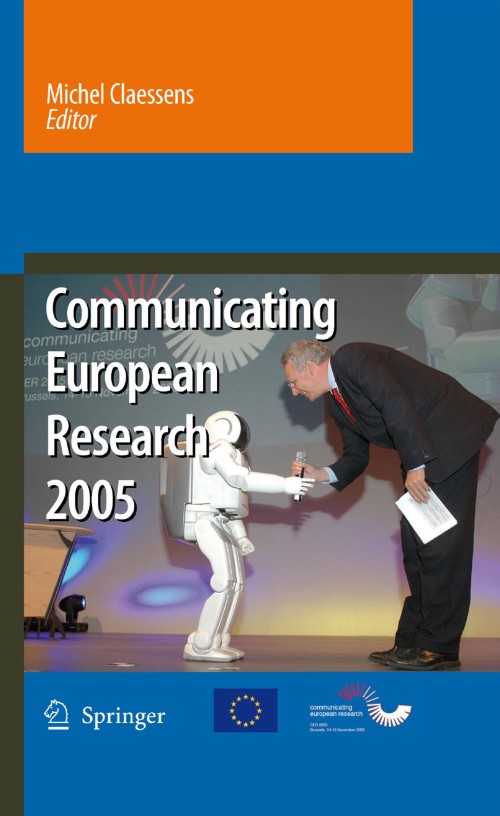
Communicating European Research 2005 [electronic resource] : Proceedings of the Conference, Brussels, 14-15 November 2005 / edited by Michel Claessens.
Erişim Adresi
ISBN
9781402053580
Dil Kodu
İngilizce
Yer Numarası
DK/12446
Basım Bildirimi
1st ed. 2007.
Yayın Bilgisi
Dordrecht : Springer Netherlands : Imprint: Springer, 2007.
Fiziksel Niteleme
XXIV, 248 p. online resource.
İçindekiler Notu
Why Communicating European Research? -- Thinking Science, Talking Science -- Let’s Make Science The Next Headline -- Information and Communication Technology Research and its Impact on Growth and Job Creation -- The Evolving Context For Science And Society -- Science Communication On Demand -- Bringing Scientists to the People -- “Science Meets Parliament” -- The Science-Media Interface: Interactions of Scientists and Journalists -- Science News on the Net -- The Changing Paradigm of Science Communication: Challenges for Researchers -- Training Scientists in Communication Skills -- Communication of Science, Communication in Science -- Advancing European Protocols for Science Communication -- Science Goes Local: Local Media Matters -- Debate, Communicate, Educate -- Media Skills Workshops: Breaking Down the Barriers Between Scientists and Journalists -- Training for Dialogue and Debate -- Training Science Communication in a Swift Moving Society -- Science Days – contact with science -- The Challenge Of Showing And Discussing The Unknown -- Science & the city -- The Genova Science Festival -- Science Class 2012 -- Scientific Literacy -- Perceptions and Images of Science and Science Education -- Representing Science Through Multiple-Channel Digital Television -- How to Get Science in the News -- Heard it on the Radio! -- Communicating Research in Developing Countries -- Getting R&D Results into the Press -- Towards More Responsibility in Communicating Science -- European Media: Two Cultures of Science Communication -- How to reach the business media? -- The Same Old Future -- Europe in Space - Taking off Without the Public? -- Population Exposure to Air Pollutants in Europe (People) -- Communicating Eu Food and Health Research -- Communicating Environmental Research -- Talking Nano – What MakesNanotechnology Special -- Communicate Internationally - With Partners from the New Independent States (NIS) -- How to Communicate an Interdisciplinary Project? -- When Diversity Means Richness.
Özet, vb.
The book contains a series of 40 articles written by forward-thinking speakers who presented their findings at the "Communicating European Research 2005" event which was organised by the European Commission in Brussels on 14-15 November 2005. This event was attended by well over 2,100 participants. The contents of this book clearly illustrate that a highly important element of research projects funded by the European Union is communication. Authors include scientists, journalists and communication professionals. The book covers the main aspects of science and technology communication today and addresses topical questions such as: Is science journalism necessary at all? Should communication become one of the basic skills of scientists, as compulsory as thinking, testing and experimenting? Should our schools of the future put scientific literacy at the top of the science curriculum? Do we need science critics? Does the coverage of science in the media reflect the choice of the editors or does it accurately mirror the public’s interest? How does one capture the public’s attention when promoting science on local, commercial or entertainment radio? Why would we need standards in science communication? How can we remove any obstacles to communication among researchers and between researchers? The book casts light on these issues and many others. It offers a selection of good practices and professional services to scientists and science communicators, and should help them design and carry out their communication activities with a European and international dimension.
Konu
Social sciences.
Science __ Study and teaching.
Business.
Management science.
Engineering.
Life sciences.
Humanities.
Society.
Science Education.
Business and Management.
Technology and Engineering.
Life Sciences.
Humanities and Social Sciences.
Science __ Study and teaching.
Business.
Management science.
Engineering.
Life sciences.
Humanities.
Society.
Science Education.
Business and Management.
Technology and Engineering.
Life Sciences.
Humanities and Social Sciences.
Diğer Yazarlar
Kurum Adı
Eseri Alıntıla
Referansları kullanmadan önce gözden geçirmeniz ve varsa gerekli düzeltmeleri yapmanız önerilir.
Dijital Kaynak
MARC Görünümü
LEADER 05738nam a22006255i 4500
001 811182
003 TR_AnAIT
005 20260131011934
007 cr nn 008mamaa
008 100301s2007 ne | s |||| 0|eng d
020 |a9781402053580|9978-1-4020-5358-0
024 7 |a10.1007/1-4020-5358-4|2doi
041 |aeng
049 |aTürk Tarih Kurumu Kütüphanesi
050 4|aH1-970.9
072 7|aJ|2bicssc
072 7|aJHB|2bicssc
072 7|aSOC000000|2bisacsh
072 7|aJ|2thema
072 7|aJHB|2thema
082 04|a300|223
090 |aDK/12446
245 10|aCommunicating European Research 2005|h[electronic resource] :|bProceedings of the Conference, Brussels, 14-15 November 2005 /|cedited by Michel Claessens.
250 |a1st ed. 2007.
264 1|aDordrecht :|bSpringer Netherlands :|bImprint: Springer,|c2007.
300 |aXXIV, 248 p.|bonline resource.
336 |atext|btxt|2rdacontent
337 |acomputer|bc|2rdamedia
338 |aonline resource|bcr|2rdacarrier
347 |atext file|bPDF|2rda
505 0 |aWhy Communicating European Research? -- Thinking Science, Talking Science -- Let’s Make Science The Next Headline -- Information and Communication Technology Research and its Impact on Growth and Job Creation -- The Evolving Context For Science And Society -- Science Communication On Demand -- Bringing Scientists to the People -- “Science Meets Parliament” -- The Science-Media Interface: Interactions of Scientists and Journalists -- Science News on the Net -- The Changing Paradigm of Science Communication: Challenges for Researchers -- Training Scientists in Communication Skills -- Communication of Science, Communication in Science -- Advancing European Protocols for Science Communication -- Science Goes Local: Local Media Matters -- Debate, Communicate, Educate -- Media Skills Workshops: Breaking Down the Barriers Between Scientists and Journalists -- Training for Dialogue and Debate -- Training Science Communication in a Swift Moving Society -- Science Days – contact with science -- The Challenge Of Showing And Discussing The Unknown -- Science & the city -- The Genova Science Festival -- Science Class 2012 -- Scientific Literacy -- Perceptions and Images of Science and Science Education -- Representing Science Through Multiple-Channel Digital Television -- How to Get Science in the News -- Heard it on the Radio! -- Communicating Research in Developing Countries -- Getting R&D Results into the Press -- Towards More Responsibility in Communicating Science -- European Media: Two Cultures of Science Communication -- How to reach the business media? -- The Same Old Future -- Europe in Space - Taking off Without the Public? -- Population Exposure to Air Pollutants in Europe (People) -- Communicating Eu Food and Health Research -- Communicating Environmental Research -- Talking Nano – What MakesNanotechnology Special -- Communicate Internationally - With Partners from the New Independent States (NIS) -- How to Communicate an Interdisciplinary Project? -- When Diversity Means Richness.
520 |aThe book contains a series of 40 articles written by forward-thinking speakers who presented their findings at the "Communicating European Research 2005" event which was organised by the European Commission in Brussels on 14-15 November 2005. This event was attended by well over 2,100 participants. The contents of this book clearly illustrate that a highly important element of research projects funded by the European Union is communication. Authors include scientists, journalists and communication professionals. The book covers the main aspects of science and technology communication today and addresses topical questions such as: Is science journalism necessary at all? Should communication become one of the basic skills of scientists, as compulsory as thinking, testing and experimenting? Should our schools of the future put scientific literacy at the top of the science curriculum? Do we need science critics? Does the coverage of science in the media reflect the choice of the editors or does it accurately mirror the public’s interest? How does one capture the public’s attention when promoting science on local, commercial or entertainment radio? Why would we need standards in science communication? How can we remove any obstacles to communication among researchers and between researchers? The book casts light on these issues and many others. It offers a selection of good practices and professional services to scientists and science communicators, and should help them design and carry out their communication activities with a European and international dimension.
650 0|aSocial sciences.
650 0|aScience|xStudy and teaching.
650 0|aBusiness.
650 0|aManagement science.
650 0|aEngineering.
650 0|aLife sciences.
650 0|aHumanities.
650 14|aSociety.
650 24|aScience Education.
650 24|aBusiness and Management.
650 24|aTechnology and Engineering.
650 24|aLife Sciences.
650 24|aHumanities and Social Sciences.
700 1 |aClaessens, Michel.|eeditor.|4edt|4http://id.loc.gov/vocabulary/relators/edt
710 2 |aSpringerLink (Online service)
773 0 |tSpringer Nature eBook
776 08|iPrinted edition:|z9781402053573
776 08|iPrinted edition:|z9789048110889
776 08|iPrinted edition:|z9789401776677
856 40|uhttps://doi.org/10.1007/1-4020-5358-4
912 |aZDB-2-SHU
912 |aZDB-2-SXS
912 |aZDB-2-SXPE
950 |aHumanities, Social Sciences and Law (SpringerNature-11648)
950 |aSocial Sciences (R0) (SpringerNature-43726)
950 |aSpringer Nature Proceedings excluding Computer Science (SpringerNature-85345)
001 811182
003 TR_AnAIT
005 20260131011934
007 cr nn 008mamaa
008 100301s2007 ne | s |||| 0|eng d
020 |a9781402053580|9978-1-4020-5358-0
024 7 |a10.1007/1-4020-5358-4|2doi
041 |aeng
049 |aTürk Tarih Kurumu Kütüphanesi
050 4|aH1-970.9
072 7|aJ|2bicssc
072 7|aJHB|2bicssc
072 7|aSOC000000|2bisacsh
072 7|aJ|2thema
072 7|aJHB|2thema
082 04|a300|223
090 |aDK/12446
245 10|aCommunicating European Research 2005|h[electronic resource] :|bProceedings of the Conference, Brussels, 14-15 November 2005 /|cedited by Michel Claessens.
250 |a1st ed. 2007.
264 1|aDordrecht :|bSpringer Netherlands :|bImprint: Springer,|c2007.
300 |aXXIV, 248 p.|bonline resource.
336 |atext|btxt|2rdacontent
337 |acomputer|bc|2rdamedia
338 |aonline resource|bcr|2rdacarrier
347 |atext file|bPDF|2rda
505 0 |aWhy Communicating European Research? -- Thinking Science, Talking Science -- Let’s Make Science The Next Headline -- Information and Communication Technology Research and its Impact on Growth and Job Creation -- The Evolving Context For Science And Society -- Science Communication On Demand -- Bringing Scientists to the People -- “Science Meets Parliament” -- The Science-Media Interface: Interactions of Scientists and Journalists -- Science News on the Net -- The Changing Paradigm of Science Communication: Challenges for Researchers -- Training Scientists in Communication Skills -- Communication of Science, Communication in Science -- Advancing European Protocols for Science Communication -- Science Goes Local: Local Media Matters -- Debate, Communicate, Educate -- Media Skills Workshops: Breaking Down the Barriers Between Scientists and Journalists -- Training for Dialogue and Debate -- Training Science Communication in a Swift Moving Society -- Science Days – contact with science -- The Challenge Of Showing And Discussing The Unknown -- Science & the city -- The Genova Science Festival -- Science Class 2012 -- Scientific Literacy -- Perceptions and Images of Science and Science Education -- Representing Science Through Multiple-Channel Digital Television -- How to Get Science in the News -- Heard it on the Radio! -- Communicating Research in Developing Countries -- Getting R&D Results into the Press -- Towards More Responsibility in Communicating Science -- European Media: Two Cultures of Science Communication -- How to reach the business media? -- The Same Old Future -- Europe in Space - Taking off Without the Public? -- Population Exposure to Air Pollutants in Europe (People) -- Communicating Eu Food and Health Research -- Communicating Environmental Research -- Talking Nano – What MakesNanotechnology Special -- Communicate Internationally - With Partners from the New Independent States (NIS) -- How to Communicate an Interdisciplinary Project? -- When Diversity Means Richness.
520 |aThe book contains a series of 40 articles written by forward-thinking speakers who presented their findings at the "Communicating European Research 2005" event which was organised by the European Commission in Brussels on 14-15 November 2005. This event was attended by well over 2,100 participants. The contents of this book clearly illustrate that a highly important element of research projects funded by the European Union is communication. Authors include scientists, journalists and communication professionals. The book covers the main aspects of science and technology communication today and addresses topical questions such as: Is science journalism necessary at all? Should communication become one of the basic skills of scientists, as compulsory as thinking, testing and experimenting? Should our schools of the future put scientific literacy at the top of the science curriculum? Do we need science critics? Does the coverage of science in the media reflect the choice of the editors or does it accurately mirror the public’s interest? How does one capture the public’s attention when promoting science on local, commercial or entertainment radio? Why would we need standards in science communication? How can we remove any obstacles to communication among researchers and between researchers? The book casts light on these issues and many others. It offers a selection of good practices and professional services to scientists and science communicators, and should help them design and carry out their communication activities with a European and international dimension.
650 0|aSocial sciences.
650 0|aScience|xStudy and teaching.
650 0|aBusiness.
650 0|aManagement science.
650 0|aEngineering.
650 0|aLife sciences.
650 0|aHumanities.
650 14|aSociety.
650 24|aScience Education.
650 24|aBusiness and Management.
650 24|aTechnology and Engineering.
650 24|aLife Sciences.
650 24|aHumanities and Social Sciences.
700 1 |aClaessens, Michel.|eeditor.|4edt|4http://id.loc.gov/vocabulary/relators/edt
710 2 |aSpringerLink (Online service)
773 0 |tSpringer Nature eBook
776 08|iPrinted edition:|z9781402053573
776 08|iPrinted edition:|z9789048110889
776 08|iPrinted edition:|z9789401776677
856 40|uhttps://doi.org/10.1007/1-4020-5358-4
912 |aZDB-2-SHU
912 |aZDB-2-SXS
912 |aZDB-2-SXPE
950 |aHumanities, Social Sciences and Law (SpringerNature-11648)
950 |aSocial Sciences (R0) (SpringerNature-43726)
950 |aSpringer Nature Proceedings excluding Computer Science (SpringerNature-85345)
Materyaller
Depodan talep edilen materyal sadece kütüphane içerisinde kullanılmaktadır.
Materyal dışarıya ödünç verilmemektedir.
Materyal dışarıya ödünç verilmemektedir.
