

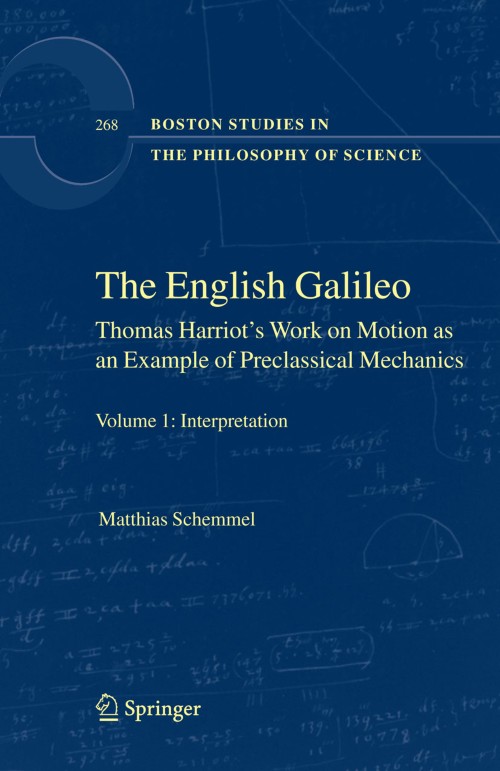
The English Galileo [electronic resource] : Thomas Harriot's Work on Motion as an Example of Preclassical Mechanics / by Matthias Schemmel.
Erişim Adresi
ISBN
9781402054990
Dil Kodu
İngilizce
Yer Numarası
DK/12451
Yazar
Basım Bildirimi
1st ed. 2008.
Yayın Bilgisi
Dordrecht : Springer Netherlands : Imprint: Springer, 2008.
Fiziksel Niteleme
XXXII, 766 p. online resource.
Dizi
Boston Studies in the Philosophy and History of Science, 2214-7942 ; 268
İçindekiler Notu
Harriot’s Work on Motion in Context -- Thomas Harriot: Practical Mathematician and Pioneer of Modern Science -- Harriot and the Challenge of Projectile Motion -- An Introduction to Harriot’s Manuscripts on Motion -- Major Strands of Harriot’s Work on Motion -- Mathematical Analysis of the Motion of Fall -- Free Fall Experiments and Their Evaluation: The “Weight” of Falling Bodies -- Free Fall Experiments and Their Evaluation: Motion in a Medium -- Graphical Construction of Projectile Trajectories -- Exploration of the Inclined-Plane Conception of Projectile Motion -- Conclusion -- Shared Knowledge and Alternative Solutions in Harriot’s and Galileo’s Work on Motion -- Facsimile and Transcription -- Notes and Conventions -- Thomas Harriot’s Notes on Projectile Motion and the Fall of Bodies.
Özet, vb.
The short series The Historical Epistemology of Mechanics presents the long-term development of mechanical knowledge. The books in this series combine the presentation of a broad selection of relevant sources with in-depth analyses of the long-term development of mechanical knowledge focusing on the early modern period. This series is conceived in analogy to the four-volume series on The Genesis of General Relativity (BSPS 250). The English Galileo, the first book in this series, investigates the shared knowledge of preclassical mechanics by relating the work of Thomas Harriot on motion, documented by a wealth of manuscripts, to that of Galileo and other contemporaries. Harriot and Galileo indeed exploited the same shared knowledge resources in order to approach the same challenging objects. While the paths Harriot traces through the shared knowledge are different from Galileo’s, the work of the two scientists displays striking similarities as regards their achievements as well as the problems they were unable to solve. The study of Harriot’s parallel work thus allows the exploration of the structure of the shared knowledge of early modern mechanics, to perceive possible alternative histories, and to distinguish between individual peculiarities and shared structures of early modern mechanical reasoning. This study has received two distinguished awards, the Junior Scholar Award of the Georg Agricola Society and the Georg Uschmann Award of the German National Academy of Sciences, Leopoldina.
Konu
Science __ Philosophy.
Science __ History.
Philosophy of Science.
History of Science.
Science __ History.
Philosophy of Science.
History of Science.
Kurum Adı
Eseri Alıntıla
Referansları kullanmadan önce gözden geçirmeniz ve varsa gerekli düzeltmeleri yapmanız önerilir.
Dijital Kaynak
MARC Görünümü
LEADER 04189nam a22005055i 4500
001 811187
003 TR_AnAIT
005 20260131011923
007 cr nn 008mamaa
008 100301s2008 ne | s |||| 0|eng d
020 |a9781402054990|9978-1-4020-5499-0
024 7 |a10.1007/978-1-4020-5499-0|2doi
041 |aeng
049 |aTürk Tarih Kurumu Kütüphanesi
050 4|aQ174-175.3
050 4|aB67
072 7|aPDA|2bicssc
072 7|aSCI075000|2bisacsh
072 7|aPDA|2thema
082 04|a501|223
090 |aDK/12451
100 1 |aSchemmel, Matthias.|eauthor.|4aut|4http://id.loc.gov/vocabulary/relators/aut
245 14|aThe English Galileo|h[electronic resource] :|bThomas Harriot's Work on Motion as an Example of Preclassical Mechanics /|cby Matthias Schemmel.
250 |a1st ed. 2008.
264 1|aDordrecht :|bSpringer Netherlands :|bImprint: Springer,|c2008.
300 |aXXXII, 766 p.|bonline resource.
336 |atext|btxt|2rdacontent
337 |acomputer|bc|2rdamedia
338 |aonline resource|bcr|2rdacarrier
347 |atext file|bPDF|2rda
490 1 |aBoston Studies in the Philosophy and History of Science,|x2214-7942 ;|v268
505 0 |aHarriot’s Work on Motion in Context -- Thomas Harriot: Practical Mathematician and Pioneer of Modern Science -- Harriot and the Challenge of Projectile Motion -- An Introduction to Harriot’s Manuscripts on Motion -- Major Strands of Harriot’s Work on Motion -- Mathematical Analysis of the Motion of Fall -- Free Fall Experiments and Their Evaluation: The “Weight” of Falling Bodies -- Free Fall Experiments and Their Evaluation: Motion in a Medium -- Graphical Construction of Projectile Trajectories -- Exploration of the Inclined-Plane Conception of Projectile Motion -- Conclusion -- Shared Knowledge and Alternative Solutions in Harriot’s and Galileo’s Work on Motion -- Facsimile and Transcription -- Notes and Conventions -- Thomas Harriot’s Notes on Projectile Motion and the Fall of Bodies.
520 |aThe short series The Historical Epistemology of Mechanics presents the long-term development of mechanical knowledge. The books in this series combine the presentation of a broad selection of relevant sources with in-depth analyses of the long-term development of mechanical knowledge focusing on the early modern period. This series is conceived in analogy to the four-volume series on The Genesis of General Relativity (BSPS 250). The English Galileo, the first book in this series, investigates the shared knowledge of preclassical mechanics by relating the work of Thomas Harriot on motion, documented by a wealth of manuscripts, to that of Galileo and other contemporaries. Harriot and Galileo indeed exploited the same shared knowledge resources in order to approach the same challenging objects. While the paths Harriot traces through the shared knowledge are different from Galileo’s, the work of the two scientists displays striking similarities as regards their achievements as well as the problems they were unable to solve. The study of Harriot’s parallel work thus allows the exploration of the structure of the shared knowledge of early modern mechanics, to perceive possible alternative histories, and to distinguish between individual peculiarities and shared structures of early modern mechanical reasoning. This study has received two distinguished awards, the Junior Scholar Award of the Georg Agricola Society and the Georg Uschmann Award of the German National Academy of Sciences, Leopoldina.
650 0|aScience|xPhilosophy.
650 0|aScience|xHistory.
650 14|aPhilosophy of Science.
650 24|aHistory of Science.
710 2 |aSpringerLink (Online service)
773 0 |tSpringer Nature eBook
776 08|iPrinted edition:|z9781402054983
776 08|iPrinted edition:|z9781402093425
776 08|iPrinted edition:|z9789400787063
830 0|aBoston Studies in the Philosophy and History of Science,|x2214-7942 ;|v268
856 40|uhttps://doi.org/10.1007/978-1-4020-5499-0
912 |aZDB-2-SHU
912 |aZDB-2-SXPR
950 |aHumanities, Social Sciences and Law (SpringerNature-11648)
950 |aPhilosophy and Religion (R0) (SpringerNature-43725)
001 811187
003 TR_AnAIT
005 20260131011923
007 cr nn 008mamaa
008 100301s2008 ne | s |||| 0|eng d
020 |a9781402054990|9978-1-4020-5499-0
024 7 |a10.1007/978-1-4020-5499-0|2doi
041 |aeng
049 |aTürk Tarih Kurumu Kütüphanesi
050 4|aQ174-175.3
050 4|aB67
072 7|aPDA|2bicssc
072 7|aSCI075000|2bisacsh
072 7|aPDA|2thema
082 04|a501|223
090 |aDK/12451
100 1 |aSchemmel, Matthias.|eauthor.|4aut|4http://id.loc.gov/vocabulary/relators/aut
245 14|aThe English Galileo|h[electronic resource] :|bThomas Harriot's Work on Motion as an Example of Preclassical Mechanics /|cby Matthias Schemmel.
250 |a1st ed. 2008.
264 1|aDordrecht :|bSpringer Netherlands :|bImprint: Springer,|c2008.
300 |aXXXII, 766 p.|bonline resource.
336 |atext|btxt|2rdacontent
337 |acomputer|bc|2rdamedia
338 |aonline resource|bcr|2rdacarrier
347 |atext file|bPDF|2rda
490 1 |aBoston Studies in the Philosophy and History of Science,|x2214-7942 ;|v268
505 0 |aHarriot’s Work on Motion in Context -- Thomas Harriot: Practical Mathematician and Pioneer of Modern Science -- Harriot and the Challenge of Projectile Motion -- An Introduction to Harriot’s Manuscripts on Motion -- Major Strands of Harriot’s Work on Motion -- Mathematical Analysis of the Motion of Fall -- Free Fall Experiments and Their Evaluation: The “Weight” of Falling Bodies -- Free Fall Experiments and Their Evaluation: Motion in a Medium -- Graphical Construction of Projectile Trajectories -- Exploration of the Inclined-Plane Conception of Projectile Motion -- Conclusion -- Shared Knowledge and Alternative Solutions in Harriot’s and Galileo’s Work on Motion -- Facsimile and Transcription -- Notes and Conventions -- Thomas Harriot’s Notes on Projectile Motion and the Fall of Bodies.
520 |aThe short series The Historical Epistemology of Mechanics presents the long-term development of mechanical knowledge. The books in this series combine the presentation of a broad selection of relevant sources with in-depth analyses of the long-term development of mechanical knowledge focusing on the early modern period. This series is conceived in analogy to the four-volume series on The Genesis of General Relativity (BSPS 250). The English Galileo, the first book in this series, investigates the shared knowledge of preclassical mechanics by relating the work of Thomas Harriot on motion, documented by a wealth of manuscripts, to that of Galileo and other contemporaries. Harriot and Galileo indeed exploited the same shared knowledge resources in order to approach the same challenging objects. While the paths Harriot traces through the shared knowledge are different from Galileo’s, the work of the two scientists displays striking similarities as regards their achievements as well as the problems they were unable to solve. The study of Harriot’s parallel work thus allows the exploration of the structure of the shared knowledge of early modern mechanics, to perceive possible alternative histories, and to distinguish between individual peculiarities and shared structures of early modern mechanical reasoning. This study has received two distinguished awards, the Junior Scholar Award of the Georg Agricola Society and the Georg Uschmann Award of the German National Academy of Sciences, Leopoldina.
650 0|aScience|xPhilosophy.
650 0|aScience|xHistory.
650 14|aPhilosophy of Science.
650 24|aHistory of Science.
710 2 |aSpringerLink (Online service)
773 0 |tSpringer Nature eBook
776 08|iPrinted edition:|z9781402054983
776 08|iPrinted edition:|z9781402093425
776 08|iPrinted edition:|z9789400787063
830 0|aBoston Studies in the Philosophy and History of Science,|x2214-7942 ;|v268
856 40|uhttps://doi.org/10.1007/978-1-4020-5499-0
912 |aZDB-2-SHU
912 |aZDB-2-SXPR
950 |aHumanities, Social Sciences and Law (SpringerNature-11648)
950 |aPhilosophy and Religion (R0) (SpringerNature-43725)
Materyaller
Depodan talep edilen materyal sadece kütüphane içerisinde kullanılmaktadır.
Materyal dışarıya ödünç verilmemektedir.
Materyal dışarıya ödünç verilmemektedir.
