

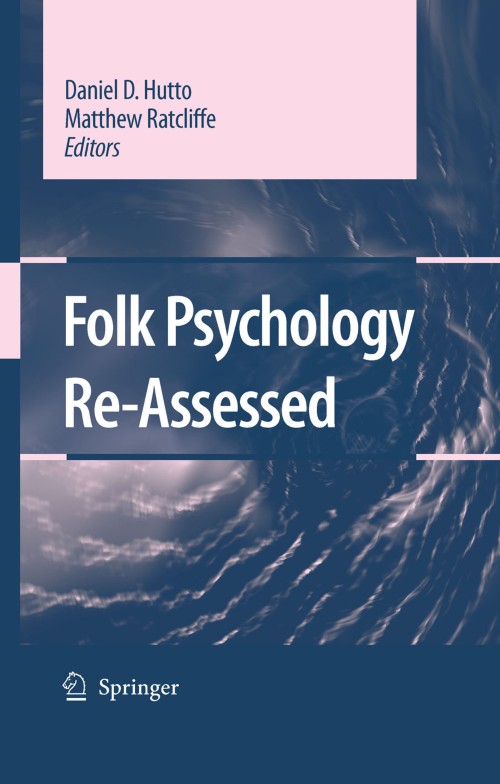
Folk Psychology Re-Assessed [electronic resource] / edited by D. Hutto, Matthew M. Ratcliffe.
Erişim Adresi
ISBN
9781402055584
Dil Kodu
İngilizce
Yer Numarası
DK/12455
Basım Bildirimi
1st ed. 2007.
Yayın Bilgisi
Dordrecht : Springer Netherlands : Imprint: Springer, 2007.
Fiziksel Niteleme
VIII, 254 p. online resource.
İçindekiler Notu
Emotion, Perception, and Interaction -- Expression and Empathy -- We Share, Therefore We Think -- Logical and Phenomenological Arguments Against Simulation Theory -- Persons, Pronouns, and Perspectives -- Reasons, Norms, Narratives and Institutions -- There are Reasons and Reasons -- Folk Psychology Without Theory or Simulation -- The Regulative Dimension of Folk Psychology -- Folk Psychology: Science and Morals -- Folk Psychology and Freedom of the Will -- The Fragmentation of Folk Psychology -- Critter Psychology: On the Possibility of Nonhuman Animal Folk Psychology -- Folk Psychology Does not Exist -- From Folk Psychology to Commonsense.
Özet, vb.
1.1. FOLK PSYCHOLOGY, THEORY OF MIND AND SIMULATION The tasks we face in our day to day social lives are quite heterogeneous but many of them make a common demand upon us. They require us to understand and interact with other people and, in most social encounters, we exhibit a special sensitivity to our fellow human beings that is quite different from the way we respond to inanimate objects and most other species of organism. Social life is dependent, to a considerable degree, on our ability to understand what is distinctive about human behaviour and to successfully apply that understanding in all manner of situations. What is central to our ability to interpret one another? A great deal of work in philosophy of mind, cognitive science, anthropology, developmental psychology and a host of other disciplines assumes that, at root, interpersonal interpretation is accomplished through the employment of a ‘commonsense’ or ‘folk’ psychology, meaning an ‘everyday’, rather than ‘scientific’, appreciation of mindedness. Although there is considerable debate over which cognitive processes support our folk psychological abilities and how those abilities develop during childhood, there is a remarkable degree of consensus concerning what folk psychology consists of. Almost all discussions of the topic begin by stating or presupposing that it is the ability to attribute intentional states, principally beliefs and desires, to other people and perhaps also to oneself, in order to predict and explain behaviour.
Konu
Philosophy of mind.
Developmental psychology.
Phenomenology .
Personality.
Difference (Psychology).
Philosophy of Mind.
Developmental Psychology.
Phenomenology.
Personality and Differential Psychology.
Developmental psychology.
Phenomenology .
Personality.
Difference (Psychology).
Philosophy of Mind.
Developmental Psychology.
Phenomenology.
Personality and Differential Psychology.
Diğer Yazarlar
Kurum Adı
