

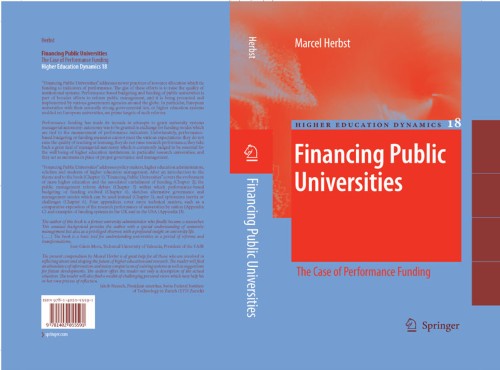
Financing Public Universities [electronic resource] : The Case of Performance Funding / by Marcel Herbst.
Erişim Adresi
ISBN
9781402055607
Dil Kodu
İngilizce
Yer Numarası
DK/12456
Yazar
Basım Bildirimi
1st ed. 2007.
Yayın Bilgisi
Dordrecht : Springer Netherlands : Imprint: Springer, 2007.
Fiziksel Niteleme
XVIII, 236 p. online resource.
Dizi
Higher Education Dynamics, 2215-1923 ; 18
İçindekiler Notu
Executive Summary -- Foreword -- 1. Introduction -- 2 Mass Higher Education and Funding Bases -- 3 Public Management Reform Debate -- 4 Performance-based Budgeting or Funding -- 5 Alternative Governance and Management Modes -- 6 Inertia and Challenges -- Appendix A: Background Information -- Appendix B: Technical Notes -- Appendix C: The Atlantic Split -- Appendix D: Examples of Funding Systems -- References -- Index.
Özet, vb.
"Financing Public Universities" addresses newer practices of resource allocation which tie funding to indicators of performance. The gist of these efforts is to raise the quality of institutional systems. Performance-based budgeting and funding of public universities is part of broader efforts to reform public management, and it is being promoted and implemented by various government agencies around the globe. In particular, European universities with their normally strong governmental ties, or higher education systems molded on European universities, are prime targets of such reforms. Performance funding has made its inroads in attempts to grant university systems managerial autonomy: autonomy was to be granted in exchange for funding modes which are tied to the measurement of performance indicators. Unfortunately, performance-based budgeting or funding measures cannot meet the various expectations: they do not raise the quality of teaching or learning; they do not raise research performance; they take back a great deal of managerial autonomy which is commonly judged to be essential for the well being of higher education institutions, in particular research universities; and they act as automata in place of proper governance and management. "Financing Public Universities" addresses policy makers, higher education administrators, scholars and students of higher education management. After an introduction to the theme and to the book (Chapter 1), "Financing Public Universities" covers the evolvement of mass higher education and the associated curtailment of funding (Chapter 2), the public management reform debate (Chapter 3) within which performance-based budgeting or funding evolved (Chapter 4), sketches alternative governance and management modes which can be used instead (Chapter 5), and epitomizes inertia or challenges (Chapter 6). Four appendices cover more technical matters, such as a comparative exposition of the research performance of universities by nation (Appendix C) and examples of funding systems in the UK and in the USA (Appendix D). The author of this book is a former university administrator who finally became a researcher. This unusual background provides the author with a special understanding of university management but also, as a privileged observer, with a profound insight on university life. (.......) This book is a basic tool for understanding universities in a period of reforms and transformations. Jose-Gines Mora, Technical University of Valencia, President of the EAIR The present compendium by Marcel Herbst is of great help for all those who are involved in reflecting about and shaping the future of higher education and research. The reader will find an abundance of information and many comparisons of existing systems as well as suggestions for future developments. The author offers the reader not only a description of the actual situation. The reader will also find a wealth of challenging personal views which may help his of her own process of reflection. Jakob Nuesch, President emeritus, Swiss Federal Institute of Technology in Zurich (ETH Zurich).
Konu
Education, Higher.
Finance, Public.
School management and organization.
School administration.
Political science.
Social policy.
Higher Education.
Public Economics.
Organization and Leadership.
Political Science.
Social Policy.
Finance, Public.
School management and organization.
School administration.
Political science.
Social policy.
Higher Education.
Public Economics.
Organization and Leadership.
Political Science.
Social Policy.
Kurum Adı
Eseri Alıntıla
Referansları kullanmadan önce gözden geçirmeniz ve varsa gerekli düzeltmeleri yapmanız önerilir.
Dijital Kaynak
MARC Görünümü
LEADER 05537nam a22005775i 4500
001 811192
003 TR_AnAIT
005 20260131011916
007 cr nn 008mamaa
008 100301s2007 ne | s |||| 0|eng d
020 |a9781402055607|9978-1-4020-5560-7
024 7 |a10.1007/978-1-4020-5560-7|2doi
041 |aeng
049 |aTürk Tarih Kurumu Kütüphanesi
050 4|aLB2300-2799.3
072 7|aJNM|2bicssc
072 7|aEDU015000|2bisacsh
072 7|aJNM|2thema
082 04|a378|223
090 |aDK/12456
100 1 |aHerbst, Marcel.|eauthor.|4aut|4http://id.loc.gov/vocabulary/relators/aut
245 10|aFinancing Public Universities|h[electronic resource] :|bThe Case of Performance Funding /|cby Marcel Herbst.
250 |a1st ed. 2007.
264 1|aDordrecht :|bSpringer Netherlands :|bImprint: Springer,|c2007.
300 |aXVIII, 236 p.|bonline resource.
336 |atext|btxt|2rdacontent
337 |acomputer|bc|2rdamedia
338 |aonline resource|bcr|2rdacarrier
347 |atext file|bPDF|2rda
490 1 |aHigher Education Dynamics,|x2215-1923 ;|v18
505 0 |aExecutive Summary -- Foreword -- 1. Introduction -- 2 Mass Higher Education and Funding Bases -- 3 Public Management Reform Debate -- 4 Performance-based Budgeting or Funding -- 5 Alternative Governance and Management Modes -- 6 Inertia and Challenges -- Appendix A: Background Information -- Appendix B: Technical Notes -- Appendix C: The Atlantic Split -- Appendix D: Examples of Funding Systems -- References -- Index.
520 |a"Financing Public Universities" addresses newer practices of resource allocation which tie funding to indicators of performance. The gist of these efforts is to raise the quality of institutional systems. Performance-based budgeting and funding of public universities is part of broader efforts to reform public management, and it is being promoted and implemented by various government agencies around the globe. In particular, European universities with their normally strong governmental ties, or higher education systems molded on European universities, are prime targets of such reforms. Performance funding has made its inroads in attempts to grant university systems managerial autonomy: autonomy was to be granted in exchange for funding modes which are tied to the measurement of performance indicators. Unfortunately, performance-based budgeting or funding measures cannot meet the various expectations: they do not raise the quality of teaching or learning; they do not raise research performance; they take back a great deal of managerial autonomy which is commonly judged to be essential for the well being of higher education institutions, in particular research universities; and they act as automata in place of proper governance and management. "Financing Public Universities" addresses policy makers, higher education administrators, scholars and students of higher education management. After an introduction to the theme and to the book (Chapter 1), "Financing Public Universities" covers the evolvement of mass higher education and the associated curtailment of funding (Chapter 2), the public management reform debate (Chapter 3) within which performance-based budgeting or funding evolved (Chapter 4), sketches alternative governance and management modes which can be used instead (Chapter 5), and epitomizes inertia or challenges (Chapter 6). Four appendices cover more technical matters, such as a comparative exposition of the research performance of universities by nation (Appendix C) and examples of funding systems in the UK and in the USA (Appendix D). The author of this book is a former university administrator who finally became a researcher. This unusual background provides the author with a special understanding of university management but also, as a privileged observer, with a profound insight on university life. (.......) This book is a basic tool for understanding universities in a period of reforms and transformations. Jose-Gines Mora, Technical University of Valencia, President of the EAIR The present compendium by Marcel Herbst is of great help for all those who are involved in reflecting about and shaping the future of higher education and research. The reader will find an abundance of information and many comparisons of existing systems as well as suggestions for future developments. The author offers the reader not only a description of the actual situation. The reader will also find a wealth of challenging personal views which may help his of her own process of reflection. Jakob Nuesch, President emeritus, Swiss Federal Institute of Technology in Zurich (ETH Zurich).
650 0|aEducation, Higher.
650 0|aFinance, Public.
650 0|aSchool management and organization.
650 0|aSchool administration.
650 0|aPolitical science.
650 0|aSocial policy.
650 14|aHigher Education.
650 24|aPublic Economics.
650 24|aOrganization and Leadership.
650 24|aPolitical Science.
650 24|aSocial Policy.
710 2 |aSpringerLink (Online service)
773 0 |tSpringer Nature eBook
776 08|iPrinted edition:|z9781402055591
776 08|iPrinted edition:|z9789048111510
776 08|iPrinted edition:|z9781402095023
830 0|aHigher Education Dynamics,|x2215-1923 ;|v18
856 40|uhttps://doi.org/10.1007/978-1-4020-5560-7
912 |aZDB-2-SHU
912 |aZDB-2-SXED
950 |aHumanities, Social Sciences and Law (SpringerNature-11648)
950 |aEducation (R0) (SpringerNature-43721)
001 811192
003 TR_AnAIT
005 20260131011916
007 cr nn 008mamaa
008 100301s2007 ne | s |||| 0|eng d
020 |a9781402055607|9978-1-4020-5560-7
024 7 |a10.1007/978-1-4020-5560-7|2doi
041 |aeng
049 |aTürk Tarih Kurumu Kütüphanesi
050 4|aLB2300-2799.3
072 7|aJNM|2bicssc
072 7|aEDU015000|2bisacsh
072 7|aJNM|2thema
082 04|a378|223
090 |aDK/12456
100 1 |aHerbst, Marcel.|eauthor.|4aut|4http://id.loc.gov/vocabulary/relators/aut
245 10|aFinancing Public Universities|h[electronic resource] :|bThe Case of Performance Funding /|cby Marcel Herbst.
250 |a1st ed. 2007.
264 1|aDordrecht :|bSpringer Netherlands :|bImprint: Springer,|c2007.
300 |aXVIII, 236 p.|bonline resource.
336 |atext|btxt|2rdacontent
337 |acomputer|bc|2rdamedia
338 |aonline resource|bcr|2rdacarrier
347 |atext file|bPDF|2rda
490 1 |aHigher Education Dynamics,|x2215-1923 ;|v18
505 0 |aExecutive Summary -- Foreword -- 1. Introduction -- 2 Mass Higher Education and Funding Bases -- 3 Public Management Reform Debate -- 4 Performance-based Budgeting or Funding -- 5 Alternative Governance and Management Modes -- 6 Inertia and Challenges -- Appendix A: Background Information -- Appendix B: Technical Notes -- Appendix C: The Atlantic Split -- Appendix D: Examples of Funding Systems -- References -- Index.
520 |a"Financing Public Universities" addresses newer practices of resource allocation which tie funding to indicators of performance. The gist of these efforts is to raise the quality of institutional systems. Performance-based budgeting and funding of public universities is part of broader efforts to reform public management, and it is being promoted and implemented by various government agencies around the globe. In particular, European universities with their normally strong governmental ties, or higher education systems molded on European universities, are prime targets of such reforms. Performance funding has made its inroads in attempts to grant university systems managerial autonomy: autonomy was to be granted in exchange for funding modes which are tied to the measurement of performance indicators. Unfortunately, performance-based budgeting or funding measures cannot meet the various expectations: they do not raise the quality of teaching or learning; they do not raise research performance; they take back a great deal of managerial autonomy which is commonly judged to be essential for the well being of higher education institutions, in particular research universities; and they act as automata in place of proper governance and management. "Financing Public Universities" addresses policy makers, higher education administrators, scholars and students of higher education management. After an introduction to the theme and to the book (Chapter 1), "Financing Public Universities" covers the evolvement of mass higher education and the associated curtailment of funding (Chapter 2), the public management reform debate (Chapter 3) within which performance-based budgeting or funding evolved (Chapter 4), sketches alternative governance and management modes which can be used instead (Chapter 5), and epitomizes inertia or challenges (Chapter 6). Four appendices cover more technical matters, such as a comparative exposition of the research performance of universities by nation (Appendix C) and examples of funding systems in the UK and in the USA (Appendix D). The author of this book is a former university administrator who finally became a researcher. This unusual background provides the author with a special understanding of university management but also, as a privileged observer, with a profound insight on university life. (.......) This book is a basic tool for understanding universities in a period of reforms and transformations. Jose-Gines Mora, Technical University of Valencia, President of the EAIR The present compendium by Marcel Herbst is of great help for all those who are involved in reflecting about and shaping the future of higher education and research. The reader will find an abundance of information and many comparisons of existing systems as well as suggestions for future developments. The author offers the reader not only a description of the actual situation. The reader will also find a wealth of challenging personal views which may help his of her own process of reflection. Jakob Nuesch, President emeritus, Swiss Federal Institute of Technology in Zurich (ETH Zurich).
650 0|aEducation, Higher.
650 0|aFinance, Public.
650 0|aSchool management and organization.
650 0|aSchool administration.
650 0|aPolitical science.
650 0|aSocial policy.
650 14|aHigher Education.
650 24|aPublic Economics.
650 24|aOrganization and Leadership.
650 24|aPolitical Science.
650 24|aSocial Policy.
710 2 |aSpringerLink (Online service)
773 0 |tSpringer Nature eBook
776 08|iPrinted edition:|z9781402055591
776 08|iPrinted edition:|z9789048111510
776 08|iPrinted edition:|z9781402095023
830 0|aHigher Education Dynamics,|x2215-1923 ;|v18
856 40|uhttps://doi.org/10.1007/978-1-4020-5560-7
912 |aZDB-2-SHU
912 |aZDB-2-SXED
950 |aHumanities, Social Sciences and Law (SpringerNature-11648)
950 |aEducation (R0) (SpringerNature-43721)
Materyaller
Depodan talep edilen materyal sadece kütüphane içerisinde kullanılmaktadır.
Materyal dışarıya ödünç verilmemektedir.
Materyal dışarıya ödünç verilmemektedir.
