

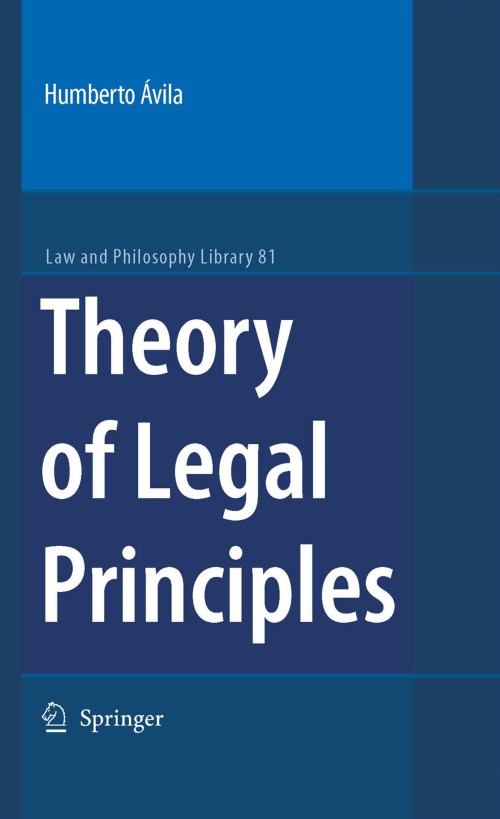
Theory of Legal Principles [electronic resource] / by Humberto Avila.
Erişim Adresi
ISBN
9781402058790
Dil Kodu
İngilizce
Yer Numarası
DK/12471
Yazar
Basım Bildirimi
1st ed. 2007.
Yayın Bilgisi
Dordrecht : Springer Netherlands : Imprint: Springer, 2007.
Fiziksel Niteleme
XIV, 154 p. online resource.
Dizi
Law and Philosophy Library, 2215-0315 ; 81
Özet, vb.
This book intends to help understand and apply principles and rules better. Its target is to keep the distinction between principles and rules whereas structuring it on different foundations than those jurisprudence ordinarily employs. The first object of investigation is the phenomenon of interpretation in Law in order to understand that the classification of certain normative species as either principles or rules depends in the first place on axiological connections that are not ready prior to the interpretation process that unveils them. Then, a definition of principles is proposed, aiming to understand what their unique characteristics are when compared to other norms of the legal order. Thirdly, the conditions for the application of principles and rules are examined, which are the normative applicative postulates. It will be shown, on one hand, that principles not only explicit values, but also set forth precise species of behaviors, though indirectly; on the other hand, the creation of conducts by rules is also to be weighed, even though the behavior set forth in advance may be overcome, depending on the accomplishment of a few requirements. That will surpass both the mere praise of values, which does not create behaviors, and the automatic application of rules. A model is proposed to explain the normative species, which includes structured weighing on the application process while encompassing substantive criteria of justice in its argument, through the analytical reconstruction of the concrete use of normative postulates, especially those of reasonableness and proportionality. All of that is done with a focus on the ability of intersubjective control of the argumentation, which often degenerates into capricious decisionism. "Although there are books about legal rules, and although the role of legal principles has been a focus of legal theory since Dworkin, there has yet to be a serious systematic study of what legal principles are, where theycome from, how they are identified, and how precisely they intersect with other sources in legal argument and legal decision-making. Professor Avila's much-needed book fills this gap with rigor, depth, and creativity, and it should become essential reading for anyone interested in legal reasoning and legal argumentation." Frederick Schauer, John F Kennedy School of Government, Harvard University, USA.
Konu
Law.
Constitutional law.
Law __ Philosophy.
Law __ History.
Fundamentals of Law.
Constitutional Law.
Theories of Law, Philosophy of Law, Legal History.
Constitutional law.
Law __ Philosophy.
Law __ History.
Fundamentals of Law.
Constitutional Law.
Theories of Law, Philosophy of Law, Legal History.
Kurum Adı
Eseri Alıntıla
Referansları kullanmadan önce gözden geçirmeniz ve varsa gerekli düzeltmeleri yapmanız önerilir.
Dijital Kaynak
MARC Görünümü
LEADER 04179nam a22005175i 4500
001 811207
003 TR_AnAIT
005 20260131011859
007 cr nn 008mamaa
008 100301s2007 ne | s |||| 0|eng d
020 |a9781402058790|9978-1-4020-5879-0
024 7 |a10.1007/978-1-4020-5879-0|2doi
041 |aeng
049 |aTürk Tarih Kurumu Kütüphanesi
050 4|aK201-487
072 7|aLA|2bicssc
072 7|aLAW000000|2bisacsh
072 7|aLA|2thema
082 04|a340.1|223
090 |aDK/12471
100 1 |aAvila, Humberto.|eauthor.|4aut|4http://id.loc.gov/vocabulary/relators/aut
245 10|aTheory of Legal Principles|h[electronic resource] /|cby Humberto Avila.
250 |a1st ed. 2007.
264 1|aDordrecht :|bSpringer Netherlands :|bImprint: Springer,|c2007.
300 |aXIV, 154 p.|bonline resource.
336 |atext|btxt|2rdacontent
337 |acomputer|bc|2rdamedia
338 |aonline resource|bcr|2rdacarrier
347 |atext file|bPDF|2rda
490 1 |aLaw and Philosophy Library,|x2215-0315 ;|v81
520 |aThis book intends to help understand and apply principles and rules better. Its target is to keep the distinction between principles and rules whereas structuring it on different foundations than those jurisprudence ordinarily employs. The first object of investigation is the phenomenon of interpretation in Law in order to understand that the classification of certain normative species as either principles or rules depends in the first place on axiological connections that are not ready prior to the interpretation process that unveils them. Then, a definition of principles is proposed, aiming to understand what their unique characteristics are when compared to other norms of the legal order. Thirdly, the conditions for the application of principles and rules are examined, which are the normative applicative postulates. It will be shown, on one hand, that principles not only explicit values, but also set forth precise species of behaviors, though indirectly; on the other hand, the creation of conducts by rules is also to be weighed, even though the behavior set forth in advance may be overcome, depending on the accomplishment of a few requirements. That will surpass both the mere praise of values, which does not create behaviors, and the automatic application of rules. A model is proposed to explain the normative species, which includes structured weighing on the application process while encompassing substantive criteria of justice in its argument, through the analytical reconstruction of the concrete use of normative postulates, especially those of reasonableness and proportionality. All of that is done with a focus on the ability of intersubjective control of the argumentation, which often degenerates into capricious decisionism. "Although there are books about legal rules, and although the role of legal principles has been a focus of legal theory since Dworkin, there has yet to be a serious systematic study of what legal principles are, where theycome from, how they are identified, and how precisely they intersect with other sources in legal argument and legal decision-making. Professor Avila's much-needed book fills this gap with rigor, depth, and creativity, and it should become essential reading for anyone interested in legal reasoning and legal argumentation." Frederick Schauer, John F Kennedy School of Government, Harvard University, USA.
650 0|aLaw.
650 0|aConstitutional law.
650 0|aLaw|xPhilosophy.
650 0|aLaw|xHistory.
650 14|aFundamentals of Law.
650 24|aConstitutional Law.
650 24|aTheories of Law, Philosophy of Law, Legal History.
710 2 |aSpringerLink (Online service)
773 0 |tSpringer Nature eBook
776 08|iPrinted edition:|z9781402058783
776 08|iPrinted edition:|z9789048112647
776 08|iPrinted edition:|z9789048174652
830 0|aLaw and Philosophy Library,|x2215-0315 ;|v81
856 40|uhttps://doi.org/10.1007/978-1-4020-5879-0
912 |aZDB-2-SHU
912 |aZDB-2-SXLC
950 |aHumanities, Social Sciences and Law (SpringerNature-11648)
950 |aLaw and Criminology (R0) (SpringerNature-43727)
001 811207
003 TR_AnAIT
005 20260131011859
007 cr nn 008mamaa
008 100301s2007 ne | s |||| 0|eng d
020 |a9781402058790|9978-1-4020-5879-0
024 7 |a10.1007/978-1-4020-5879-0|2doi
041 |aeng
049 |aTürk Tarih Kurumu Kütüphanesi
050 4|aK201-487
072 7|aLA|2bicssc
072 7|aLAW000000|2bisacsh
072 7|aLA|2thema
082 04|a340.1|223
090 |aDK/12471
100 1 |aAvila, Humberto.|eauthor.|4aut|4http://id.loc.gov/vocabulary/relators/aut
245 10|aTheory of Legal Principles|h[electronic resource] /|cby Humberto Avila.
250 |a1st ed. 2007.
264 1|aDordrecht :|bSpringer Netherlands :|bImprint: Springer,|c2007.
300 |aXIV, 154 p.|bonline resource.
336 |atext|btxt|2rdacontent
337 |acomputer|bc|2rdamedia
338 |aonline resource|bcr|2rdacarrier
347 |atext file|bPDF|2rda
490 1 |aLaw and Philosophy Library,|x2215-0315 ;|v81
520 |aThis book intends to help understand and apply principles and rules better. Its target is to keep the distinction between principles and rules whereas structuring it on different foundations than those jurisprudence ordinarily employs. The first object of investigation is the phenomenon of interpretation in Law in order to understand that the classification of certain normative species as either principles or rules depends in the first place on axiological connections that are not ready prior to the interpretation process that unveils them. Then, a definition of principles is proposed, aiming to understand what their unique characteristics are when compared to other norms of the legal order. Thirdly, the conditions for the application of principles and rules are examined, which are the normative applicative postulates. It will be shown, on one hand, that principles not only explicit values, but also set forth precise species of behaviors, though indirectly; on the other hand, the creation of conducts by rules is also to be weighed, even though the behavior set forth in advance may be overcome, depending on the accomplishment of a few requirements. That will surpass both the mere praise of values, which does not create behaviors, and the automatic application of rules. A model is proposed to explain the normative species, which includes structured weighing on the application process while encompassing substantive criteria of justice in its argument, through the analytical reconstruction of the concrete use of normative postulates, especially those of reasonableness and proportionality. All of that is done with a focus on the ability of intersubjective control of the argumentation, which often degenerates into capricious decisionism. "Although there are books about legal rules, and although the role of legal principles has been a focus of legal theory since Dworkin, there has yet to be a serious systematic study of what legal principles are, where theycome from, how they are identified, and how precisely they intersect with other sources in legal argument and legal decision-making. Professor Avila's much-needed book fills this gap with rigor, depth, and creativity, and it should become essential reading for anyone interested in legal reasoning and legal argumentation." Frederick Schauer, John F Kennedy School of Government, Harvard University, USA.
650 0|aLaw.
650 0|aConstitutional law.
650 0|aLaw|xPhilosophy.
650 0|aLaw|xHistory.
650 14|aFundamentals of Law.
650 24|aConstitutional Law.
650 24|aTheories of Law, Philosophy of Law, Legal History.
710 2 |aSpringerLink (Online service)
773 0 |tSpringer Nature eBook
776 08|iPrinted edition:|z9781402058783
776 08|iPrinted edition:|z9789048112647
776 08|iPrinted edition:|z9789048174652
830 0|aLaw and Philosophy Library,|x2215-0315 ;|v81
856 40|uhttps://doi.org/10.1007/978-1-4020-5879-0
912 |aZDB-2-SHU
912 |aZDB-2-SXLC
950 |aHumanities, Social Sciences and Law (SpringerNature-11648)
950 |aLaw and Criminology (R0) (SpringerNature-43727)
Materyaller
Depodan talep edilen materyal sadece kütüphane içerisinde kullanılmaktadır.
Materyal dışarıya ödünç verilmemektedir.
Materyal dışarıya ödünç verilmemektedir.
