

Mechanics and Natural Philosophy before the Scientific Revolution [electronic resource] / edited by Walter Roy Laird, Sophie Roux.
Erişim Adresi
ISBN
9781402059674
Dil Kodu
İngilizce
Yer Numarası
DK/12475
Basım Bildirimi
1st ed. 2008.
Yayın Bilgisi
Dordrecht : Springer Netherlands : Imprint: Springer, 2008.
Fiziksel Niteleme
VIII, 320 p. online resource.
Dizi
Boston Studies in the Philosophy and History of Science, 2214-7942 ; 254
İçindekiler Notu
Ancient and Medieval Mechanics -- Theory and Practice in Heron’S Mechanics -- Bradwardine’S Rule: A Mathematical Law? -- The Origin and Fate of Thomas Bradwardine’S De Proportionibus Velocitatum in Motibus in Relation to the History of Mathematics -- Concepts of Impetus and the History of Mechanics -- The Reappropriation and Transformation of Ancient Mechanics -- Circular and Rectilinear Motion in the Mechanica and in the 16th Century -- Nature, Mechanics, and Voluntary Movement in Giuseppe Moletti’S Lectures on The Pseudo-Aristotelian Mechanica -- Mechanics and Natural Philosophy in Late 16th-Century Pisa: Cesalpino and Buonamici, Humanist Masters of The Faculty of Arts -- The Enigma of the Inclined Plane from Heron to Galileo -- Mechanics in New Contexts -- The Pendulum as A Challenging Object in Early-Modern Mechanics -- Mechanics in Spain at the End of the 16th Century and the Madrid Academy of Mathematics -- Mechanics and Mechanical Philosophy in some Jesuit Mathematical Textbooks of the Early 17th Century.
Özet, vb.
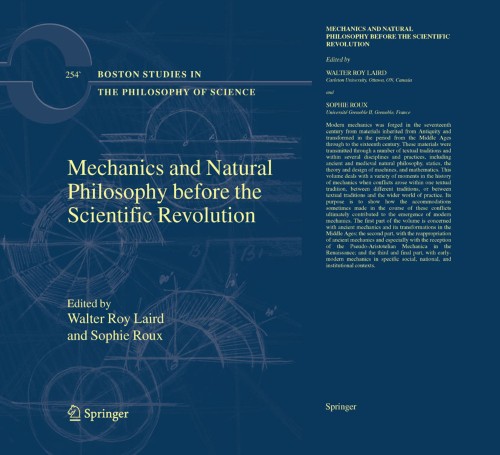
Modern mechanics was forged in the seventeenth century from materials inherited from Antiquity and transformed in the period from the Middle Ages through to the sixteenth century. These materials were transmitted through a number of textual traditions and within several disciplines and practices, including ancient and medieval natural philosophy, statics, the theory and design of machines, and mathematics. This volume deals with a variety of moments in the history of mechanics when conflicts arose within one textual tradition, between different traditions, or between textual traditions and the wider world of practice. Its purpose is to show how the accommodations sometimes made in the course of these conflicts ultimately contributed to the emergence of modern mechanics. The first part of the volume is concerned with ancient mechanics and its transformations in the Middle Ages; the second part with the reappropriation of ancient mechanics and especially with the reception of the Pseudo-Aristotelian Mechanica in the Renaissance; and the third and final part, with early-modern mechanics in specific social, national, and institutional contexts.
Konu
Science __ Philosophy.
Physics __ Philosophy.
Mathematics.
History.
Philosophy, Medieval.
Philosophy, Ancient.
Philosophy of Science.
Philosophical Foundations of Physics and Astronomy.
History of Mathematical Sciences.
Medieval Philosophy.
Ancient Philosophy / Classical Philosophy.
Physics __ Philosophy.
Mathematics.
History.
Philosophy, Medieval.
Philosophy, Ancient.
Philosophy of Science.
Philosophical Foundations of Physics and Astronomy.
History of Mathematical Sciences.
Medieval Philosophy.
Ancient Philosophy / Classical Philosophy.
Diğer Yazarlar
Kurum Adı
Eseri Alıntıla
Referansları kullanmadan önce gözden geçirmeniz ve varsa gerekli düzeltmeleri yapmanız önerilir.
Dijital Kaynak
MARC Görünümü
LEADER 04434nam a22006015i 4500
001 811211
003 TR_AnAIT
005 20260131011850
007 cr nn 008mamaa
008 100301s2008 ne | s |||| 0|eng d
020 |a9781402059674|9978-1-4020-5967-4
024 7 |a10.1007/978-1-4020-5967-4|2doi
041 |aeng
049 |aTürk Tarih Kurumu Kütüphanesi
050 4|aQ174-175.3
050 4|aB67
072 7|aPDA|2bicssc
072 7|aSCI075000|2bisacsh
072 7|aPDA|2thema
082 04|a501|223
090 |aDK/12475
245 10|aMechanics and Natural Philosophy before the Scientific Revolution|h[electronic resource] /|cedited by Walter Roy Laird, Sophie Roux.
250 |a1st ed. 2008.
264 1|aDordrecht :|bSpringer Netherlands :|bImprint: Springer,|c2008.
300 |aVIII, 320 p.|bonline resource.
336 |atext|btxt|2rdacontent
337 |acomputer|bc|2rdamedia
338 |aonline resource|bcr|2rdacarrier
347 |atext file|bPDF|2rda
490 1 |aBoston Studies in the Philosophy and History of Science,|x2214-7942 ;|v254
505 0 |aAncient and Medieval Mechanics -- Theory and Practice in Heron’S Mechanics -- Bradwardine’S Rule: A Mathematical Law? -- The Origin and Fate of Thomas Bradwardine’S De Proportionibus Velocitatum in Motibus in Relation to the History of Mathematics -- Concepts of Impetus and the History of Mechanics -- The Reappropriation and Transformation of Ancient Mechanics -- Circular and Rectilinear Motion in the Mechanica and in the 16th Century -- Nature, Mechanics, and Voluntary Movement in Giuseppe Moletti’S Lectures on The Pseudo-Aristotelian Mechanica -- Mechanics and Natural Philosophy in Late 16th-Century Pisa: Cesalpino and Buonamici, Humanist Masters of The Faculty of Arts -- The Enigma of the Inclined Plane from Heron to Galileo -- Mechanics in New Contexts -- The Pendulum as A Challenging Object in Early-Modern Mechanics -- Mechanics in Spain at the End of the 16th Century and the Madrid Academy of Mathematics -- Mechanics and Mechanical Philosophy in some Jesuit Mathematical Textbooks of the Early 17th Century.
520 |aModern mechanics was forged in the seventeenth century from materials inherited from Antiquity and transformed in the period from the Middle Ages through to the sixteenth century. These materials were transmitted through a number of textual traditions and within several disciplines and practices, including ancient and medieval natural philosophy, statics, the theory and design of machines, and mathematics. This volume deals with a variety of moments in the history of mechanics when conflicts arose within one textual tradition, between different traditions, or between textual traditions and the wider world of practice. Its purpose is to show how the accommodations sometimes made in the course of these conflicts ultimately contributed to the emergence of modern mechanics. The first part of the volume is concerned with ancient mechanics and its transformations in the Middle Ages; the second part with the reappropriation of ancient mechanics and especially with the reception of the Pseudo-Aristotelian Mechanica in the Renaissance; and the third and final part, with early-modern mechanics in specific social, national, and institutional contexts.
650 0|aScience|xPhilosophy.
650 0|aPhysics|xPhilosophy.
650 0|aMathematics.
650 0|aHistory.
650 0|aPhilosophy, Medieval.
650 0|aPhilosophy, Ancient.
650 14|aPhilosophy of Science.
650 24|aPhilosophical Foundations of Physics and Astronomy.
650 24|aHistory of Mathematical Sciences.
650 24|aMedieval Philosophy.
650 24|aAncient Philosophy / Classical Philosophy.
700 1 |aLaird, Walter Roy.|eeditor.|4edt|4http://id.loc.gov/vocabulary/relators/edt
700 1 |aRoux, Sophie.|eeditor.|4edt|4http://id.loc.gov/vocabulary/relators/edt
710 2 |aSpringerLink (Online service)
773 0 |tSpringer Nature eBook
776 08|iPrinted edition:|z9781402059667
776 08|iPrinted edition:|z9789048113002
776 08|iPrinted edition:|z9789048174911
830 0|aBoston Studies in the Philosophy and History of Science,|x2214-7942 ;|v254
856 40|uhttps://doi.org/10.1007/978-1-4020-5967-4
912 |aZDB-2-SHU
912 |aZDB-2-SXPR
950 |aHumanities, Social Sciences and Law (SpringerNature-11648)
950 |aPhilosophy and Religion (R0) (SpringerNature-43725)
001 811211
003 TR_AnAIT
005 20260131011850
007 cr nn 008mamaa
008 100301s2008 ne | s |||| 0|eng d
020 |a9781402059674|9978-1-4020-5967-4
024 7 |a10.1007/978-1-4020-5967-4|2doi
041 |aeng
049 |aTürk Tarih Kurumu Kütüphanesi
050 4|aQ174-175.3
050 4|aB67
072 7|aPDA|2bicssc
072 7|aSCI075000|2bisacsh
072 7|aPDA|2thema
082 04|a501|223
090 |aDK/12475
245 10|aMechanics and Natural Philosophy before the Scientific Revolution|h[electronic resource] /|cedited by Walter Roy Laird, Sophie Roux.
250 |a1st ed. 2008.
264 1|aDordrecht :|bSpringer Netherlands :|bImprint: Springer,|c2008.
300 |aVIII, 320 p.|bonline resource.
336 |atext|btxt|2rdacontent
337 |acomputer|bc|2rdamedia
338 |aonline resource|bcr|2rdacarrier
347 |atext file|bPDF|2rda
490 1 |aBoston Studies in the Philosophy and History of Science,|x2214-7942 ;|v254
505 0 |aAncient and Medieval Mechanics -- Theory and Practice in Heron’S Mechanics -- Bradwardine’S Rule: A Mathematical Law? -- The Origin and Fate of Thomas Bradwardine’S De Proportionibus Velocitatum in Motibus in Relation to the History of Mathematics -- Concepts of Impetus and the History of Mechanics -- The Reappropriation and Transformation of Ancient Mechanics -- Circular and Rectilinear Motion in the Mechanica and in the 16th Century -- Nature, Mechanics, and Voluntary Movement in Giuseppe Moletti’S Lectures on The Pseudo-Aristotelian Mechanica -- Mechanics and Natural Philosophy in Late 16th-Century Pisa: Cesalpino and Buonamici, Humanist Masters of The Faculty of Arts -- The Enigma of the Inclined Plane from Heron to Galileo -- Mechanics in New Contexts -- The Pendulum as A Challenging Object in Early-Modern Mechanics -- Mechanics in Spain at the End of the 16th Century and the Madrid Academy of Mathematics -- Mechanics and Mechanical Philosophy in some Jesuit Mathematical Textbooks of the Early 17th Century.
520 |aModern mechanics was forged in the seventeenth century from materials inherited from Antiquity and transformed in the period from the Middle Ages through to the sixteenth century. These materials were transmitted through a number of textual traditions and within several disciplines and practices, including ancient and medieval natural philosophy, statics, the theory and design of machines, and mathematics. This volume deals with a variety of moments in the history of mechanics when conflicts arose within one textual tradition, between different traditions, or between textual traditions and the wider world of practice. Its purpose is to show how the accommodations sometimes made in the course of these conflicts ultimately contributed to the emergence of modern mechanics. The first part of the volume is concerned with ancient mechanics and its transformations in the Middle Ages; the second part with the reappropriation of ancient mechanics and especially with the reception of the Pseudo-Aristotelian Mechanica in the Renaissance; and the third and final part, with early-modern mechanics in specific social, national, and institutional contexts.
650 0|aScience|xPhilosophy.
650 0|aPhysics|xPhilosophy.
650 0|aMathematics.
650 0|aHistory.
650 0|aPhilosophy, Medieval.
650 0|aPhilosophy, Ancient.
650 14|aPhilosophy of Science.
650 24|aPhilosophical Foundations of Physics and Astronomy.
650 24|aHistory of Mathematical Sciences.
650 24|aMedieval Philosophy.
650 24|aAncient Philosophy / Classical Philosophy.
700 1 |aLaird, Walter Roy.|eeditor.|4edt|4http://id.loc.gov/vocabulary/relators/edt
700 1 |aRoux, Sophie.|eeditor.|4edt|4http://id.loc.gov/vocabulary/relators/edt
710 2 |aSpringerLink (Online service)
773 0 |tSpringer Nature eBook
776 08|iPrinted edition:|z9781402059667
776 08|iPrinted edition:|z9789048113002
776 08|iPrinted edition:|z9789048174911
830 0|aBoston Studies in the Philosophy and History of Science,|x2214-7942 ;|v254
856 40|uhttps://doi.org/10.1007/978-1-4020-5967-4
912 |aZDB-2-SHU
912 |aZDB-2-SXPR
950 |aHumanities, Social Sciences and Law (SpringerNature-11648)
950 |aPhilosophy and Religion (R0) (SpringerNature-43725)
Materyaller
Depodan talep edilen materyal sadece kütüphane içerisinde kullanılmaktadır.
Materyal dışarıya ödünç verilmemektedir.
Materyal dışarıya ödünç verilmemektedir.
