

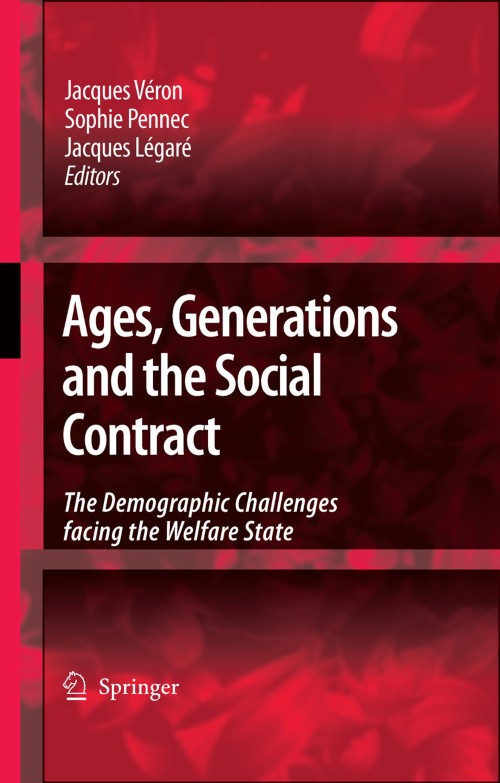
Ages, Generations and the Social Contract [electronic resource] : The Demographic Challenges Facing the Welfare State / edited by Jacques Véron, Sophie Pennec, Jacques Légaré.
Erişim Adresi
ISBN
9781402059735
Dil Kodu
İngilizce
Yer Numarası
DK/12476
Basım Bildirimi
1st ed. 2007.
Yayın Bilgisi
Dordrecht : Springer Netherlands : Imprint: Springer, 2007.
Fiziksel Niteleme
XVI, 390 p. online resource.
İçindekiler Notu
Changing Background of Intergenerational Relationships -- Demographic Change, Welfare, and Intergenerational Transfers: A Global Overview -- Demographic Context of the Social Contract in Developed Countries: Unity and Diversity -- Generations, Social Contract and Labour Force Participation: Theoretical and Empirical Issues -- Economics of the Intergenerational Debate: Normative, Accounting and Political Viewpoints -- Reorganizing the Activity Cycle: The Stakes in a New Social Contract -- Social Contract and Age at Retirement: Some Elements of a Franco-American Comparison -- Longevity and Work -- Family and Relationships Between Generations -- Changes to the Legal Relationship Between Grandparents and Grandchildren in Quebec: A Disconcerting Evolution -- Demographic Change and the Social Contract of Informal Support Within the Family -- Change and Reciprocity in Intergenerational Relationships: The Discourse Of Spanish Working Mothers -- Intergenerational Exchanges in Older Populations -- Family Solidarities at the Beginning of Retirement in France -- Redistribution and Intergenerational Equity -- Pensions and Income Redistribution in a Comparative Perspective: Evidence from the Luxembourg Income Study -- Social Spending: Recent Changes and Conditions for its Long-Term Viability -- Pensions, Privilege and Poverty: Another “Take” on Intergenerational Equity -- Social Time -- Toward a 24-Hour Economy: Implications for the Temporal Structure and Functioning of Family Life -- Working Schedules: In Search of a Balance Between Family Time and Economic Wellbeing -- Determinants of Paths of Transition to Total-Work Retirement: A Preliminary Empirical Analysis.
Özet, vb.
Our societies are ageing. The Family is changing. Labour force behaviour is evolving. How is the organisation of family and collective solidarity adapting in this context of longer life spans, low fertility, and work that is simultaneously scarce and abundant? The welfare states are currently facing three main challenges: ensure satisfactory living conditions for the elderly without increasing the cost burden on the active population, reduce social inequality, and maintain equity between successive generations. In this book, researchers from different countries compare their experiences and offer contrasting views on the future of social protection. They consider the theoretical aspects of the intergenerational debate, relations between generations within the family, the living standards of elderly people, and the question of social time.
Konu
Demography.
Population.
Aging.
Social sciences.
Social policy.
Counseling.
Population __ Economic aspects.
Population and Demography.
Ageing.
Society.
Social Policy.
Counseling Psychology.
Population Economics.
Population.
Aging.
Social sciences.
Social policy.
Counseling.
Population __ Economic aspects.
Population and Demography.
Ageing.
Society.
Social Policy.
Counseling Psychology.
Population Economics.
Diğer Yazarlar
Kurum Adı
Eseri Alıntıla
Referansları kullanmadan önce gözden geçirmeniz ve varsa gerekli düzeltmeleri yapmanız önerilir.
Dijital Kaynak
MARC Görünümü
LEADER 04668nam a22006015i 4500
001 811212
003 TR_AnAIT
005 20260131011845
007 cr nn 008mamaa
008 100301s2007 ne | s |||| 0|eng d
020 |a9781402059735|9978-1-4020-5973-5
024 7 |a10.1007/978-1-4020-5973-5|2doi
041 |aeng
049 |aTürk Tarih Kurumu Kütüphanesi
050 4|aHB848-3697
072 7|aJHBD|2bicssc
072 7|aSOC006000|2bisacsh
072 7|aJHBD|2thema
082 04|a304.6|223
090 |aDK/12476
245 10|aAges, Generations and the Social Contract|h[electronic resource] :|bThe Demographic Challenges Facing the Welfare State /|cedited by Jacques Véron, Sophie Pennec, Jacques Légaré.
250 |a1st ed. 2007.
264 1|aDordrecht :|bSpringer Netherlands :|bImprint: Springer,|c2007.
300 |aXVI, 390 p.|bonline resource.
336 |atext|btxt|2rdacontent
337 |acomputer|bc|2rdamedia
338 |aonline resource|bcr|2rdacarrier
347 |atext file|bPDF|2rda
505 0 |aChanging Background of Intergenerational Relationships -- Demographic Change, Welfare, and Intergenerational Transfers: A Global Overview -- Demographic Context of the Social Contract in Developed Countries: Unity and Diversity -- Generations, Social Contract and Labour Force Participation: Theoretical and Empirical Issues -- Economics of the Intergenerational Debate: Normative, Accounting and Political Viewpoints -- Reorganizing the Activity Cycle: The Stakes in a New Social Contract -- Social Contract and Age at Retirement: Some Elements of a Franco-American Comparison -- Longevity and Work -- Family and Relationships Between Generations -- Changes to the Legal Relationship Between Grandparents and Grandchildren in Quebec: A Disconcerting Evolution -- Demographic Change and the Social Contract of Informal Support Within the Family -- Change and Reciprocity in Intergenerational Relationships: The Discourse Of Spanish Working Mothers -- Intergenerational Exchanges in Older Populations -- Family Solidarities at the Beginning of Retirement in France -- Redistribution and Intergenerational Equity -- Pensions and Income Redistribution in a Comparative Perspective: Evidence from the Luxembourg Income Study -- Social Spending: Recent Changes and Conditions for its Long-Term Viability -- Pensions, Privilege and Poverty: Another “Take” on Intergenerational Equity -- Social Time -- Toward a 24-Hour Economy: Implications for the Temporal Structure and Functioning of Family Life -- Working Schedules: In Search of a Balance Between Family Time and Economic Wellbeing -- Determinants of Paths of Transition to Total-Work Retirement: A Preliminary Empirical Analysis.
520 |aOur societies are ageing. The Family is changing. Labour force behaviour is evolving. How is the organisation of family and collective solidarity adapting in this context of longer life spans, low fertility, and work that is simultaneously scarce and abundant? The welfare states are currently facing three main challenges: ensure satisfactory living conditions for the elderly without increasing the cost burden on the active population, reduce social inequality, and maintain equity between successive generations. In this book, researchers from different countries compare their experiences and offer contrasting views on the future of social protection. They consider the theoretical aspects of the intergenerational debate, relations between generations within the family, the living standards of elderly people, and the question of social time.
650 0|aDemography.
650 0|aPopulation.
650 0|aAging.
650 0|aSocial sciences.
650 0|aSocial policy.
650 0|aCounseling.
650 0|aPopulation|xEconomic aspects.
650 14|aPopulation and Demography.
650 24|aAgeing.
650 24|aSociety.
650 24|aSocial Policy.
650 24|aCounseling Psychology.
650 24|aPopulation Economics.
700 1 |aVéron, Jacques.|eeditor.|4edt|4http://id.loc.gov/vocabulary/relators/edt
700 1 |aPennec, Sophie.|eeditor.|4edt|4http://id.loc.gov/vocabulary/relators/edt
700 1 |aLégaré, Jacques.|eeditor.|4edt|4http://id.loc.gov/vocabulary/relators/edt
710 2 |aSpringerLink (Online service)
773 0 |tSpringer Nature eBook
776 08|iPrinted edition:|z9781402059728
776 08|iPrinted edition:|z9789048113033
776 08|iPrinted edition:|z9789048174935
856 40|uhttps://doi.org/10.1007/978-1-4020-5973-5
912 |aZDB-2-SHU
912 |aZDB-2-SXS
950 |aHumanities, Social Sciences and Law (SpringerNature-11648)
950 |aSocial Sciences (R0) (SpringerNature-43726)
001 811212
003 TR_AnAIT
005 20260131011845
007 cr nn 008mamaa
008 100301s2007 ne | s |||| 0|eng d
020 |a9781402059735|9978-1-4020-5973-5
024 7 |a10.1007/978-1-4020-5973-5|2doi
041 |aeng
049 |aTürk Tarih Kurumu Kütüphanesi
050 4|aHB848-3697
072 7|aJHBD|2bicssc
072 7|aSOC006000|2bisacsh
072 7|aJHBD|2thema
082 04|a304.6|223
090 |aDK/12476
245 10|aAges, Generations and the Social Contract|h[electronic resource] :|bThe Demographic Challenges Facing the Welfare State /|cedited by Jacques Véron, Sophie Pennec, Jacques Légaré.
250 |a1st ed. 2007.
264 1|aDordrecht :|bSpringer Netherlands :|bImprint: Springer,|c2007.
300 |aXVI, 390 p.|bonline resource.
336 |atext|btxt|2rdacontent
337 |acomputer|bc|2rdamedia
338 |aonline resource|bcr|2rdacarrier
347 |atext file|bPDF|2rda
505 0 |aChanging Background of Intergenerational Relationships -- Demographic Change, Welfare, and Intergenerational Transfers: A Global Overview -- Demographic Context of the Social Contract in Developed Countries: Unity and Diversity -- Generations, Social Contract and Labour Force Participation: Theoretical and Empirical Issues -- Economics of the Intergenerational Debate: Normative, Accounting and Political Viewpoints -- Reorganizing the Activity Cycle: The Stakes in a New Social Contract -- Social Contract and Age at Retirement: Some Elements of a Franco-American Comparison -- Longevity and Work -- Family and Relationships Between Generations -- Changes to the Legal Relationship Between Grandparents and Grandchildren in Quebec: A Disconcerting Evolution -- Demographic Change and the Social Contract of Informal Support Within the Family -- Change and Reciprocity in Intergenerational Relationships: The Discourse Of Spanish Working Mothers -- Intergenerational Exchanges in Older Populations -- Family Solidarities at the Beginning of Retirement in France -- Redistribution and Intergenerational Equity -- Pensions and Income Redistribution in a Comparative Perspective: Evidence from the Luxembourg Income Study -- Social Spending: Recent Changes and Conditions for its Long-Term Viability -- Pensions, Privilege and Poverty: Another “Take” on Intergenerational Equity -- Social Time -- Toward a 24-Hour Economy: Implications for the Temporal Structure and Functioning of Family Life -- Working Schedules: In Search of a Balance Between Family Time and Economic Wellbeing -- Determinants of Paths of Transition to Total-Work Retirement: A Preliminary Empirical Analysis.
520 |aOur societies are ageing. The Family is changing. Labour force behaviour is evolving. How is the organisation of family and collective solidarity adapting in this context of longer life spans, low fertility, and work that is simultaneously scarce and abundant? The welfare states are currently facing three main challenges: ensure satisfactory living conditions for the elderly without increasing the cost burden on the active population, reduce social inequality, and maintain equity between successive generations. In this book, researchers from different countries compare their experiences and offer contrasting views on the future of social protection. They consider the theoretical aspects of the intergenerational debate, relations between generations within the family, the living standards of elderly people, and the question of social time.
650 0|aDemography.
650 0|aPopulation.
650 0|aAging.
650 0|aSocial sciences.
650 0|aSocial policy.
650 0|aCounseling.
650 0|aPopulation|xEconomic aspects.
650 14|aPopulation and Demography.
650 24|aAgeing.
650 24|aSociety.
650 24|aSocial Policy.
650 24|aCounseling Psychology.
650 24|aPopulation Economics.
700 1 |aVéron, Jacques.|eeditor.|4edt|4http://id.loc.gov/vocabulary/relators/edt
700 1 |aPennec, Sophie.|eeditor.|4edt|4http://id.loc.gov/vocabulary/relators/edt
700 1 |aLégaré, Jacques.|eeditor.|4edt|4http://id.loc.gov/vocabulary/relators/edt
710 2 |aSpringerLink (Online service)
773 0 |tSpringer Nature eBook
776 08|iPrinted edition:|z9781402059728
776 08|iPrinted edition:|z9789048113033
776 08|iPrinted edition:|z9789048174935
856 40|uhttps://doi.org/10.1007/978-1-4020-5973-5
912 |aZDB-2-SHU
912 |aZDB-2-SXS
950 |aHumanities, Social Sciences and Law (SpringerNature-11648)
950 |aSocial Sciences (R0) (SpringerNature-43726)
Materyaller
Depodan talep edilen materyal sadece kütüphane içerisinde kullanılmaktadır.
Materyal dışarıya ödünç verilmemektedir.
Materyal dışarıya ödünç verilmemektedir.
