LEADER 03773nam a22006135i 4500
001 811216
003 TR_AnAIT
005 20260131011841
007 cr nn 008mamaa
008 100301s2007 ne | s |||| 0|eng d
020 |a9781402061271|9978-1-4020-6127-1
024 7 |a10.1007/978-1-4020-6127-1|2doi
041 |aeng
049 |aTürk Tarih Kurumu Kütüphanesi
050 4|aBD143-237
072 7|aHPK|2bicssc
072 7|aPHI004000|2bisacsh
072 7|aQDTK|2thema
082 04|a120|223
090 |aDK/12480
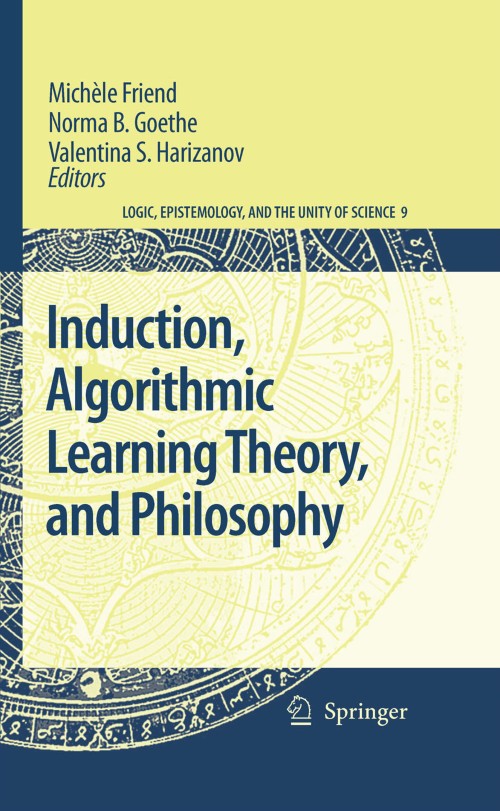
245 10|aInduction, Algorithmic Learning Theory, and Philosophy|h[electronic resource] /|cedited by Michèle Friend, Norma B. Goethe, Valentina S. Harizanov.
250 |a1st ed. 2007.
264 1|aDordrecht :|bSpringer Netherlands :|bImprint: Springer,|c2007.
300 |aXIV, 290 p.|bonline resource.
336 |atext|btxt|2rdacontent
337 |acomputer|bc|2rdamedia
338 |aonline resource|bcr|2rdacarrier
347 |atext file|bPDF|2rda
490 1 |aLogic, Epistemology, and the Unity of Science,|x2214-9783 ;|v9
505 0 |ato the Philosophy and Mathematics of Algorithmic Learning Theory -- to the Philosophy and Mathematics of Algorithmic Learning Theory -- Technical Papers -- Inductive Inference Systems for Learning Classes of Algorithmically Generated Sets and Structures -- Deduction, Induction, and beyond in Parametric Logic -- How Simplicity Helps You Find the Truth without Pointing at it -- Induction over the Continuum -- Philosophy Papers -- Logically Reliable Inductive Inference -- Some Philosophical Concerns about the Confidence in ‘Confident Learning’ -- How to Do Things with an Infinite Regress -- Trade-Offs -- Two Ways of Thinking about Induction -- Between History and Logic.
520 |aThis is the first book to collect essays from philosophers, mathematicians and computer scientists working at the exciting interface of algorithmic learning theory and the epistemology of science and inductive inference. Readable, introductory essays provide engaging surveys of different, complementary, and mutually inspiring approaches to the topic, both from a philosophical and a mathematical viewpoint. Building upon this base, subsequent papers present novel extensions of algorithmic learning theory as well as bold, new applications to traditional issues in epistemology and the philosophy of science. The volume is vital reading for students and researchers seeking a fresh, truth-directed approach to the philosophy of science and induction, epistemology, logic, and statistics.
650 0|aKnowledge, Theory of.
650 0|aMathematical logic.
650 0|aMachine theory.
650 0|aScience|xPhilosophy.
650 0|aAlgorithms.
650 0|aCognitive psychology.
650 14|aEpistemology.
650 24|aMathematical Logic and Foundations.
650 24|aFormal Languages and Automata Theory.
650 24|aPhilosophy of Science.
650 24|aAlgorithms.
650 24|aCognitive Psychology.
700 1 |aFriend, Michèle.|eeditor.|4edt|4http://id.loc.gov/vocabulary/relators/edt
700 1 |aGoethe, Norma B.|eeditor.|4edt|4http://id.loc.gov/vocabulary/relators/edt
700 1 |aHarizanov, Valentina S.|eeditor.|4edt|4http://id.loc.gov/vocabulary/relators/edt
710 2 |aSpringerLink (Online service)
773 0 |tSpringer Nature eBook
776 08|iPrinted edition:|z9781402061264
776 08|iPrinted edition:|z9789048113712
776 08|iPrinted edition:|z9789048175444
830 0|aLogic, Epistemology, and the Unity of Science,|x2214-9783 ;|v9
856 40|uhttps://doi.org/10.1007/978-1-4020-6127-1
912 |aZDB-2-SHU
912 |aZDB-2-SXPR
950 |aHumanities, Social Sciences and Law (SpringerNature-11648)
950 |aPhilosophy and Religion (R0) (SpringerNature-43725)