LEADER 03575nam a22005535i 4500
001 811220
003 TR_AnAIT
005 20260131011837
007 cr nn 008mamaa
008 100301s2007 ne | s |||| 0|eng d
020 |a9781402061769|9978-1-4020-6176-9
024 7 |a10.1007/978-1-4020-6176-9|2doi
041 |aeng
049 |aTürk Tarih Kurumu Kütüphanesi
050 4|aP291-298
072 7|aCFK|2bicssc
072 7|aLAN009060|2bisacsh
072 7|aCFK|2thema
082 04|a415|223
090 |aDK/12484
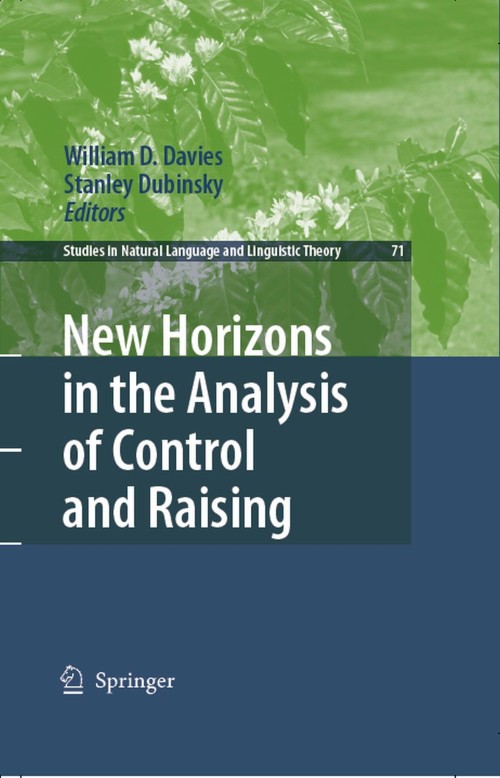
245 10|aNew Horizons in the Analysis of Control and Raising|h[electronic resource] /|cedited by William D. Davies, STANLEY DUBINSKY.
250 |a1st ed. 2007.
264 1|aDordrecht :|bSpringer Netherlands :|bImprint: Springer,|c2007.
300 |aX, 352 p.|bonline resource.
336 |atext|btxt|2rdacontent
337 |acomputer|bc|2rdamedia
338 |aonline resource|bcr|2rdacarrier
347 |atext file|bPDF|2rda
490 1 |aStudies in Natural Language and Linguistic Theory,|x2215-0358 ;|v71
505 0 |aNew Horizons in the Analysis of Control and Raising -- Looking Out Over the Horizon -- New Views of Raising -- Raising in DP Revisited -- The Late Development of Raising: What Children Seem to Think about Seem -- Raising of Major Arguments in Korean (and Japanese) -- Raising or Control in Greek -- Not Really ECM, not Exactly Control: The ‘Quasi-ECM’ Construction in Greek -- Control in Modern Greek: It's Another Good Move -- Finiteness and Control in Greek -- Control in Romance -- Moving Forward with Romanian Backward Control and Raising -- Agreement and Flotation in Partial and Inverse Partial Control Configurations -- Null Subjects in Brazilian Portuguese and Finnish: They are not Derived by Movement -- Extensions and Alternatives to the MTC -- On (Non-)Obligatory Control -- Control and Wh-infinitivals -- Control via Selection -- Movement-Resistant Aspects of Control.
520 |aRaising and control have figured in every comprehensive model of syntax for forty years. Recent renewed attention to them makes this collection a timely one. The contributions, representing some of the most exciting recent work, address many fundamental research questions. What beside the canonical constructions might be subject to raising or control analyses? What constructions traditionally treated as raising or control might not actually be so? What classes of control must be recognized? How do tense, agreement, or clausal completeness figure in their distribution? The chapters address these and other relevant issues, and bring new empirical data into focus.
650 0|aGrammar, Comparative and general|xSyntax.
650 0|aLinguistics.
650 0|aGreek language.
650 0|aRomance languages.
650 14|aSyntax.
650 24|aTheoretical Linguistics / Grammar.
650 24|aGreek.
650 24|aRomance Languages.
700 1 |aDavies, William D.|eeditor.|4edt|4http://id.loc.gov/vocabulary/relators/edt
700 1 |aDUBINSKY, STANLEY.|eeditor.|4edt|4http://id.loc.gov/vocabulary/relators/edt
710 2 |aSpringerLink (Online service)
773 0 |tSpringer Nature eBook
776 08|iPrinted edition:|z9781402061752
776 08|iPrinted edition:|z9781402061776
776 08|iPrinted edition:|z9789048113897
830 0|aStudies in Natural Language and Linguistic Theory,|x2215-0358 ;|v71
856 40|uhttps://doi.org/10.1007/978-1-4020-6176-9
912 |aZDB-2-SHU
912 |aZDB-2-SXS
950 |aHumanities, Social Sciences and Law (SpringerNature-11648)
950 |aSocial Sciences (R0) (SpringerNature-43726)