

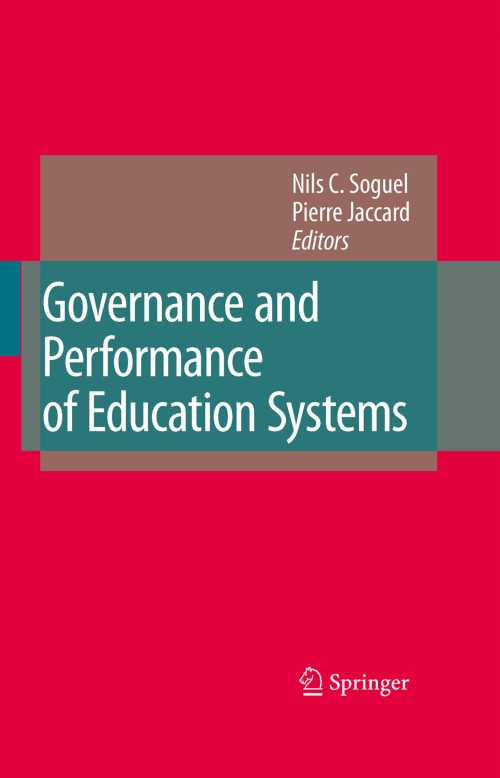
Governance and Performance of Education Systems [electronic resource] / edited by Nils C. Soguel, Pierre Jaccard.
Erişim Adresi
ISBN
9781402064463
Dil Kodu
İngilizce
Yer Numarası
DK/12495
Basım Bildirimi
1st ed. 2008.
Yayın Bilgisi
Dordrecht : Springer Netherlands : Imprint: Springer, 2008.
Fiziksel Niteleme
XVIII, 330 p. online resource.
İçindekiler Notu
Introduction: Governance and Performance of Education Systems -- Introduction: Governance and Performance of Education Systems -- The Changing Governance of Educational Systems -- The New Regulation Forms of Educational Systems in Europe: Towards a Post-bureaucratic Regime -- Comparing Higher Education Governance Systems in Four European Countries -- Performance Monitoring and Evaluation -- Purpose and Limits of a National Monitoring of the Education System Through Indicators -- Measuring and Comparing the Equity of Education Systems in Europe -- The Economic Benefits of Improved Teacher Quality -- Direct Democracy and Public Education in Swiss Cantons -- School Factors Related to Quality: Multilevel Analysis for Three Swiss Cantons -- Are Swiss Secondary Schools Efficient? -- Explaining and Controlling the Costs of Education Systems -- Funding Schools by Formula -- A Cost Model of Schools: School Size, School Structure and Student Composition -- Strategies to Encourage Performance and Equity -- The Potential of School Information Systems for Enhancing School Improvement -- School Autonomy and Financial Manoeuvrability: French Principals’ Strategies -- Finnish Strategy for High-Level Education for All.
Özet, vb.
Education has increasingly become the focus of public discourse and policy, with its methods, resources and achievements widely debated. As a result, educational systems are now more than ever faced with the challenge of improving their performance and of proving that suitable measures are being taken to guarantee greater efficiency regarding equity. This desire for better results requires that better methods for their measurement exist so that they can be better understood and, ultimately, improved. Several disciplines have already developed instruments for this purpose. The educational sciences have been particularly active in this field. Other disciplines, such as sociology, economics, management, information technology, and political science are also making significant contributions to the emergence of a better form of governance. Before one can benefit from these developments, one first must know about their existence and analyse and question them. The proposed book is unique in that it brings together a wide range of disciplines and experience from several countries. What are possible models of governance? How do we measure their effects in terms of efficiency and equity? What type of contribution can financial and information systems make? How do we adapt the prevailing culture to the challenge of better performance? These are some of the concrete questions to which this book provides an answer.
Konu
School management and organization.
School administration.
Educational tests and measurements.
Education and state.
Organization and Leadership.
Assessment and Testing.
Educational Policy and Politics.
School administration.
Educational tests and measurements.
Education and state.
Organization and Leadership.
Assessment and Testing.
Educational Policy and Politics.
Diğer Yazarlar
Kurum Adı
Eseri Alıntıla
Referansları kullanmadan önce gözden geçirmeniz ve varsa gerekli düzeltmeleri yapmanız önerilir.
Dijital Kaynak
MARC Görünümü
LEADER 04518nam a22005175i 4500
001 811231
003 TR_AnAIT
005 20260131011757
007 cr nn 008mamaa
008 100301s2008 ne | s |||| 0|eng d
020 |a9781402064463|9978-1-4020-6446-3
024 7 |a10.1007/978-1-4020-6446-3|2doi
041 |aeng
049 |aTürk Tarih Kurumu Kütüphanesi
050 4|aLB2801-3095
072 7|aJNK|2bicssc
072 7|aEDU001000|2bisacsh
072 7|aJNK|2thema
082 04|a371.2|223
090 |aDK/12495
245 10|aGovernance and Performance of Education Systems|h[electronic resource] /|cedited by Nils C. Soguel, Pierre Jaccard.
250 |a1st ed. 2008.
264 1|aDordrecht :|bSpringer Netherlands :|bImprint: Springer,|c2008.
300 |aXVIII, 330 p.|bonline resource.
336 |atext|btxt|2rdacontent
337 |acomputer|bc|2rdamedia
338 |aonline resource|bcr|2rdacarrier
347 |atext file|bPDF|2rda
505 0 |aIntroduction: Governance and Performance of Education Systems -- Introduction: Governance and Performance of Education Systems -- The Changing Governance of Educational Systems -- The New Regulation Forms of Educational Systems in Europe: Towards a Post-bureaucratic Regime -- Comparing Higher Education Governance Systems in Four European Countries -- Performance Monitoring and Evaluation -- Purpose and Limits of a National Monitoring of the Education System Through Indicators -- Measuring and Comparing the Equity of Education Systems in Europe -- The Economic Benefits of Improved Teacher Quality -- Direct Democracy and Public Education in Swiss Cantons -- School Factors Related to Quality: Multilevel Analysis for Three Swiss Cantons -- Are Swiss Secondary Schools Efficient? -- Explaining and Controlling the Costs of Education Systems -- Funding Schools by Formula -- A Cost Model of Schools: School Size, School Structure and Student Composition -- Strategies to Encourage Performance and Equity -- The Potential of School Information Systems for Enhancing School Improvement -- School Autonomy and Financial Manoeuvrability: French Principals’ Strategies -- Finnish Strategy for High-Level Education for All.
520 |aEducation has increasingly become the focus of public discourse and policy, with its methods, resources and achievements widely debated. As a result, educational systems are now more than ever faced with the challenge of improving their performance and of proving that suitable measures are being taken to guarantee greater efficiency regarding equity. This desire for better results requires that better methods for their measurement exist so that they can be better understood and, ultimately, improved. Several disciplines have already developed instruments for this purpose. The educational sciences have been particularly active in this field. Other disciplines, such as sociology, economics, management, information technology, and political science are also making significant contributions to the emergence of a better form of governance. Before one can benefit from these developments, one first must know about their existence and analyse and question them. The proposed book is unique in that it brings together a wide range of disciplines and experience from several countries. What are possible models of governance? How do we measure their effects in terms of efficiency and equity? What type of contribution can financial and information systems make? How do we adapt the prevailing culture to the challenge of better performance? These are some of the concrete questions to which this book provides an answer.
650 0|aSchool management and organization.
650 0|aSchool administration.
650 0|aEducational tests and measurements.
650 0|aEducation and state.
650 14|aOrganization and Leadership.
650 24|aAssessment and Testing.
650 24|aEducational Policy and Politics.
700 1 |aSoguel, Nils C.|eeditor.|4edt|4http://id.loc.gov/vocabulary/relators/edt
700 1 |aJaccard, Pierre.|eeditor.|4edt|4http://id.loc.gov/vocabulary/relators/edt
710 2 |aSpringerLink (Online service)
773 0 |tSpringer Nature eBook
776 08|iPrinted edition:|z9781402064456
776 08|iPrinted edition:|z9789048114962
776 08|iPrinted edition:|z9789048176427
856 40|uhttps://doi.org/10.1007/978-1-4020-6446-3
912 |aZDB-2-SHU
912 |aZDB-2-SXED
950 |aHumanities, Social Sciences and Law (SpringerNature-11648)
950 |aEducation (R0) (SpringerNature-43721)
001 811231
003 TR_AnAIT
005 20260131011757
007 cr nn 008mamaa
008 100301s2008 ne | s |||| 0|eng d
020 |a9781402064463|9978-1-4020-6446-3
024 7 |a10.1007/978-1-4020-6446-3|2doi
041 |aeng
049 |aTürk Tarih Kurumu Kütüphanesi
050 4|aLB2801-3095
072 7|aJNK|2bicssc
072 7|aEDU001000|2bisacsh
072 7|aJNK|2thema
082 04|a371.2|223
090 |aDK/12495
245 10|aGovernance and Performance of Education Systems|h[electronic resource] /|cedited by Nils C. Soguel, Pierre Jaccard.
250 |a1st ed. 2008.
264 1|aDordrecht :|bSpringer Netherlands :|bImprint: Springer,|c2008.
300 |aXVIII, 330 p.|bonline resource.
336 |atext|btxt|2rdacontent
337 |acomputer|bc|2rdamedia
338 |aonline resource|bcr|2rdacarrier
347 |atext file|bPDF|2rda
505 0 |aIntroduction: Governance and Performance of Education Systems -- Introduction: Governance and Performance of Education Systems -- The Changing Governance of Educational Systems -- The New Regulation Forms of Educational Systems in Europe: Towards a Post-bureaucratic Regime -- Comparing Higher Education Governance Systems in Four European Countries -- Performance Monitoring and Evaluation -- Purpose and Limits of a National Monitoring of the Education System Through Indicators -- Measuring and Comparing the Equity of Education Systems in Europe -- The Economic Benefits of Improved Teacher Quality -- Direct Democracy and Public Education in Swiss Cantons -- School Factors Related to Quality: Multilevel Analysis for Three Swiss Cantons -- Are Swiss Secondary Schools Efficient? -- Explaining and Controlling the Costs of Education Systems -- Funding Schools by Formula -- A Cost Model of Schools: School Size, School Structure and Student Composition -- Strategies to Encourage Performance and Equity -- The Potential of School Information Systems for Enhancing School Improvement -- School Autonomy and Financial Manoeuvrability: French Principals’ Strategies -- Finnish Strategy for High-Level Education for All.
520 |aEducation has increasingly become the focus of public discourse and policy, with its methods, resources and achievements widely debated. As a result, educational systems are now more than ever faced with the challenge of improving their performance and of proving that suitable measures are being taken to guarantee greater efficiency regarding equity. This desire for better results requires that better methods for their measurement exist so that they can be better understood and, ultimately, improved. Several disciplines have already developed instruments for this purpose. The educational sciences have been particularly active in this field. Other disciplines, such as sociology, economics, management, information technology, and political science are also making significant contributions to the emergence of a better form of governance. Before one can benefit from these developments, one first must know about their existence and analyse and question them. The proposed book is unique in that it brings together a wide range of disciplines and experience from several countries. What are possible models of governance? How do we measure their effects in terms of efficiency and equity? What type of contribution can financial and information systems make? How do we adapt the prevailing culture to the challenge of better performance? These are some of the concrete questions to which this book provides an answer.
650 0|aSchool management and organization.
650 0|aSchool administration.
650 0|aEducational tests and measurements.
650 0|aEducation and state.
650 14|aOrganization and Leadership.
650 24|aAssessment and Testing.
650 24|aEducational Policy and Politics.
700 1 |aSoguel, Nils C.|eeditor.|4edt|4http://id.loc.gov/vocabulary/relators/edt
700 1 |aJaccard, Pierre.|eeditor.|4edt|4http://id.loc.gov/vocabulary/relators/edt
710 2 |aSpringerLink (Online service)
773 0 |tSpringer Nature eBook
776 08|iPrinted edition:|z9781402064456
776 08|iPrinted edition:|z9789048114962
776 08|iPrinted edition:|z9789048176427
856 40|uhttps://doi.org/10.1007/978-1-4020-6446-3
912 |aZDB-2-SHU
912 |aZDB-2-SXED
950 |aHumanities, Social Sciences and Law (SpringerNature-11648)
950 |aEducation (R0) (SpringerNature-43721)
Materyaller
Depodan talep edilen materyal sadece kütüphane içerisinde kullanılmaktadır.
Materyal dışarıya ödünç verilmemektedir.
Materyal dışarıya ödünç verilmemektedir.
