LEADER 03793nam a22005895i 4500
001 811239
003 TR_AnAIT
005 20260131011720
007 cr nn 008mamaa
008 100301s2008 ne | s |||| 0|eng d
020 |a9781402067181|9978-1-4020-6718-1
024 7 |a10.1007/978-1-4020-6718-1|2doi
041 |aeng
049 |aTürk Tarih Kurumu Kütüphanesi
050 4|aQ124.6-127.2
072 7|aPDX|2bicssc
072 7|aSCI034000|2bisacsh
072 7|aPDX|2thema
082 04|a509|223
090 |aDK/12503
100 1 |aHeim, Susanne.|eauthor.|4aut|4http://id.loc.gov/vocabulary/relators/aut
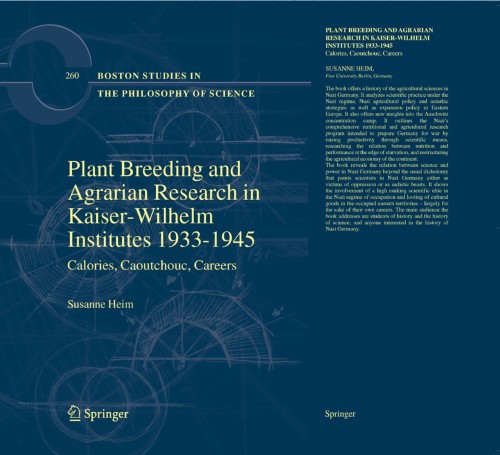
245 10|aPlant Breeding and Agrarian Research in Kaiser-Wilhelm-Institutes 1933-1945|h[electronic resource] :|bCalories, Caoutchouc, Careers /|cby Susanne Heim.
250 |a1st ed. 2008.
264 1|aDordrecht :|bSpringer Netherlands :|bImprint: Springer,|c2008.
300 |aX, 235 p.|bonline resource.
336 |atext|btxt|2rdacontent
337 |acomputer|bc|2rdamedia
338 |aonline resource|bcr|2rdacarrier
347 |atext file|bPDF|2rda
490 1 |aBoston Studies in the Philosophy and History of Science,|x2214-7942 ;|v260
505 0 |aFrom the contents Introduction: Politics and Agricultural Research -- Calories - Agricultural Research, the Food Economy and War. The Four-Year Plan, 'Greater Europe', and Substitute Substances. Résumé: War as Opportunity -- Caoutchouc – A Vital War Reserve; The Development of a Research Programme. Slave Labour for Science. Résumé: Scientific Productivity and Terror -- Careers - Hans Stubbe and Klaus von Rosenstiel; Two Breeding Researchers. The Advance of Science -- Post-War Careers. Résumé: Creators, Experts, Servants -- Conclusions: Science, Nazi Rule and War.
520 |aThe book offers a history of the agricultural sciences in Nazi Germany. It analyzes scientific practice under the Nazi regime, Nazi agricultural policy and autarkic strategies as well as expansion policy in Eastern Europe. It also offers new insights into the Auschwitz concentration camp. It outlines the Nazi’s comprehensive nutritional and agricultural research program intended to prepare Germany for war by raising productivity through scientific means, researching the relation between nutrition and performance at the edge of starvation, and restructuring the agricultural economy of the continent. The book reveals the relation between science and power in Nazi Germany beyond the usual dichotomy that paints scientists in Nazi Germany either as victims of oppression or as sadistic beasts. It shows the involvement of a high ranking scientific elite in the Nazi regime of occupation and looting of cultural goods in the occupied eastern territories – largely for the sake of their own careers. The main audience the book addresses are students of history and the history of science, and anyone interested in the history of Nazi Germany.
650 0|aScience|xHistory.
650 0|aAgriculture|xEconomic aspects.
650 0|aHistory.
650 0|aAgriculture.
650 0|aPlant genetics.
650 0|aPhysiology.
650 14|aHistory of Science.
650 24|aAgricultural Economics.
650 24|aHistory.
650 24|aAgriculture.
650 24|aPlant Genetics.
650 24|aAnimal Physiology.
710 2 |aSpringerLink (Online service)
773 0 |tSpringer Nature eBook
776 08|iPrinted edition:|z9781402067174
776 08|iPrinted edition:|z9789048115877
776 08|iPrinted edition:|z9789401776882
830 0|aBoston Studies in the Philosophy and History of Science,|x2214-7942 ;|v260
856 40|uhttps://doi.org/10.1007/978-1-4020-6718-1
912 |aZDB-2-SHU
912 |aZDB-2-SXH
950 |aHumanities, Social Sciences and Law (SpringerNature-11648)
950 |aHistory (R0) (SpringerNature-43722)