LEADER 04094nam a22005415i 4500
001 811243
003 TR_AnAIT
005 20260131011715
007 cr nn 008mamaa
008 100301s2004 xxu| s |||| 0|eng d
020 |a9781402079146|9978-1-4020-7914-6
024 7 |a10.1007/b120597|2doi
041 |aeng
049 |aTürk Tarih Kurumu Kütüphanesi
050 4|aQA10.92-20
072 7|aJNU|2bicssc
072 7|aPB|2bicssc
072 7|aEDU029010|2bisacsh
072 7|aJNU|2thema
072 7|aPB|2thema
082 04|a510.71|223
090 |aDK/12507
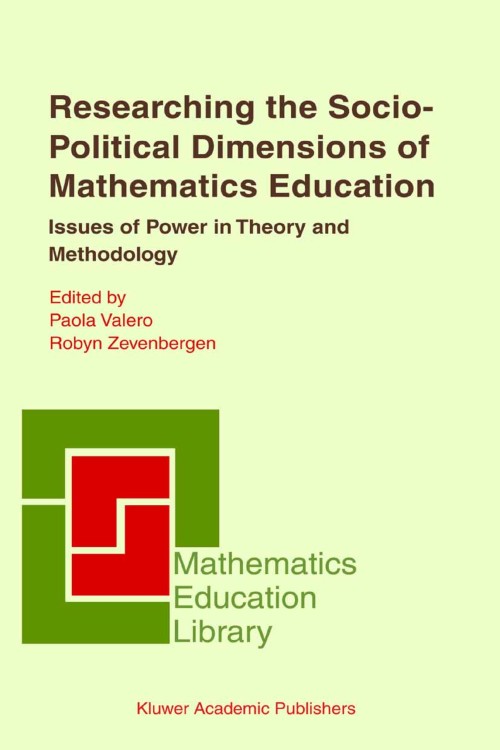
245 10|aResearching the Socio-Political Dimensions of Mathematics Education|h[electronic resource] :|bIssues of Power in Theory and Methodology /|cedited by Paola Valero, Robyn Zevenbergen.
250 |a1st ed. 2004.
264 1|aNew York, NY :|bSpringer US :|bImprint: Springer,|c2004.
300 |aXIV, 280 p.|bonline resource.
336 |atext|btxt|2rdacontent
337 |acomputer|bc|2rdamedia
338 |aonline resource|bcr|2rdacarrier
347 |atext file|bPDF|2rda
490 1 |aMathematics Education Library,|x2214-983X ;|v35
505 0 |aSetting the Scene of this Book -- Socio-political Perspectives on Mathematics Education -- First Dialogic Unit: Challenging Traditional Research Areas from Socio-political Perspectives -- The Socio-political Context of the Mathematics Classroom -- Assessment, Learning and Identity -- Second Dialogic Unit: Finding Alternative Theoretical Tools -- Postmodernity and Social Research in Mathematics Education -- Problematising Culture and Discourse for Mathematics Education Research -- Third Dialogic Unit: Researching in Conflictive situations -- Dichotomies, Complementarities and Tensions -- Lessons from Research with a Social Movement -- Fourth Dialogic Unit: Addressing the Researcher’s Positioning -- Researching the School Mathematics Culture of ‘Others’ -- The Fly on the Edge of the Porridge Bowl -- Fifth Dialogic Unit: Adopting Critical Approaches in Research Methodology -- Understanding for Changing and Changing for Understanding -- Research Methodology and Critical Mathematics Education -- Methodological Challenges for Mathematics Education Research from a Critical Perspective -- Epilogoue: Talking Back to Mathematics Education Research -- School Subjects, the Politics of Knowledge, and the Projects of Intellectuals in Change.
520 |aThis book examines mathematics education research from socio-political perspectives. It is organized in dialogic units which examine issues such as the critique of existing research results based on the adoption of socio-political approaches; the implications of alternative theoretical tools in researching mathematics education; the tensions emerging while conducting research in highly conflictive environments; the researchers’ positioning with respect to research participants; and the adoption of socio-political methodological frameworks. As a whole, the book serves to illuminate what it means to say that power is a central constituent of mathematics education practices and research. This book will be of interest to researchers in mathematics education and general education as well as to graduate students taking courses on mathematics education research.
650 0|aMathematics|xStudy and teaching .
650 0|aEducational sociology.
650 14|aMathematics Education.
650 24|aSociology of Education.
700 1 |aValero, Paola.|eeditor.|4edt|4http://id.loc.gov/vocabulary/relators/edt
700 1 |aZevenbergen, Robyn.|eeditor.|4edt|4http://id.loc.gov/vocabulary/relators/edt
710 2 |aSpringerLink (Online service)
773 0 |tSpringer Nature eBook
776 08|iPrinted edition:|z9781402079061
776 08|iPrinted edition:|z9781441954503
776 08|iPrinted edition:|z9781475788655
830 0|aMathematics Education Library,|x2214-983X ;|v35
856 40|uhttps://doi.org/10.1007/b120597
912 |aZDB-2-SHU
912 |aZDB-2-SXED
912 |aZDB-2-BAE
950 |aHumanities, Social Sciences and Law (SpringerNature-11648)
950 |aEducation (R0) (SpringerNature-43721)