LEADER 03843nam a22005895i 4500
001 811244
003 TR_AnAIT
005 20260131011708
007 cr nn 008mamaa
008 100301s2004 ne | s |||| 0|eng d
020 |a9781402079214|9978-1-4020-7921-4
024 7 |a10.1007/1-4020-7921-4|2doi
041 |aeng
049 |aTürk Tarih Kurumu Kütüphanesi
050 4|aL1-991
072 7|aJN|2bicssc
072 7|aEDU000000|2bisacsh
072 7|aJN|2thema
082 04|a370|223
090 |aDK/12508
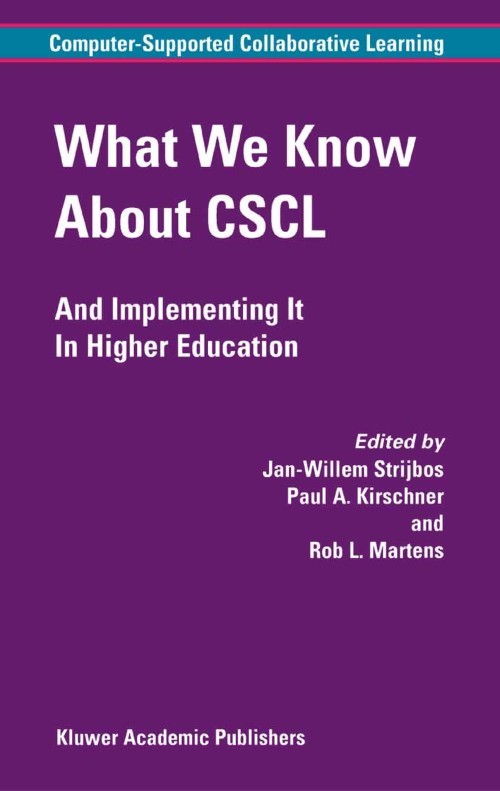
245 10|aWhat We Know About CSCL|h[electronic resource] :|bAnd Implementing It In Higher Education /|cedited by Jan-Willem Strijbos, Paul A. Kirschner, Rob L. Martens.
250 |a1st ed. 2004.
264 1|aDordrecht :|bSpringer Netherlands :|bImprint: Springer,|c2004.
300 |aXVIII, 262 p.|bonline resource.
336 |atext|btxt|2rdacontent
337 |acomputer|bc|2rdamedia
338 |aonline resource|bcr|2rdacarrier
347 |atext file|bPDF|2rda
490 1 |aComputer-Supported Collaborative Learning Series,|x2543-0157 ;|v3
505 0 |aIt is All About Learning! -- CSCL in Higher Education? -- Practices and Orientations of CSCL -- Learning, Collaboration and Assessment -- Building Collaborative Knowing -- Learning, Assessment and Collaboration in Computer-Supported Environments -- What do you Mean by‘Support’? -- Instructional Support in CSCL -- Computer Software Support for CSCL -- Human Support in CSCL -- Technology and Interaction -- CSCL-Ware in Practice -- Designing Sociable CSCL Environments -- Conclusion -- What We Know About CSCL.
520 |aA Dutch policy scientist once said the information and knowledge in the twenty-first century has the shelf life of fresh fish, and learning in this age often means learning where and how to find something and how to relate it to a specific situation instead of knowing everything one needs to know. On top of this, the world has become so highly interconnected that we have come to realise that every decision that we make can have repercussions somewhere else. To touch as many bases as possible, we need to work with knowledgeable others from different fields (multiple agents) and take heed of their points of view (multiple representations). To do this, we make increasing use of computers and computer-mediated communication. If computer-supported collaborative learning (CSCL) is not simply a newly discovered hype in education, what is it and why are we writing a book about it? Dissecting the phrase into its constituent parts, we see that first of all CSCL is about learning, and in the twenty-first century this usually means constructivist learning.
650 0|aEducation.
650 0|aUser interfaces (Computer systems).
650 0|aHuman-computer interaction.
650 0|aEducational technology.
650 0|aLearning, Psychology of.
650 14|aEducation.
650 24|aUser Interfaces and Human Computer Interaction.
650 24|aDigital Education and Educational Technology.
650 24|aInstructional Psychology.
700 1 |aStrijbos, Jan-Willem.|eeditor.|4edt|4http://id.loc.gov/vocabulary/relators/edt
700 1 |aKirschner, Paul A.|eeditor.|4edt|4http://id.loc.gov/vocabulary/relators/edt
700 1 |aMartens, Rob L.|eeditor.|4edt|4http://id.loc.gov/vocabulary/relators/edt
710 2 |aSpringerLink (Online service)
773 0 |tSpringer Nature eBook
776 08|iPrinted edition:|z9781402077791
776 08|iPrinted edition:|z9789401742009
776 08|iPrinted edition:|z9789401742016
830 0|aComputer-Supported Collaborative Learning Series,|x2543-0157 ;|v3
856 40|uhttps://doi.org/10.1007/1-4020-7921-4
912 |aZDB-2-SHU
912 |aZDB-2-SXED
912 |aZDB-2-BAE
950 |aHumanities, Social Sciences and Law (SpringerNature-11648)
950 |aEducation (R0) (SpringerNature-43721)