

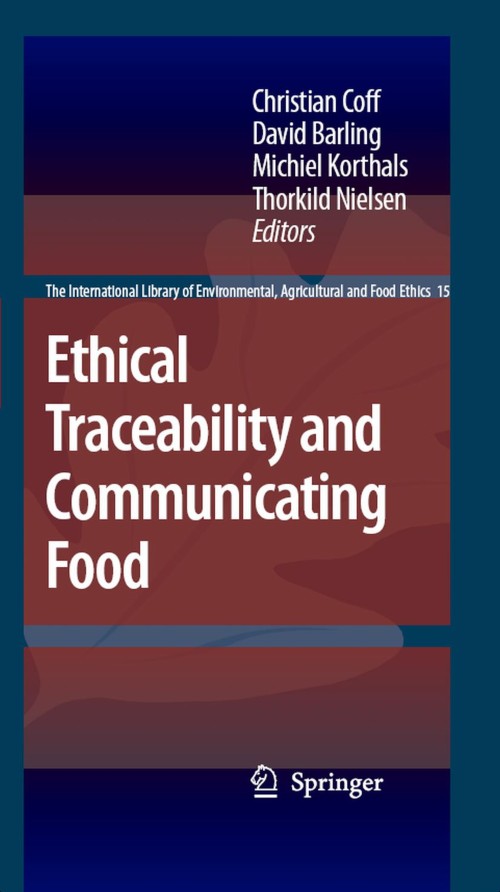
Ethical Traceability and Communicating Food [electronic resource] / edited by Christian Coff, David Barling, Michiel Korthals, Thorkild Nielsen.
Erişim Adresi
ISBN
9781402085246
Dil Kodu
İngilizce
Yer Numarası
DK/12525
Basım Bildirimi
1st ed. 2008.
Yayın Bilgisi
Dordrecht : Springer Netherlands : Imprint: Springer, 2008.
Fiziksel Niteleme
XXVI, 318 p. online resource.
Dizi
The International Library of Environmental, Agricultural and Food Ethics, 2215-1737 ; 15
İçindekiler Notu
Regulation, Governance and Narrative Strategies of Food Traceability -- Ethical Traceability and Informed Food Choice -- The European Union and the Regulation of Food Traceability: From Risk Management to Informed Choice? -- Governing and Governance in the Agri-Food Sector and Traceability -- Narrative Strategies in Food Advertising -- Ethical Traceability in Three Food Supply Chains: Case Studies of Danish Bacon, UK Wheat-Bread and Greek Olive Oil -- Ethical Traceability in the Bacon Supply Chain -- Ethical Traceability in the UK Wheat-Flour-Bread Chain -- Traceability and Ethical Traceability in the Greek Olive Oil Chain -- Ethical Traceability and its Philosophical Implications for Civil Society, Market, State and Democracy -- Challenges of Ethical Traceability to the Public-Private Divide -- Traceability of Animal Welfare: Market or State, Good or Right? -- Consumer Rights to Food Ethical Traceability -- Ethical Traceability and Ethical Room for Manoeuvre -- Interpreting Traceability: Improving the Democratic Quality of Traceability -- Conclusions and Outlook -- Communicating Ethical Traceability -- Conclusions and Policy Options.
Özet, vb.
Traceability – the ability to track a product from farm to plate – is now widely used in the food sector for a range of purposes: it allows companies to improve efficiency, facilitates product recall, and helps producers flag the specific characteristics of their goods. But traceability systems are mainly designed and used by the people directly involved in the food chain. The people at the end of the food chain – food consumers – have little say in which attributes are traced, and can rarely access the information stored in traceability systems. This book draws on philosophical discourses (like ethics, political philosophy and philosophy of law) around food ethics and empirical research in three important food chains (UK bread, Danish bacon and Greek olive oil) to argue that ethical traceability systems could be used to communicate food information to consumers, allowing them not only to make food choices consistent with their own values, but also to play a more informed role in the way food is produced and distributed. It will appeal to academics, students and policy makers with an interest in traceability, food ethics and food policy.
Konu
Ethics.
Technology __ Philosophy.
Sociology.
Moral Philosophy and Applied Ethics.
Philosophy of Technology.
Sociology.
Technology __ Philosophy.
Sociology.
Moral Philosophy and Applied Ethics.
Philosophy of Technology.
Sociology.
Kurum Adı
Eseri Alıntıla
Referansları kullanmadan önce gözden geçirmeniz ve varsa gerekli düzeltmeleri yapmanız önerilir.
Dijital Kaynak
MARC Görünümü
LEADER 04522nam a22005535i 4500
001 811261
003 TR_AnAIT
005 20260131011557
007 cr nn 008mamaa
008 100301s2008 ne | s |||| 0|eng d
020 |a9781402085246|9978-1-4020-8524-6
024 7 |a10.1007/978-1-4020-8524-6|2doi
041 |aeng
049 |aTürk Tarih Kurumu Kütüphanesi
050 4|aBJ1-1725
072 7|aHPQ|2bicssc
072 7|aPHI005000|2bisacsh
072 7|aQDTQ|2thema
082 04|a170|223
090 |aDK/12525
245 10|aEthical Traceability and Communicating Food|h[electronic resource] /|cedited by Christian Coff, David Barling, Michiel Korthals, Thorkild Nielsen.
250 |a1st ed. 2008.
264 1|aDordrecht :|bSpringer Netherlands :|bImprint: Springer,|c2008.
300 |aXXVI, 318 p.|bonline resource.
336 |atext|btxt|2rdacontent
337 |acomputer|bc|2rdamedia
338 |aonline resource|bcr|2rdacarrier
347 |atext file|bPDF|2rda
490 1 |aThe International Library of Environmental, Agricultural and Food Ethics,|x2215-1737 ;|v15
505 0 |aRegulation, Governance and Narrative Strategies of Food Traceability -- Ethical Traceability and Informed Food Choice -- The European Union and the Regulation of Food Traceability: From Risk Management to Informed Choice? -- Governing and Governance in the Agri-Food Sector and Traceability -- Narrative Strategies in Food Advertising -- Ethical Traceability in Three Food Supply Chains: Case Studies of Danish Bacon, UK Wheat-Bread and Greek Olive Oil -- Ethical Traceability in the Bacon Supply Chain -- Ethical Traceability in the UK Wheat-Flour-Bread Chain -- Traceability and Ethical Traceability in the Greek Olive Oil Chain -- Ethical Traceability and its Philosophical Implications for Civil Society, Market, State and Democracy -- Challenges of Ethical Traceability to the Public-Private Divide -- Traceability of Animal Welfare: Market or State, Good or Right? -- Consumer Rights to Food Ethical Traceability -- Ethical Traceability and Ethical Room for Manoeuvre -- Interpreting Traceability: Improving the Democratic Quality of Traceability -- Conclusions and Outlook -- Communicating Ethical Traceability -- Conclusions and Policy Options.
520 |aTraceability – the ability to track a product from farm to plate – is now widely used in the food sector for a range of purposes: it allows companies to improve efficiency, facilitates product recall, and helps producers flag the specific characteristics of their goods. But traceability systems are mainly designed and used by the people directly involved in the food chain. The people at the end of the food chain – food consumers – have little say in which attributes are traced, and can rarely access the information stored in traceability systems. This book draws on philosophical discourses (like ethics, political philosophy and philosophy of law) around food ethics and empirical research in three important food chains (UK bread, Danish bacon and Greek olive oil) to argue that ethical traceability systems could be used to communicate food information to consumers, allowing them not only to make food choices consistent with their own values, but also to play a more informed role in the way food is produced and distributed. It will appeal to academics, students and policy makers with an interest in traceability, food ethics and food policy.
650 0|aEthics.
650 0|aTechnology|xPhilosophy.
650 0|aSociology.
650 14|aMoral Philosophy and Applied Ethics.
650 24|aPhilosophy of Technology.
650 24|aSociology.
700 1 |aCoff, Christian.|eeditor.|4edt|4http://id.loc.gov/vocabulary/relators/edt
700 1 |aBarling, David.|eeditor.|4edt|4http://id.loc.gov/vocabulary/relators/edt
700 1 |aKorthals, Michiel.|eeditor.|4edt|4http://id.loc.gov/vocabulary/relators/edt
700 1 |aNielsen, Thorkild.|eeditor.|4edt|4http://id.loc.gov/vocabulary/relators/edt
710 2 |aSpringerLink (Online service)
773 0 |tSpringer Nature eBook
776 08|iPrinted edition:|z9781402085239
776 08|iPrinted edition:|z9789048120307
776 08|iPrinted edition:|z9789048179008
830 0|aThe International Library of Environmental, Agricultural and Food Ethics,|x2215-1737 ;|v15
856 40|uhttps://doi.org/10.1007/978-1-4020-8524-6
912 |aZDB-2-SHU
912 |aZDB-2-SXPR
950 |aHumanities, Social Sciences and Law (SpringerNature-11648)
950 |aPhilosophy and Religion (R0) (SpringerNature-43725)
001 811261
003 TR_AnAIT
005 20260131011557
007 cr nn 008mamaa
008 100301s2008 ne | s |||| 0|eng d
020 |a9781402085246|9978-1-4020-8524-6
024 7 |a10.1007/978-1-4020-8524-6|2doi
041 |aeng
049 |aTürk Tarih Kurumu Kütüphanesi
050 4|aBJ1-1725
072 7|aHPQ|2bicssc
072 7|aPHI005000|2bisacsh
072 7|aQDTQ|2thema
082 04|a170|223
090 |aDK/12525
245 10|aEthical Traceability and Communicating Food|h[electronic resource] /|cedited by Christian Coff, David Barling, Michiel Korthals, Thorkild Nielsen.
250 |a1st ed. 2008.
264 1|aDordrecht :|bSpringer Netherlands :|bImprint: Springer,|c2008.
300 |aXXVI, 318 p.|bonline resource.
336 |atext|btxt|2rdacontent
337 |acomputer|bc|2rdamedia
338 |aonline resource|bcr|2rdacarrier
347 |atext file|bPDF|2rda
490 1 |aThe International Library of Environmental, Agricultural and Food Ethics,|x2215-1737 ;|v15
505 0 |aRegulation, Governance and Narrative Strategies of Food Traceability -- Ethical Traceability and Informed Food Choice -- The European Union and the Regulation of Food Traceability: From Risk Management to Informed Choice? -- Governing and Governance in the Agri-Food Sector and Traceability -- Narrative Strategies in Food Advertising -- Ethical Traceability in Three Food Supply Chains: Case Studies of Danish Bacon, UK Wheat-Bread and Greek Olive Oil -- Ethical Traceability in the Bacon Supply Chain -- Ethical Traceability in the UK Wheat-Flour-Bread Chain -- Traceability and Ethical Traceability in the Greek Olive Oil Chain -- Ethical Traceability and its Philosophical Implications for Civil Society, Market, State and Democracy -- Challenges of Ethical Traceability to the Public-Private Divide -- Traceability of Animal Welfare: Market or State, Good or Right? -- Consumer Rights to Food Ethical Traceability -- Ethical Traceability and Ethical Room for Manoeuvre -- Interpreting Traceability: Improving the Democratic Quality of Traceability -- Conclusions and Outlook -- Communicating Ethical Traceability -- Conclusions and Policy Options.
520 |aTraceability – the ability to track a product from farm to plate – is now widely used in the food sector for a range of purposes: it allows companies to improve efficiency, facilitates product recall, and helps producers flag the specific characteristics of their goods. But traceability systems are mainly designed and used by the people directly involved in the food chain. The people at the end of the food chain – food consumers – have little say in which attributes are traced, and can rarely access the information stored in traceability systems. This book draws on philosophical discourses (like ethics, political philosophy and philosophy of law) around food ethics and empirical research in three important food chains (UK bread, Danish bacon and Greek olive oil) to argue that ethical traceability systems could be used to communicate food information to consumers, allowing them not only to make food choices consistent with their own values, but also to play a more informed role in the way food is produced and distributed. It will appeal to academics, students and policy makers with an interest in traceability, food ethics and food policy.
650 0|aEthics.
650 0|aTechnology|xPhilosophy.
650 0|aSociology.
650 14|aMoral Philosophy and Applied Ethics.
650 24|aPhilosophy of Technology.
650 24|aSociology.
700 1 |aCoff, Christian.|eeditor.|4edt|4http://id.loc.gov/vocabulary/relators/edt
700 1 |aBarling, David.|eeditor.|4edt|4http://id.loc.gov/vocabulary/relators/edt
700 1 |aKorthals, Michiel.|eeditor.|4edt|4http://id.loc.gov/vocabulary/relators/edt
700 1 |aNielsen, Thorkild.|eeditor.|4edt|4http://id.loc.gov/vocabulary/relators/edt
710 2 |aSpringerLink (Online service)
773 0 |tSpringer Nature eBook
776 08|iPrinted edition:|z9781402085239
776 08|iPrinted edition:|z9789048120307
776 08|iPrinted edition:|z9789048179008
830 0|aThe International Library of Environmental, Agricultural and Food Ethics,|x2215-1737 ;|v15
856 40|uhttps://doi.org/10.1007/978-1-4020-8524-6
912 |aZDB-2-SHU
912 |aZDB-2-SXPR
950 |aHumanities, Social Sciences and Law (SpringerNature-11648)
950 |aPhilosophy and Religion (R0) (SpringerNature-43725)
Materyaller
Depodan talep edilen materyal sadece kütüphane içerisinde kullanılmaktadır.
Materyal dışarıya ödünç verilmemektedir.
Materyal dışarıya ödünç verilmemektedir.
