

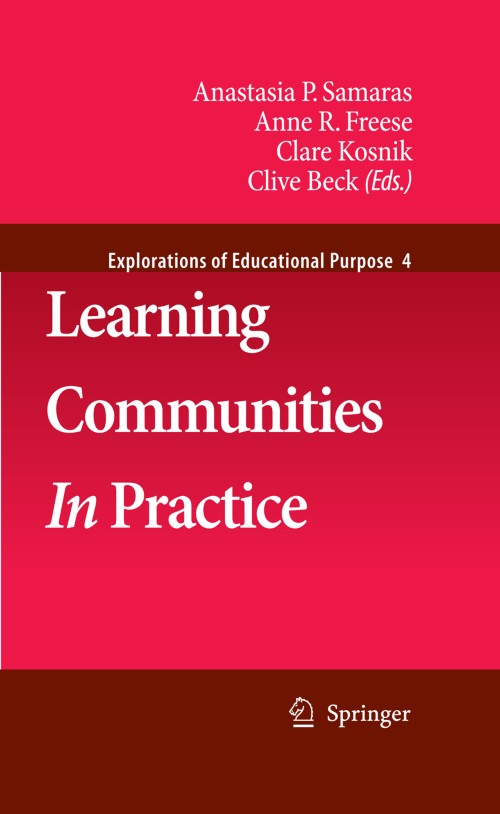
Learning Communities In Practice [electronic resource] / edited by Anastasia Samaras, Anne R. Freese, Clare Kosnik, Clive Beck.
Erişim Adresi
ISBN
9781402087882
Dil Kodu
İngilizce
Yer Numarası
DK/12533
Basım Bildirimi
1st ed. 2008.
Yayın Bilgisi
Dordrecht : Springer Netherlands : Imprint: Springer, 2008.
Fiziksel Niteleme
XIX, 251 p. online resource.
Dizi
Explorations of Educational Purpose, 1875-4457 ; 4
İçindekiler Notu
Learning Communities in School Settings -- The Project for Enhancing Effective Learning (PEEL): 22 Years of Praxis -- DICEP: Promoting Collaborative Inquiry in Diverse Educational Settings -- Pre-Service Teachers and Sixth Graders Explore Social Justice as a Community of Inquiry -- Lights, Camera, Action! Using Slowmation as a Common Teaching Approach to Promote a School Learning Community -- Growing Our Own: A Learning Community Partnership between a University and a Public Middle School -- A Whole-School Approach to Urban Educational Renewal: Community, Collaboration, and Leadership -- Learning Communities in University Settings -- Fellow Travelers: New Teachers and Their Graduate School Faculty Take a Journey to the Land of Peer Discussion Groups -- Establishing a Learning Community as a Site to Explore Our Multicultural Selves -- Dissertation Support Groups: Building a Community of Practice Using Noddings' Ethic of Care -- Collective Creativity: A Learning Community of Self-Study Scholars -- Learning Communities in Professional Networks -- A Learning Community for Teacher Induction -- Creating an International Learning Community for Teacher Education Scholars -- Role of Teacher Research Communities and Cross-Culture Collaboration in the Context of Curriculum Reform in China -- Creating Stages for Development: A Learning Community with Many Tasks and No Goal -- Supervisors of Teacher Interns: Building a Learning Community Through Inquiry-Based Practices -- Funny, This Does Not Look Like a Community: Working Collaboratively Across Borders and Institutions.
Özet, vb.
Most would agree that a learning community of practice cultivates social and intellectual development in educational settings but what are the other benefits and what does a learning community actually look like in practice? This book explores such questions as: "Are learning communities essential in education?" "How are they designed and developed?" "What difference do they make in learning?" The book contains contributions of educators who share their research and practice in designing and implementing learning communities in school, university, and professional network settings. It presents their experiences, and the "how to" of these educators who are passionate about building and sustaining learning communities to make a real difference for students, teachers, faculty, and communities. Combining scholarly and practitioner research, the book offers practical information to teachers, school and university administrators, teacher educators, and community educators. "This is an extraordinary collection of theoretically sound and practical ideas for teachers and teacher educators. The authors present fascinating accounts of down-to-earth practices tested in experience. Priceless!" Nel Noddings, Lee Jacks Professor of Education Emerita, Stanford University "This book provides a wealth of information on how learning communities function in practice and, more importantly, how they are sustained over time. The chapter authors document a wide array of international programs located in different institutional settings, including cross-institutional and cross-national programs. I recommend this book for both university-based and school or district-based educators who are serious about improving instruction based on locally available data." Renée T. Clift, Professor, University of Illinois at Urbana-Champaign "As the title announces, this wide-ranging collection of chapters shows learningcommunities actually at work, as their members– in schools, universities, and professional networks – describe what got them started and what keeps them going, despite the wider educational community’s general lack of support. Common to all chapters is a strong awareness of the benefits of learning communities not only for the teachers and researchers who share, critique and improve their own professional activities, but also for the students they teach; indeed, in several cases, the authors’ classrooms also metamorphosed into powerful communities of student coresearchers. Thus, for those who have been involved in a learning community such as those described here, the answer to the question the editors pose, "Are learning communities essential in education?" the answer is an unequivocal "Yes." Hopefully, this book will enable others to see why this is so; it will certainly provide guidance for those who decide to embark on the kinds of journey that are so eloquently and persuasively presented in all the different sections of this book. " Gordon Wells, Professor of Education, University of California, Santa Cruz.
Konu
Teachers __ Training of.
Learning, Psychology of.
Teaching and Teacher Education.
Instructional Psychology.
Learning, Psychology of.
Teaching and Teacher Education.
Instructional Psychology.
Diğer Yazarlar
Kurum Adı
Eseri Alıntıla
Referansları kullanmadan önce gözden geçirmeniz ve varsa gerekli düzeltmeleri yapmanız önerilir.
Dijital Kaynak
MARC Görünümü
LEADER 06692nam a22005295i 4500
001 811270
003 TR_AnAIT
005 20260131011526
007 cr nn 008mamaa
008 100301s2008 ne | s |||| 0|eng d
020 |a9781402087882|9978-1-4020-8788-2
024 7 |a10.1007/978-1-4020-8788-2|2doi
041 |aeng
049 |aTürk Tarih Kurumu Kütüphanesi
050 4|aLB1705-2286
072 7|aJNMT|2bicssc
072 7|aEDU053000|2bisacsh
072 7|aJNMT|2thema
082 04|a370.711|223
090 |aDK/12533
245 10|aLearning Communities In Practice|h[electronic resource] /|cedited by Anastasia Samaras, Anne R. Freese, Clare Kosnik, Clive Beck.
250 |a1st ed. 2008.
264 1|aDordrecht :|bSpringer Netherlands :|bImprint: Springer,|c2008.
300 |aXIX, 251 p.|bonline resource.
336 |atext|btxt|2rdacontent
337 |acomputer|bc|2rdamedia
338 |aonline resource|bcr|2rdacarrier
347 |atext file|bPDF|2rda
490 1 |aExplorations of Educational Purpose,|x1875-4457 ;|v4
505 0 |aLearning Communities in School Settings -- The Project for Enhancing Effective Learning (PEEL): 22 Years of Praxis -- DICEP: Promoting Collaborative Inquiry in Diverse Educational Settings -- Pre-Service Teachers and Sixth Graders Explore Social Justice as a Community of Inquiry -- Lights, Camera, Action! Using Slowmation as a Common Teaching Approach to Promote a School Learning Community -- Growing Our Own: A Learning Community Partnership between a University and a Public Middle School -- A Whole-School Approach to Urban Educational Renewal: Community, Collaboration, and Leadership -- Learning Communities in University Settings -- Fellow Travelers: New Teachers and Their Graduate School Faculty Take a Journey to the Land of Peer Discussion Groups -- Establishing a Learning Community as a Site to Explore Our Multicultural Selves -- Dissertation Support Groups: Building a Community of Practice Using Noddings' Ethic of Care -- Collective Creativity: A Learning Community of Self-Study Scholars -- Learning Communities in Professional Networks -- A Learning Community for Teacher Induction -- Creating an International Learning Community for Teacher Education Scholars -- Role of Teacher Research Communities and Cross-Culture Collaboration in the Context of Curriculum Reform in China -- Creating Stages for Development: A Learning Community with Many Tasks and No Goal -- Supervisors of Teacher Interns: Building a Learning Community Through Inquiry-Based Practices -- Funny, This Does Not Look Like a Community: Working Collaboratively Across Borders and Institutions.
520 |aMost would agree that a learning community of practice cultivates social and intellectual development in educational settings but what are the other benefits and what does a learning community actually look like in practice? This book explores such questions as: "Are learning communities essential in education?" "How are they designed and developed?" "What difference do they make in learning?" The book contains contributions of educators who share their research and practice in designing and implementing learning communities in school, university, and professional network settings. It presents their experiences, and the "how to" of these educators who are passionate about building and sustaining learning communities to make a real difference for students, teachers, faculty, and communities. Combining scholarly and practitioner research, the book offers practical information to teachers, school and university administrators, teacher educators, and community educators. "This is an extraordinary collection of theoretically sound and practical ideas for teachers and teacher educators. The authors present fascinating accounts of down-to-earth practices tested in experience. Priceless!" Nel Noddings, Lee Jacks Professor of Education Emerita, Stanford University "This book provides a wealth of information on how learning communities function in practice and, more importantly, how they are sustained over time. The chapter authors document a wide array of international programs located in different institutional settings, including cross-institutional and cross-national programs. I recommend this book for both university-based and school or district-based educators who are serious about improving instruction based on locally available data." Renée T. Clift, Professor, University of Illinois at Urbana-Champaign "As the title announces, this wide-ranging collection of chapters shows learningcommunities actually at work, as their members– in schools, universities, and professional networks – describe what got them started and what keeps them going, despite the wider educational community’s general lack of support. Common to all chapters is a strong awareness of the benefits of learning communities not only for the teachers and researchers who share, critique and improve their own professional activities, but also for the students they teach; indeed, in several cases, the authors’ classrooms also metamorphosed into powerful communities of student coresearchers. Thus, for those who have been involved in a learning community such as those described here, the answer to the question the editors pose, "Are learning communities essential in education?" the answer is an unequivocal "Yes." Hopefully, this book will enable others to see why this is so; it will certainly provide guidance for those who decide to embark on the kinds of journey that are so eloquently and persuasively presented in all the different sections of this book. " Gordon Wells, Professor of Education, University of California, Santa Cruz.
650 0|aTeachers|xTraining of.
650 0|aLearning, Psychology of.
650 14|aTeaching and Teacher Education.
650 24|aInstructional Psychology.
700 1 |aSamaras, Anastasia.|eeditor.|4edt|4http://id.loc.gov/vocabulary/relators/edt
700 1 |aFreese, Anne R.|eeditor.|4edt|4http://id.loc.gov/vocabulary/relators/edt
700 1 |aKosnik, Clare.|eeditor.|4edt|4http://id.loc.gov/vocabulary/relators/edt
700 1 |aBeck, Clive.|eeditor.|4edt|4http://id.loc.gov/vocabulary/relators/edt
710 2 |aSpringerLink (Online service)
773 0 |tSpringer Nature eBook
776 08|iPrinted edition:|z9781402087875
776 08|iPrinted edition:|z9789048121519
776 08|iPrinted edition:|z9789048179886
830 0|aExplorations of Educational Purpose,|x1875-4457 ;|v4
856 40|uhttps://doi.org/10.1007/978-1-4020-8788-2
912 |aZDB-2-SHU
912 |aZDB-2-SXED
950 |aHumanities, Social Sciences and Law (SpringerNature-11648)
950 |aEducation (R0) (SpringerNature-43721)
001 811270
003 TR_AnAIT
005 20260131011526
007 cr nn 008mamaa
008 100301s2008 ne | s |||| 0|eng d
020 |a9781402087882|9978-1-4020-8788-2
024 7 |a10.1007/978-1-4020-8788-2|2doi
041 |aeng
049 |aTürk Tarih Kurumu Kütüphanesi
050 4|aLB1705-2286
072 7|aJNMT|2bicssc
072 7|aEDU053000|2bisacsh
072 7|aJNMT|2thema
082 04|a370.711|223
090 |aDK/12533
245 10|aLearning Communities In Practice|h[electronic resource] /|cedited by Anastasia Samaras, Anne R. Freese, Clare Kosnik, Clive Beck.
250 |a1st ed. 2008.
264 1|aDordrecht :|bSpringer Netherlands :|bImprint: Springer,|c2008.
300 |aXIX, 251 p.|bonline resource.
336 |atext|btxt|2rdacontent
337 |acomputer|bc|2rdamedia
338 |aonline resource|bcr|2rdacarrier
347 |atext file|bPDF|2rda
490 1 |aExplorations of Educational Purpose,|x1875-4457 ;|v4
505 0 |aLearning Communities in School Settings -- The Project for Enhancing Effective Learning (PEEL): 22 Years of Praxis -- DICEP: Promoting Collaborative Inquiry in Diverse Educational Settings -- Pre-Service Teachers and Sixth Graders Explore Social Justice as a Community of Inquiry -- Lights, Camera, Action! Using Slowmation as a Common Teaching Approach to Promote a School Learning Community -- Growing Our Own: A Learning Community Partnership between a University and a Public Middle School -- A Whole-School Approach to Urban Educational Renewal: Community, Collaboration, and Leadership -- Learning Communities in University Settings -- Fellow Travelers: New Teachers and Their Graduate School Faculty Take a Journey to the Land of Peer Discussion Groups -- Establishing a Learning Community as a Site to Explore Our Multicultural Selves -- Dissertation Support Groups: Building a Community of Practice Using Noddings' Ethic of Care -- Collective Creativity: A Learning Community of Self-Study Scholars -- Learning Communities in Professional Networks -- A Learning Community for Teacher Induction -- Creating an International Learning Community for Teacher Education Scholars -- Role of Teacher Research Communities and Cross-Culture Collaboration in the Context of Curriculum Reform in China -- Creating Stages for Development: A Learning Community with Many Tasks and No Goal -- Supervisors of Teacher Interns: Building a Learning Community Through Inquiry-Based Practices -- Funny, This Does Not Look Like a Community: Working Collaboratively Across Borders and Institutions.
520 |aMost would agree that a learning community of practice cultivates social and intellectual development in educational settings but what are the other benefits and what does a learning community actually look like in practice? This book explores such questions as: "Are learning communities essential in education?" "How are they designed and developed?" "What difference do they make in learning?" The book contains contributions of educators who share their research and practice in designing and implementing learning communities in school, university, and professional network settings. It presents their experiences, and the "how to" of these educators who are passionate about building and sustaining learning communities to make a real difference for students, teachers, faculty, and communities. Combining scholarly and practitioner research, the book offers practical information to teachers, school and university administrators, teacher educators, and community educators. "This is an extraordinary collection of theoretically sound and practical ideas for teachers and teacher educators. The authors present fascinating accounts of down-to-earth practices tested in experience. Priceless!" Nel Noddings, Lee Jacks Professor of Education Emerita, Stanford University "This book provides a wealth of information on how learning communities function in practice and, more importantly, how they are sustained over time. The chapter authors document a wide array of international programs located in different institutional settings, including cross-institutional and cross-national programs. I recommend this book for both university-based and school or district-based educators who are serious about improving instruction based on locally available data." Renée T. Clift, Professor, University of Illinois at Urbana-Champaign "As the title announces, this wide-ranging collection of chapters shows learningcommunities actually at work, as their members– in schools, universities, and professional networks – describe what got them started and what keeps them going, despite the wider educational community’s general lack of support. Common to all chapters is a strong awareness of the benefits of learning communities not only for the teachers and researchers who share, critique and improve their own professional activities, but also for the students they teach; indeed, in several cases, the authors’ classrooms also metamorphosed into powerful communities of student coresearchers. Thus, for those who have been involved in a learning community such as those described here, the answer to the question the editors pose, "Are learning communities essential in education?" the answer is an unequivocal "Yes." Hopefully, this book will enable others to see why this is so; it will certainly provide guidance for those who decide to embark on the kinds of journey that are so eloquently and persuasively presented in all the different sections of this book. " Gordon Wells, Professor of Education, University of California, Santa Cruz.
650 0|aTeachers|xTraining of.
650 0|aLearning, Psychology of.
650 14|aTeaching and Teacher Education.
650 24|aInstructional Psychology.
700 1 |aSamaras, Anastasia.|eeditor.|4edt|4http://id.loc.gov/vocabulary/relators/edt
700 1 |aFreese, Anne R.|eeditor.|4edt|4http://id.loc.gov/vocabulary/relators/edt
700 1 |aKosnik, Clare.|eeditor.|4edt|4http://id.loc.gov/vocabulary/relators/edt
700 1 |aBeck, Clive.|eeditor.|4edt|4http://id.loc.gov/vocabulary/relators/edt
710 2 |aSpringerLink (Online service)
773 0 |tSpringer Nature eBook
776 08|iPrinted edition:|z9781402087875
776 08|iPrinted edition:|z9789048121519
776 08|iPrinted edition:|z9789048179886
830 0|aExplorations of Educational Purpose,|x1875-4457 ;|v4
856 40|uhttps://doi.org/10.1007/978-1-4020-8788-2
912 |aZDB-2-SHU
912 |aZDB-2-SXED
950 |aHumanities, Social Sciences and Law (SpringerNature-11648)
950 |aEducation (R0) (SpringerNature-43721)
Materyaller
Depodan talep edilen materyal sadece kütüphane içerisinde kullanılmaktadır.
Materyal dışarıya ödünç verilmemektedir.
Materyal dışarıya ödünç verilmemektedir.
