

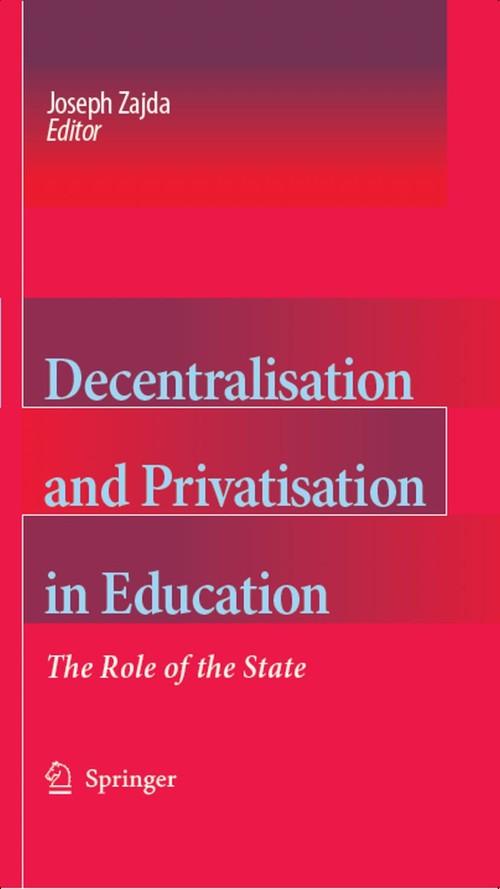
Decentralisation and Privatisation in Education [electronic resource] : The Role of the State / edited by Joseph Zajda.
Erişim Adresi
ISBN
9781402033582
Dil Kodu
İngilizce
Yer Numarası
DK/12560
Basım Bildirimi
1st ed. 2006.
Yayın Bilgisi
Dordrecht : Springer Netherlands : Imprint: Springer, 2006.
Fiziksel Niteleme
XVIII, 240 p. online resource.
İçindekiler Notu
Global Perspectives on Decentralisation and Privatisation in Education -- Introduction: Decentralisation and Privatisation in Education: The Role of the State -- Privatisation in Education in Canada: A Survey of Trends -- Decentralisation and Privatisation of Education in Africa: Which one for Nigeria? -- Privatisation, Decentralisation and Governance in Education in the Czech Republic, England, France, Germany, and Sweden -- Privatisation, Decentralisation, and Education in the United Kingdom: The Role of the State -- Focus on Asia and Latin America -- The Decentralisation of Education in Kerala State, India: Rhetoric and Reality -- Decentralisation in Education, Institutional Culture and Teacher Autonomy in Indonesia -- Decentralisation and School-Based Management in Thailand -- The Politics of Decentralisation in Latin America -- Privatisation and Vouchers in Colombia and Chile -- The Politics of Privatisation, Decentralisation and Education Reform in Mexico.
Özet, vb.
Decentralisation and Privatisation in Education explores the ambivalent and problematic relationship between the State, privatisation, and decentralisation in education globally. Using a number of diverse paradigms, ranging from critical theory to globalisation, the authors, by focusing on privatisation, marketisation and decentralisation, will attempt to examine critically both the reasons and outcomes of education reforms, policy change and transformation and provide a more informed critique on the Western-driven models of accountability, quality and school effectiveness. We want to demonstrate that claims of advantages in ‘efficiency’ brought about by privatisation in education are not always supported empirically as proposed by proponents. The book examines the overall interplay between privatisation, decentralisation and the role of the state. The authors draw upon recent studies in the areas of decentralisation, privatisation and the role of the state in education. By referring to Bourdieu’s call for critical policy analysts to engage in a ‘critical sociology’ of their own contexts of practice, and poststructuralist and postmodernist pedagogy, this collection of book chapters demonstrate how central discourses surrounding the debate of privatisation, decentralisation and the role of the state are formed in the contexts of dominant ideology, power, and culturally and historically derived perceptions and practices. The authors discuss the newly constructed and re-invented imperatives of privatisation, decentralisation and marketisation and show how they may well be operating as an educational model of a new global ‘master narrative’— playing a hegemonic role within the framework of economic, political and cultural hybrids of globalization.
Konu
Education and state.
International education .
Comparative education.
School management and organization.
School administration.
Educational Policy and Politics.
International and Comparative Education.
Organization and Leadership.
International education .
Comparative education.
School management and organization.
School administration.
Educational Policy and Politics.
International and Comparative Education.
Organization and Leadership.
Diğer Yazarlar
Kurum Adı
Eseri Alıntıla
Referansları kullanmadan önce gözden geçirmeniz ve varsa gerekli düzeltmeleri yapmanız önerilir.
Dijital Kaynak
MARC Görünümü
LEADER 04593nam a22005175i 4500
001 811297
003 TR_AnAIT
005 20260131011311
007 cr nn 008mamaa
008 100301s2006 ne | s |||| 0|eng d
020 |a9781402033582|9978-1-4020-3358-2
024 7 |a10.1007/978-1-4020-3358-2|2doi
041 |aeng
049 |aTürk Tarih Kurumu Kütüphanesi
050 4|aLC71-188
072 7|aJNF|2bicssc
072 7|aEDU034000|2bisacsh
072 7|aJNF|2thema
082 04|a379|223
090 |aDK/12560
245 10|aDecentralisation and Privatisation in Education|h[electronic resource] :|bThe Role of the State /|cedited by Joseph Zajda.
250 |a1st ed. 2006.
264 1|aDordrecht :|bSpringer Netherlands :|bImprint: Springer,|c2006.
300 |aXVIII, 240 p.|bonline resource.
336 |atext|btxt|2rdacontent
337 |acomputer|bc|2rdamedia
338 |aonline resource|bcr|2rdacarrier
347 |atext file|bPDF|2rda
505 0 |aGlobal Perspectives on Decentralisation and Privatisation in Education -- Introduction: Decentralisation and Privatisation in Education: The Role of the State -- Privatisation in Education in Canada: A Survey of Trends -- Decentralisation and Privatisation of Education in Africa: Which one for Nigeria? -- Privatisation, Decentralisation and Governance in Education in the Czech Republic, England, France, Germany, and Sweden -- Privatisation, Decentralisation, and Education in the United Kingdom: The Role of the State -- Focus on Asia and Latin America -- The Decentralisation of Education in Kerala State, India: Rhetoric and Reality -- Decentralisation in Education, Institutional Culture and Teacher Autonomy in Indonesia -- Decentralisation and School-Based Management in Thailand -- The Politics of Decentralisation in Latin America -- Privatisation and Vouchers in Colombia and Chile -- The Politics of Privatisation, Decentralisation and Education Reform in Mexico.
520 |aDecentralisation and Privatisation in Education explores the ambivalent and problematic relationship between the State, privatisation, and decentralisation in education globally. Using a number of diverse paradigms, ranging from critical theory to globalisation, the authors, by focusing on privatisation, marketisation and decentralisation, will attempt to examine critically both the reasons and outcomes of education reforms, policy change and transformation and provide a more informed critique on the Western-driven models of accountability, quality and school effectiveness. We want to demonstrate that claims of advantages in ‘efficiency’ brought about by privatisation in education are not always supported empirically as proposed by proponents. The book examines the overall interplay between privatisation, decentralisation and the role of the state. The authors draw upon recent studies in the areas of decentralisation, privatisation and the role of the state in education. By referring to Bourdieu’s call for critical policy analysts to engage in a ‘critical sociology’ of their own contexts of practice, and poststructuralist and postmodernist pedagogy, this collection of book chapters demonstrate how central discourses surrounding the debate of privatisation, decentralisation and the role of the state are formed in the contexts of dominant ideology, power, and culturally and historically derived perceptions and practices. The authors discuss the newly constructed and re-invented imperatives of privatisation, decentralisation and marketisation and show how they may well be operating as an educational model of a new global ‘master narrative’— playing a hegemonic role within the framework of economic, political and cultural hybrids of globalization.
650 0|aEducation and state.
650 0|aInternational education .
650 0|aComparative education.
650 0|aSchool management and organization.
650 0|aSchool administration.
650 14|aEducational Policy and Politics.
650 24|aInternational and Comparative Education.
650 24|aOrganization and Leadership.
700 1 |aZajda, Joseph.|eeditor.|4edt|4http://id.loc.gov/vocabulary/relators/edt
710 2 |aSpringerLink (Online service)
773 0 |tSpringer Nature eBook
776 08|iPrinted edition:|z9781402033575
776 08|iPrinted edition:|z9789048102778
776 08|iPrinted edition:|z9789048168446
856 40|uhttps://doi.org/10.1007/978-1-4020-3358-2
912 |aZDB-2-SHU
912 |aZDB-2-SXED
950 |aHumanities, Social Sciences and Law (SpringerNature-11648)
950 |aEducation (R0) (SpringerNature-43721)
001 811297
003 TR_AnAIT
005 20260131011311
007 cr nn 008mamaa
008 100301s2006 ne | s |||| 0|eng d
020 |a9781402033582|9978-1-4020-3358-2
024 7 |a10.1007/978-1-4020-3358-2|2doi
041 |aeng
049 |aTürk Tarih Kurumu Kütüphanesi
050 4|aLC71-188
072 7|aJNF|2bicssc
072 7|aEDU034000|2bisacsh
072 7|aJNF|2thema
082 04|a379|223
090 |aDK/12560
245 10|aDecentralisation and Privatisation in Education|h[electronic resource] :|bThe Role of the State /|cedited by Joseph Zajda.
250 |a1st ed. 2006.
264 1|aDordrecht :|bSpringer Netherlands :|bImprint: Springer,|c2006.
300 |aXVIII, 240 p.|bonline resource.
336 |atext|btxt|2rdacontent
337 |acomputer|bc|2rdamedia
338 |aonline resource|bcr|2rdacarrier
347 |atext file|bPDF|2rda
505 0 |aGlobal Perspectives on Decentralisation and Privatisation in Education -- Introduction: Decentralisation and Privatisation in Education: The Role of the State -- Privatisation in Education in Canada: A Survey of Trends -- Decentralisation and Privatisation of Education in Africa: Which one for Nigeria? -- Privatisation, Decentralisation and Governance in Education in the Czech Republic, England, France, Germany, and Sweden -- Privatisation, Decentralisation, and Education in the United Kingdom: The Role of the State -- Focus on Asia and Latin America -- The Decentralisation of Education in Kerala State, India: Rhetoric and Reality -- Decentralisation in Education, Institutional Culture and Teacher Autonomy in Indonesia -- Decentralisation and School-Based Management in Thailand -- The Politics of Decentralisation in Latin America -- Privatisation and Vouchers in Colombia and Chile -- The Politics of Privatisation, Decentralisation and Education Reform in Mexico.
520 |aDecentralisation and Privatisation in Education explores the ambivalent and problematic relationship between the State, privatisation, and decentralisation in education globally. Using a number of diverse paradigms, ranging from critical theory to globalisation, the authors, by focusing on privatisation, marketisation and decentralisation, will attempt to examine critically both the reasons and outcomes of education reforms, policy change and transformation and provide a more informed critique on the Western-driven models of accountability, quality and school effectiveness. We want to demonstrate that claims of advantages in ‘efficiency’ brought about by privatisation in education are not always supported empirically as proposed by proponents. The book examines the overall interplay between privatisation, decentralisation and the role of the state. The authors draw upon recent studies in the areas of decentralisation, privatisation and the role of the state in education. By referring to Bourdieu’s call for critical policy analysts to engage in a ‘critical sociology’ of their own contexts of practice, and poststructuralist and postmodernist pedagogy, this collection of book chapters demonstrate how central discourses surrounding the debate of privatisation, decentralisation and the role of the state are formed in the contexts of dominant ideology, power, and culturally and historically derived perceptions and practices. The authors discuss the newly constructed and re-invented imperatives of privatisation, decentralisation and marketisation and show how they may well be operating as an educational model of a new global ‘master narrative’— playing a hegemonic role within the framework of economic, political and cultural hybrids of globalization.
650 0|aEducation and state.
650 0|aInternational education .
650 0|aComparative education.
650 0|aSchool management and organization.
650 0|aSchool administration.
650 14|aEducational Policy and Politics.
650 24|aInternational and Comparative Education.
650 24|aOrganization and Leadership.
700 1 |aZajda, Joseph.|eeditor.|4edt|4http://id.loc.gov/vocabulary/relators/edt
710 2 |aSpringerLink (Online service)
773 0 |tSpringer Nature eBook
776 08|iPrinted edition:|z9781402033575
776 08|iPrinted edition:|z9789048102778
776 08|iPrinted edition:|z9789048168446
856 40|uhttps://doi.org/10.1007/978-1-4020-3358-2
912 |aZDB-2-SHU
912 |aZDB-2-SXED
950 |aHumanities, Social Sciences and Law (SpringerNature-11648)
950 |aEducation (R0) (SpringerNature-43721)
Materyaller
Depodan talep edilen materyal sadece kütüphane içerisinde kullanılmaktadır.
Materyal dışarıya ödünç verilmemektedir.
Materyal dışarıya ödünç verilmemektedir.
