

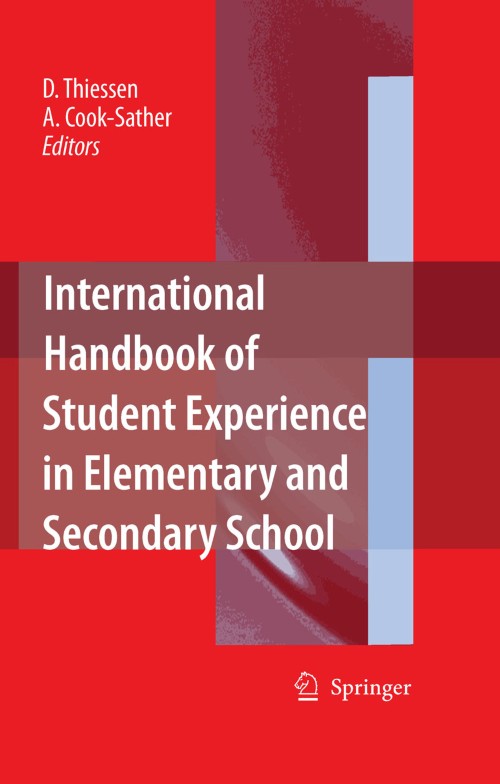
International Handbook of Student Experience in Elementary and Secondary School [electronic resource] / edited by D. Thiessen, Alison Cook-Sather.
Erişim Adresi
ISBN
9781402033674
Dil Kodu
İngilizce
Yer Numarası
DK/12561
Basım Bildirimi
1st ed. 2007.
Yayın Bilgisi
Dordrecht : Springer Netherlands : Imprint: Springer, 2007.
Fiziksel Niteleme
XXXVI, 892 p. online resource.
İçindekiler Notu
How Students Participate in and Make Sense of Life in Classrooms and Schools -- to Section One -- Naming Student Experiences and Experiencing Student Naming -- Teaching as Research: Puzzling Over Words with Fourth Graders -- School Literacy and the Development of a Child Culture: Written Remnants of the “Gusto of Life” -- Dissolving Learning Boundaries: The Doing, Re-Doing, and Undoing of School -- “Some Things are Fair, Some Things are Not Fair, and Some Things are Not, Not Fair”: Young Children’s Experiences of ‘Unfairness’ in School -- The Role of Personal Standards in Second Graders’ Moral and Academic Engagement -- Mentors for Students in Elementary School: the Promise and Possibilities -- “I’ve Decided to Change and it’s Just Really Hard to, Like, Show the Teachers that” -- Students’ Perspectives on Good Teaching: Implications for Adult Reform Behavior -- Who Students Are and How They Develop in Classrooms and Schools -- to Section Two -- “Boys Will Be Boys” but in what Ways? Social Class and the Development of Young Boys’ Schooling Identities -- Schooling, Normalisation, and Gendered Bodies: Adolescent Boys’ and Girls’ Experiences of Gender and Schooling -- Differences in Transition: Diverse Students Navigating the First Year of High School -- Building Theories of Their Lives: Youth Engaged In Drama Research -- How Students Learn About Right and Wrong in the First Year of a Pakistani Private School -- Schooling in the Context of Difference: The Challenge of Post-Colonial Education in Ghana -- Ali: Becoming A Student–A Life History -- Portraits of Self and Identity Constructions: Three Chinese Girls’ Trilingual Textual Powers -- Finding Their Way: Immigrant And Refugee Students In A Toronto High School -- How Students are Actively Involved inShaping Their Own Learning Opportunities and in the Improvement of What Happens in Classrooms and Schools -- to Section Three -- Student Voice, Student Engagement, And School Reform -- Stressed-Out Students-SOS: Youth Perspectives on Changing School Climates -- Toward the Pedagogically Engaged School: Listening to Student Voice as a Positive Response to Disengagement and ‘Dropping Out’? -- “It’s Not About Systems, It’s About Relationships”: Building A Listening Culture In A Primary School -- Using Students’ Voices To Inform And Evaluate Secondary School Reform -- Building Student Voice for School Improvement -- Student Voice in School Reform: from Listening to Leadership -- Clarifying the Purpose of Engaging Students as Researchers -- Making It Real: Engaging Students in Active Citizenship Projects -- Youth Research/Participatory Methods for Reform -- Translating Researchers: Re-imagining the Work of Investigating Students’ Experiences in School -- Researching Student Experiences in Elementary and Secondary School: An Evolving Field of Study -- Researching Student Experiences in Elementary and Secondary School: An Evolving Field of Study.
Özet, vb.
The International Handbook of Student Experience in Elementary and Secondary School is the first handbook of its kind to be published. It brings together in a single volume the groundbreaking work of scholars who have conducted studies of student experiences of school in Afghanistan, Australia, Canada, England, Ghana, Ireland, Pakistan, and the United States. Drawing extensively on students’ interpretations of their experiences in school as expressed in their own words, chapter authors offer insights into how students conceptualize and approach school, how students understand and address the ongoing social opportunities for and challenges in working with other students and teachers, and the multiple ways in which students shape and contribute to school improvement. The individual chapters are framed by an opening chapter, which provides background on, bases of, and trends in research on students’ experiences of school, and a final chapter, which uses the interpretive framework translation provided to explore how researching students’ experiences of school challenges those involved to translate the qualitative research methods they use, the terms they evoke to describe and define students’ experiences of schools, and, in fact, themselves as researchers.
Konu
Learning, Psychology of.
Teachers __ Training of.
Education __ Curricula.
Education and state.
Early childhood education.
Instructional Psychology.
Teaching and Teacher Education.
Curriculum Studies.
Educational Policy and Politics.
Early Childhood Education.
Teachers __ Training of.
Education __ Curricula.
Education and state.
Early childhood education.
Instructional Psychology.
Teaching and Teacher Education.
Curriculum Studies.
Educational Policy and Politics.
Early Childhood Education.
Diğer Yazarlar
Kurum Adı
Eseri Alıntıla
Referansları kullanmadan önce gözden geçirmeniz ve varsa gerekli düzeltmeleri yapmanız önerilir.
Dijital Kaynak
MARC Görünümü
LEADER 06269nam a22005535i 4500
001 811298
003 TR_AnAIT
005 20260131011303
007 cr nn 008mamaa
008 100301s2007 ne | s |||| 0|eng d
020 |a9781402033674|9978-1-4020-3367-4
024 7 |a10.1007/1-4020-3367-2|2doi
041 |aeng
049 |aTürk Tarih Kurumu Kütüphanesi
050 4|aLB1060-1077
072 7|aJNC|2bicssc
072 7|aEDU009000|2bisacsh
072 7|aJNC|2thema
082 04|a370.15|223
090 |aDK/12561
245 10|aInternational Handbook of Student Experience in Elementary and Secondary School|h[electronic resource] /|cedited by D. Thiessen, Alison Cook-Sather.
250 |a1st ed. 2007.
264 1|aDordrecht :|bSpringer Netherlands :|bImprint: Springer,|c2007.
300 |aXXXVI, 892 p.|bonline resource.
336 |atext|btxt|2rdacontent
337 |acomputer|bc|2rdamedia
338 |aonline resource|bcr|2rdacarrier
347 |atext file|bPDF|2rda
505 0 |aHow Students Participate in and Make Sense of Life in Classrooms and Schools -- to Section One -- Naming Student Experiences and Experiencing Student Naming -- Teaching as Research: Puzzling Over Words with Fourth Graders -- School Literacy and the Development of a Child Culture: Written Remnants of the “Gusto of Life” -- Dissolving Learning Boundaries: The Doing, Re-Doing, and Undoing of School -- “Some Things are Fair, Some Things are Not Fair, and Some Things are Not, Not Fair”: Young Children’s Experiences of ‘Unfairness’ in School -- The Role of Personal Standards in Second Graders’ Moral and Academic Engagement -- Mentors for Students in Elementary School: the Promise and Possibilities -- “I’ve Decided to Change and it’s Just Really Hard to, Like, Show the Teachers that” -- Students’ Perspectives on Good Teaching: Implications for Adult Reform Behavior -- Who Students Are and How They Develop in Classrooms and Schools -- to Section Two -- “Boys Will Be Boys” but in what Ways? Social Class and the Development of Young Boys’ Schooling Identities -- Schooling, Normalisation, and Gendered Bodies: Adolescent Boys’ and Girls’ Experiences of Gender and Schooling -- Differences in Transition: Diverse Students Navigating the First Year of High School -- Building Theories of Their Lives: Youth Engaged In Drama Research -- How Students Learn About Right and Wrong in the First Year of a Pakistani Private School -- Schooling in the Context of Difference: The Challenge of Post-Colonial Education in Ghana -- Ali: Becoming A Student–A Life History -- Portraits of Self and Identity Constructions: Three Chinese Girls’ Trilingual Textual Powers -- Finding Their Way: Immigrant And Refugee Students In A Toronto High School -- How Students are Actively Involved inShaping Their Own Learning Opportunities and in the Improvement of What Happens in Classrooms and Schools -- to Section Three -- Student Voice, Student Engagement, And School Reform -- Stressed-Out Students-SOS: Youth Perspectives on Changing School Climates -- Toward the Pedagogically Engaged School: Listening to Student Voice as a Positive Response to Disengagement and ‘Dropping Out’? -- “It’s Not About Systems, It’s About Relationships”: Building A Listening Culture In A Primary School -- Using Students’ Voices To Inform And Evaluate Secondary School Reform -- Building Student Voice for School Improvement -- Student Voice in School Reform: from Listening to Leadership -- Clarifying the Purpose of Engaging Students as Researchers -- Making It Real: Engaging Students in Active Citizenship Projects -- Youth Research/Participatory Methods for Reform -- Translating Researchers: Re-imagining the Work of Investigating Students’ Experiences in School -- Researching Student Experiences in Elementary and Secondary School: An Evolving Field of Study -- Researching Student Experiences in Elementary and Secondary School: An Evolving Field of Study.
520 |aThe International Handbook of Student Experience in Elementary and Secondary School is the first handbook of its kind to be published. It brings together in a single volume the groundbreaking work of scholars who have conducted studies of student experiences of school in Afghanistan, Australia, Canada, England, Ghana, Ireland, Pakistan, and the United States. Drawing extensively on students’ interpretations of their experiences in school as expressed in their own words, chapter authors offer insights into how students conceptualize and approach school, how students understand and address the ongoing social opportunities for and challenges in working with other students and teachers, and the multiple ways in which students shape and contribute to school improvement. The individual chapters are framed by an opening chapter, which provides background on, bases of, and trends in research on students’ experiences of school, and a final chapter, which uses the interpretive framework translation provided to explore how researching students’ experiences of school challenges those involved to translate the qualitative research methods they use, the terms they evoke to describe and define students’ experiences of schools, and, in fact, themselves as researchers.
650 0|aLearning, Psychology of.
650 0|aTeachers|xTraining of.
650 0|aEducation|xCurricula.
650 0|aEducation and state.
650 0|aEarly childhood education.
650 14|aInstructional Psychology.
650 24|aTeaching and Teacher Education.
650 24|aCurriculum Studies.
650 24|aEducational Policy and Politics.
650 24|aEarly Childhood Education.
700 1 |aThiessen, D.|eeditor.|4edt|4http://id.loc.gov/vocabulary/relators/edt
700 1 |aCook-Sather, Alison.|eeditor.|4edt|4http://id.loc.gov/vocabulary/relators/edt
710 2 |aSpringerLink (Online service)
773 0 |tSpringer Nature eBook
776 08|iPrinted edition:|z9781402033667
776 08|iPrinted edition:|z9789048102822
776 08|iPrinted edition:|z9789402404548
856 40|uhttps://doi.org/10.1007/1-4020-3367-2
912 |aZDB-2-SHU
912 |aZDB-2-SXED
950 |aHumanities, Social Sciences and Law (SpringerNature-11648)
950 |aEducation (R0) (SpringerNature-43721)
001 811298
003 TR_AnAIT
005 20260131011303
007 cr nn 008mamaa
008 100301s2007 ne | s |||| 0|eng d
020 |a9781402033674|9978-1-4020-3367-4
024 7 |a10.1007/1-4020-3367-2|2doi
041 |aeng
049 |aTürk Tarih Kurumu Kütüphanesi
050 4|aLB1060-1077
072 7|aJNC|2bicssc
072 7|aEDU009000|2bisacsh
072 7|aJNC|2thema
082 04|a370.15|223
090 |aDK/12561
245 10|aInternational Handbook of Student Experience in Elementary and Secondary School|h[electronic resource] /|cedited by D. Thiessen, Alison Cook-Sather.
250 |a1st ed. 2007.
264 1|aDordrecht :|bSpringer Netherlands :|bImprint: Springer,|c2007.
300 |aXXXVI, 892 p.|bonline resource.
336 |atext|btxt|2rdacontent
337 |acomputer|bc|2rdamedia
338 |aonline resource|bcr|2rdacarrier
347 |atext file|bPDF|2rda
505 0 |aHow Students Participate in and Make Sense of Life in Classrooms and Schools -- to Section One -- Naming Student Experiences and Experiencing Student Naming -- Teaching as Research: Puzzling Over Words with Fourth Graders -- School Literacy and the Development of a Child Culture: Written Remnants of the “Gusto of Life” -- Dissolving Learning Boundaries: The Doing, Re-Doing, and Undoing of School -- “Some Things are Fair, Some Things are Not Fair, and Some Things are Not, Not Fair”: Young Children’s Experiences of ‘Unfairness’ in School -- The Role of Personal Standards in Second Graders’ Moral and Academic Engagement -- Mentors for Students in Elementary School: the Promise and Possibilities -- “I’ve Decided to Change and it’s Just Really Hard to, Like, Show the Teachers that” -- Students’ Perspectives on Good Teaching: Implications for Adult Reform Behavior -- Who Students Are and How They Develop in Classrooms and Schools -- to Section Two -- “Boys Will Be Boys” but in what Ways? Social Class and the Development of Young Boys’ Schooling Identities -- Schooling, Normalisation, and Gendered Bodies: Adolescent Boys’ and Girls’ Experiences of Gender and Schooling -- Differences in Transition: Diverse Students Navigating the First Year of High School -- Building Theories of Their Lives: Youth Engaged In Drama Research -- How Students Learn About Right and Wrong in the First Year of a Pakistani Private School -- Schooling in the Context of Difference: The Challenge of Post-Colonial Education in Ghana -- Ali: Becoming A Student–A Life History -- Portraits of Self and Identity Constructions: Three Chinese Girls’ Trilingual Textual Powers -- Finding Their Way: Immigrant And Refugee Students In A Toronto High School -- How Students are Actively Involved inShaping Their Own Learning Opportunities and in the Improvement of What Happens in Classrooms and Schools -- to Section Three -- Student Voice, Student Engagement, And School Reform -- Stressed-Out Students-SOS: Youth Perspectives on Changing School Climates -- Toward the Pedagogically Engaged School: Listening to Student Voice as a Positive Response to Disengagement and ‘Dropping Out’? -- “It’s Not About Systems, It’s About Relationships”: Building A Listening Culture In A Primary School -- Using Students’ Voices To Inform And Evaluate Secondary School Reform -- Building Student Voice for School Improvement -- Student Voice in School Reform: from Listening to Leadership -- Clarifying the Purpose of Engaging Students as Researchers -- Making It Real: Engaging Students in Active Citizenship Projects -- Youth Research/Participatory Methods for Reform -- Translating Researchers: Re-imagining the Work of Investigating Students’ Experiences in School -- Researching Student Experiences in Elementary and Secondary School: An Evolving Field of Study -- Researching Student Experiences in Elementary and Secondary School: An Evolving Field of Study.
520 |aThe International Handbook of Student Experience in Elementary and Secondary School is the first handbook of its kind to be published. It brings together in a single volume the groundbreaking work of scholars who have conducted studies of student experiences of school in Afghanistan, Australia, Canada, England, Ghana, Ireland, Pakistan, and the United States. Drawing extensively on students’ interpretations of their experiences in school as expressed in their own words, chapter authors offer insights into how students conceptualize and approach school, how students understand and address the ongoing social opportunities for and challenges in working with other students and teachers, and the multiple ways in which students shape and contribute to school improvement. The individual chapters are framed by an opening chapter, which provides background on, bases of, and trends in research on students’ experiences of school, and a final chapter, which uses the interpretive framework translation provided to explore how researching students’ experiences of school challenges those involved to translate the qualitative research methods they use, the terms they evoke to describe and define students’ experiences of schools, and, in fact, themselves as researchers.
650 0|aLearning, Psychology of.
650 0|aTeachers|xTraining of.
650 0|aEducation|xCurricula.
650 0|aEducation and state.
650 0|aEarly childhood education.
650 14|aInstructional Psychology.
650 24|aTeaching and Teacher Education.
650 24|aCurriculum Studies.
650 24|aEducational Policy and Politics.
650 24|aEarly Childhood Education.
700 1 |aThiessen, D.|eeditor.|4edt|4http://id.loc.gov/vocabulary/relators/edt
700 1 |aCook-Sather, Alison.|eeditor.|4edt|4http://id.loc.gov/vocabulary/relators/edt
710 2 |aSpringerLink (Online service)
773 0 |tSpringer Nature eBook
776 08|iPrinted edition:|z9781402033667
776 08|iPrinted edition:|z9789048102822
776 08|iPrinted edition:|z9789402404548
856 40|uhttps://doi.org/10.1007/1-4020-3367-2
912 |aZDB-2-SHU
912 |aZDB-2-SXED
950 |aHumanities, Social Sciences and Law (SpringerNature-11648)
950 |aEducation (R0) (SpringerNature-43721)
Materyaller
Depodan talep edilen materyal sadece kütüphane içerisinde kullanılmaktadır.
Materyal dışarıya ödünç verilmemektedir.
Materyal dışarıya ödünç verilmemektedir.
