LEADER 03760nam a22005655i 4500
001 811299
003 TR_AnAIT
005 20260131011301
007 cr nn 008mamaa
008 100301s2005 ne | s |||| 0|eng d
020 |a9781402033780|9978-1-4020-3378-0
024 7 |a10.1007/1-4020-3378-8|2doi
041 |aeng
049 |aTürk Tarih Kurumu Kütüphanesi
050 4|aB1-5802
072 7|aHP|2bicssc
072 7|aPHI000000|2bisacsh
072 7|aQD|2thema
082 04|a100|223
090 |aDK/12562
100 1 |aBooth, Emily.|eauthor.|4aut|4http://id.loc.gov/vocabulary/relators/aut
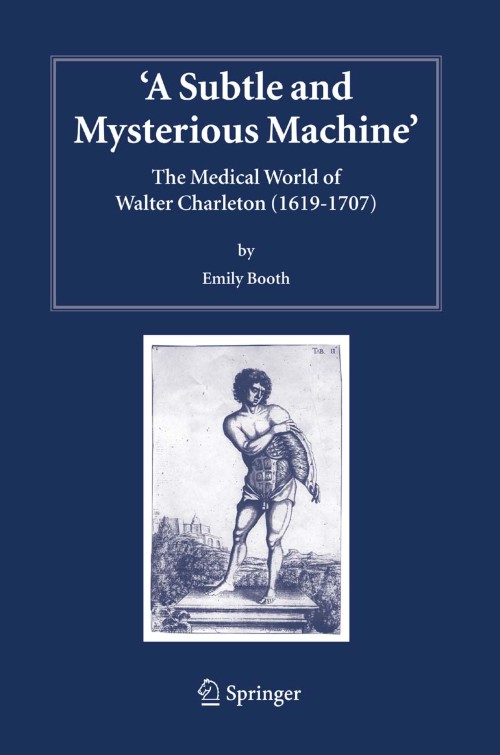
245 12|aA Subtle and Mysterious Machine|h[electronic resource] :|bThe Medical World of Walter Charleton (1619-1707) /|cby Emily Booth.
250 |a1st ed. 2005.
264 1|aDordrecht :|bSpringer Netherlands :|bImprint: Springer,|c2005.
300 |aVIII, 300 p.|bonline resource.
336 |atext|btxt|2rdacontent
337 |acomputer|bc|2rdamedia
338 |aonline resource|bcr|2rdacarrier
347 |atext file|bPDF|2rda
490 1 |aStudies in History and Philosophy of Science,|x2215-1958 ;|v18
505 0 |aRewriting Walter Charleton: Physick and Natural Philosophy -- ’The Alembic of Our Pen’: Charleton’s Identity as a Physician -- ’The Animal Oeconomy’: Natural History (1659) in the Context of English Physiology -- ’The Republick of Letters’: Charleton’s Identity in the Royal Society & College of Physicians -- Enquiries Into Human Nature (1680): Charleton’s Anatomy and Physiology After the Royal Society -- Three Anatomic Lectures (1683): Ways of Knowing and the Anatomical Body -- Conclusions.
520 |aWalter Charleton (1619-1707) has been widely depicted as a natural philosopher whose intellectual career mirrored the intellectual ferment of the ‘scientific revolution’. Instead of viewing him as a barometer of intellectual change, I examine the previously unexplored question of his identity as a physician. Examining three of his vernacular medical texts, this volume considers Charleton’s thoughts on anatomy, physiology and the methods by which he sought to understand the invisible processes of the body. Although involved in many empirical investigations within the Royal Society, he did not give epistemic primacy to experimental findings, nor did he deliberately identify himself with the empirical methods associated with the ‘new science’. Instead Charleton presented himself as a scholarly eclectic, following a classical model of the self. Physicians needed to endorse both ancient and modern authorities, in order to attract and retain patients. I argue that Charleton’s circumstances as a practising physician resulted in the construction of an identity at variance with that widely associated with natural philosophers. The insights he can offer us into the world of seventeenth century physicians are highly significant and utterly fascinating.
650 0|aPhilosophy.
650 0|aScience|xHistory.
650 0|aKnowledge, Theory of.
650 0|aMedicine|xPhilosophy.
650 0|aMedicine|xHistory.
650 14|aPhilosophy.
650 24|aHistory of Science.
650 24|aEpistemology.
650 24|aPhilosophy of Medicine.
650 24|aHistory of Medicine.
710 2 |aSpringerLink (Online service)
773 0 |tSpringer Nature eBook
776 08|iPrinted edition:|z9781402033773
776 08|iPrinted edition:|z9789048102884
776 08|iPrinted edition:|z9789048168484
830 0|aStudies in History and Philosophy of Science,|x2215-1958 ;|v18
856 40|uhttps://doi.org/10.1007/1-4020-3378-8
912 |aZDB-2-SHU
912 |aZDB-2-SXPR
950 |aHumanities, Social Sciences and Law (SpringerNature-11648)
950 |aPhilosophy and Religion (R0) (SpringerNature-43725)