

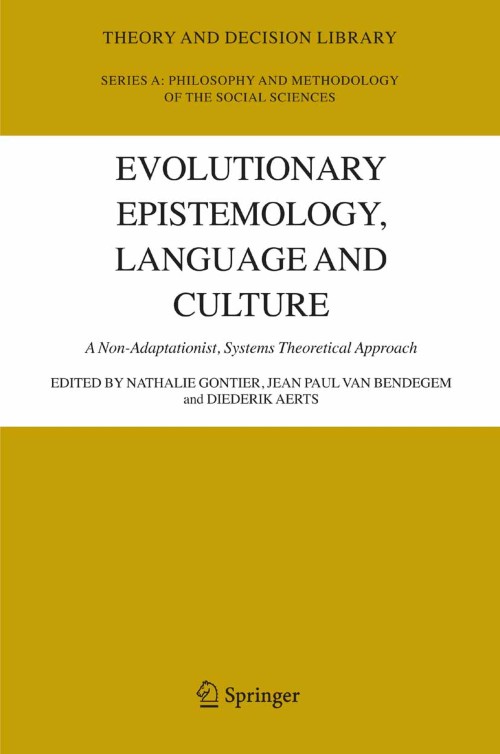
Evolutionary Epistemology, Language and Culture [electronic resource] : A Non-Adaptationist, Systems Theoretical Approach / edited by Nathalie Gontier, Jean Paul van Bendegem, Diederik Aerts.
Erişim Adresi
ISBN
9781402033957
Dil Kodu
İngilizce
Yer Numarası
DK/12564
Basım Bildirimi
1st ed. 2006.
Yayın Bilgisi
Dordrecht : Springer Netherlands : Imprint: Springer, 2006.
Fiziksel Niteleme
XX, 494 p. online resource.
Dizi
Theory and Decision Library A:, Rational Choice in Practical Philosophy and Philosophy of Science, 2352-2119 ; 39
İçindekiler Notu
to evolutionary epistemology, language and culture -- to evolutionary epistemology, language and culture -- Evolutionary epistemology -- Evolutionary epistemology: The non-adaptationist approach -- Like cats and dogs: Radical constructivism and evolutionary epistemology -- The biological boundary conditions for our classical physical world view -- Is the real world something more than the world of our experience? Relations between Neo-Darwinism, transcendental philosophy and cognitive sciences -- Universal Darwinism and process essentialism -- Evolutionary epistemology and language -- Darwinism, traditional linguistics and the new Palaeolithic Continuity Theory of language evolution -- The extended mind model of the origin of language and culture -- From changes in the world to changes in the words -- Evolutionary epistemology and the origin and evolution of language: Taking symbiogenesis seriously -- The self-organization of dynamic systems: Modularity under scrutiny -- Evolutionary epistemology and culture -- Against human nature -- Cognition, evolution, and sociality -- Cultural evolution, the Baldwin effect, and social norms -- Cultural creativity and evolutionary flexibility -- Some ideas to study the evolution of mathematics -- Evolutionary epistemology and modelling -- Computer modelling as a tool for understanding language evolution -- Simulating the syntax and semantics of linguistic constructions about time -- Evolutionary game-theoretic semantics and its foundational status -- Towards a quantum evolutionary scheme: Violating Bell’s inequalities in language.
Özet, vb.
For the first time in history, scholars working on language and culture from within an evolutionary epistemological framework, and thereby emphasizing complementary or deviating theories of the Modern Synthesis, were brought together. Of course there have been excellent conferences on Evolutionary Epistemology in the past, as well as numerous conferences on the topics of Language and Culture. However, until now these disciplines had not been brought together into one all-encompassing conference. Moreover, previously there never had been such stress on alternative and complementary theories of the Modern Synthesis. Today we know that natural selection and evolution are far from synonymous and that they do not explain isomorphic phenomena in the world. ‘Taking Darwin seriously’ is the way to go, but today the time has come to take alternative and complementary theories that developed after the Modern Synthesis, equally seriously, and, furthermore, to examine how language and culture can merit from these diverse disciplines. As this volume will make clear, a specific inter- and transdisciplinary approach is one of the next crucial steps that needs to be taken, if we ever want to unravel the secrets of phenomena such as language and culture.
Konu
Knowledge, Theory of.
Philosophy.
Science __ Philosophy.
Evolution (Biology).
Linguistics.
Anthropology.
Epistemology.
Philosophy.
Philosophy of Science.
Evolutionary Biology.
Linguistics.
Anthropology.
Philosophy.
Science __ Philosophy.
Evolution (Biology).
Linguistics.
Anthropology.
Epistemology.
Philosophy.
Philosophy of Science.
Evolutionary Biology.
Linguistics.
Anthropology.
Diğer Yazarlar
Kurum Adı
Eseri Alıntıla
Referansları kullanmadan önce gözden geçirmeniz ve varsa gerekli düzeltmeleri yapmanız önerilir.
Dijital Kaynak
MARC Görünümü
LEADER 05250nam a22006135i 4500
001 811301
003 TR_AnAIT
005 20260131011256
007 cr nn 008mamaa
008 100301s2006 ne | s |||| 0|eng d
020 |a9781402033957|9978-1-4020-3395-7
024 7 |a10.1007/1-4020-3395-8|2doi
041 |aeng
049 |aTürk Tarih Kurumu Kütüphanesi
050 4|aBD143-237
072 7|aHPK|2bicssc
072 7|aPHI004000|2bisacsh
072 7|aQDTK|2thema
082 04|a120|223
090 |aDK/12564
245 10|aEvolutionary Epistemology, Language and Culture|h[electronic resource] :|bA Non-Adaptationist, Systems Theoretical Approach /|cedited by Nathalie Gontier, Jean Paul van Bendegem, Diederik Aerts.
250 |a1st ed. 2006.
264 1|aDordrecht :|bSpringer Netherlands :|bImprint: Springer,|c2006.
300 |aXX, 494 p.|bonline resource.
336 |atext|btxt|2rdacontent
337 |acomputer|bc|2rdamedia
338 |aonline resource|bcr|2rdacarrier
347 |atext file|bPDF|2rda
490 1 |aTheory and Decision Library A:, Rational Choice in Practical Philosophy and Philosophy of Science,|x2352-2119 ;|v39
505 0 |ato evolutionary epistemology, language and culture -- to evolutionary epistemology, language and culture -- Evolutionary epistemology -- Evolutionary epistemology: The non-adaptationist approach -- Like cats and dogs: Radical constructivism and evolutionary epistemology -- The biological boundary conditions for our classical physical world view -- Is the real world something more than the world of our experience? Relations between Neo-Darwinism, transcendental philosophy and cognitive sciences -- Universal Darwinism and process essentialism -- Evolutionary epistemology and language -- Darwinism, traditional linguistics and the new Palaeolithic Continuity Theory of language evolution -- The extended mind model of the origin of language and culture -- From changes in the world to changes in the words -- Evolutionary epistemology and the origin and evolution of language: Taking symbiogenesis seriously -- The self-organization of dynamic systems: Modularity under scrutiny -- Evolutionary epistemology and culture -- Against human nature -- Cognition, evolution, and sociality -- Cultural evolution, the Baldwin effect, and social norms -- Cultural creativity and evolutionary flexibility -- Some ideas to study the evolution of mathematics -- Evolutionary epistemology and modelling -- Computer modelling as a tool for understanding language evolution -- Simulating the syntax and semantics of linguistic constructions about time -- Evolutionary game-theoretic semantics and its foundational status -- Towards a quantum evolutionary scheme: Violating Bell’s inequalities in language.
520 |aFor the first time in history, scholars working on language and culture from within an evolutionary epistemological framework, and thereby emphasizing complementary or deviating theories of the Modern Synthesis, were brought together. Of course there have been excellent conferences on Evolutionary Epistemology in the past, as well as numerous conferences on the topics of Language and Culture. However, until now these disciplines had not been brought together into one all-encompassing conference. Moreover, previously there never had been such stress on alternative and complementary theories of the Modern Synthesis. Today we know that natural selection and evolution are far from synonymous and that they do not explain isomorphic phenomena in the world. ‘Taking Darwin seriously’ is the way to go, but today the time has come to take alternative and complementary theories that developed after the Modern Synthesis, equally seriously, and, furthermore, to examine how language and culture can merit from these diverse disciplines. As this volume will make clear, a specific inter- and transdisciplinary approach is one of the next crucial steps that needs to be taken, if we ever want to unravel the secrets of phenomena such as language and culture.
650 0|aKnowledge, Theory of.
650 0|aPhilosophy.
650 0|aScience|xPhilosophy.
650 0|aEvolution (Biology).
650 0|aLinguistics.
650 0|aAnthropology.
650 14|aEpistemology.
650 24|aPhilosophy.
650 24|aPhilosophy of Science.
650 24|aEvolutionary Biology.
650 24|aLinguistics.
650 24|aAnthropology.
700 1 |aGontier, Nathalie.|eeditor.|4edt|4http://id.loc.gov/vocabulary/relators/edt
700 1 |aBendegem, Jean Paul van.|eeditor.|4edt|4http://id.loc.gov/vocabulary/relators/edt
700 1 |aAerts, Diederik.|eeditor.|4edt|4http://id.loc.gov/vocabulary/relators/edt
710 2 |aSpringerLink (Online service)
773 0 |tSpringer Nature eBook
776 08|iPrinted edition:|z9781402033940
776 08|iPrinted edition:|z9789048102969
776 08|iPrinted edition:|z9789048168521
830 0|aTheory and Decision Library A:, Rational Choice in Practical Philosophy and Philosophy of Science,|x2352-2119 ;|v39
856 40|uhttps://doi.org/10.1007/1-4020-3395-8
912 |aZDB-2-SHU
912 |aZDB-2-SXPR
950 |aHumanities, Social Sciences and Law (SpringerNature-11648)
950 |aPhilosophy and Religion (R0) (SpringerNature-43725)
001 811301
003 TR_AnAIT
005 20260131011256
007 cr nn 008mamaa
008 100301s2006 ne | s |||| 0|eng d
020 |a9781402033957|9978-1-4020-3395-7
024 7 |a10.1007/1-4020-3395-8|2doi
041 |aeng
049 |aTürk Tarih Kurumu Kütüphanesi
050 4|aBD143-237
072 7|aHPK|2bicssc
072 7|aPHI004000|2bisacsh
072 7|aQDTK|2thema
082 04|a120|223
090 |aDK/12564
245 10|aEvolutionary Epistemology, Language and Culture|h[electronic resource] :|bA Non-Adaptationist, Systems Theoretical Approach /|cedited by Nathalie Gontier, Jean Paul van Bendegem, Diederik Aerts.
250 |a1st ed. 2006.
264 1|aDordrecht :|bSpringer Netherlands :|bImprint: Springer,|c2006.
300 |aXX, 494 p.|bonline resource.
336 |atext|btxt|2rdacontent
337 |acomputer|bc|2rdamedia
338 |aonline resource|bcr|2rdacarrier
347 |atext file|bPDF|2rda
490 1 |aTheory and Decision Library A:, Rational Choice in Practical Philosophy and Philosophy of Science,|x2352-2119 ;|v39
505 0 |ato evolutionary epistemology, language and culture -- to evolutionary epistemology, language and culture -- Evolutionary epistemology -- Evolutionary epistemology: The non-adaptationist approach -- Like cats and dogs: Radical constructivism and evolutionary epistemology -- The biological boundary conditions for our classical physical world view -- Is the real world something more than the world of our experience? Relations between Neo-Darwinism, transcendental philosophy and cognitive sciences -- Universal Darwinism and process essentialism -- Evolutionary epistemology and language -- Darwinism, traditional linguistics and the new Palaeolithic Continuity Theory of language evolution -- The extended mind model of the origin of language and culture -- From changes in the world to changes in the words -- Evolutionary epistemology and the origin and evolution of language: Taking symbiogenesis seriously -- The self-organization of dynamic systems: Modularity under scrutiny -- Evolutionary epistemology and culture -- Against human nature -- Cognition, evolution, and sociality -- Cultural evolution, the Baldwin effect, and social norms -- Cultural creativity and evolutionary flexibility -- Some ideas to study the evolution of mathematics -- Evolutionary epistemology and modelling -- Computer modelling as a tool for understanding language evolution -- Simulating the syntax and semantics of linguistic constructions about time -- Evolutionary game-theoretic semantics and its foundational status -- Towards a quantum evolutionary scheme: Violating Bell’s inequalities in language.
520 |aFor the first time in history, scholars working on language and culture from within an evolutionary epistemological framework, and thereby emphasizing complementary or deviating theories of the Modern Synthesis, were brought together. Of course there have been excellent conferences on Evolutionary Epistemology in the past, as well as numerous conferences on the topics of Language and Culture. However, until now these disciplines had not been brought together into one all-encompassing conference. Moreover, previously there never had been such stress on alternative and complementary theories of the Modern Synthesis. Today we know that natural selection and evolution are far from synonymous and that they do not explain isomorphic phenomena in the world. ‘Taking Darwin seriously’ is the way to go, but today the time has come to take alternative and complementary theories that developed after the Modern Synthesis, equally seriously, and, furthermore, to examine how language and culture can merit from these diverse disciplines. As this volume will make clear, a specific inter- and transdisciplinary approach is one of the next crucial steps that needs to be taken, if we ever want to unravel the secrets of phenomena such as language and culture.
650 0|aKnowledge, Theory of.
650 0|aPhilosophy.
650 0|aScience|xPhilosophy.
650 0|aEvolution (Biology).
650 0|aLinguistics.
650 0|aAnthropology.
650 14|aEpistemology.
650 24|aPhilosophy.
650 24|aPhilosophy of Science.
650 24|aEvolutionary Biology.
650 24|aLinguistics.
650 24|aAnthropology.
700 1 |aGontier, Nathalie.|eeditor.|4edt|4http://id.loc.gov/vocabulary/relators/edt
700 1 |aBendegem, Jean Paul van.|eeditor.|4edt|4http://id.loc.gov/vocabulary/relators/edt
700 1 |aAerts, Diederik.|eeditor.|4edt|4http://id.loc.gov/vocabulary/relators/edt
710 2 |aSpringerLink (Online service)
773 0 |tSpringer Nature eBook
776 08|iPrinted edition:|z9781402033940
776 08|iPrinted edition:|z9789048102969
776 08|iPrinted edition:|z9789048168521
830 0|aTheory and Decision Library A:, Rational Choice in Practical Philosophy and Philosophy of Science,|x2352-2119 ;|v39
856 40|uhttps://doi.org/10.1007/1-4020-3395-8
912 |aZDB-2-SHU
912 |aZDB-2-SXPR
950 |aHumanities, Social Sciences and Law (SpringerNature-11648)
950 |aPhilosophy and Religion (R0) (SpringerNature-43725)
Materyaller
Depodan talep edilen materyal sadece kütüphane içerisinde kullanılmaktadır.
Materyal dışarıya ödünç verilmemektedir.
Materyal dışarıya ödünç verilmemektedir.
