LEADER 03499nam a22005175i 4500
001 811303
003 TR_AnAIT
005 20260131011245
007 cr nn 008mamaa
008 100301s2005 ne | s |||| 0|eng d
020 |a9781402034015|9978-1-4020-3401-5
024 7 |a10.1007/1-4020-3401-6|2doi
041 |aeng
049 |aTürk Tarih Kurumu Kütüphanesi
050 4|aB1-5802
072 7|aHP|2bicssc
072 7|aPHI000000|2bisacsh
072 7|aQD|2thema
082 04|a100|223
090 |aDK/12566
100 1 |aPhemister, Pauline.|eauthor.|4aut|4http://id.loc.gov/vocabulary/relators/aut
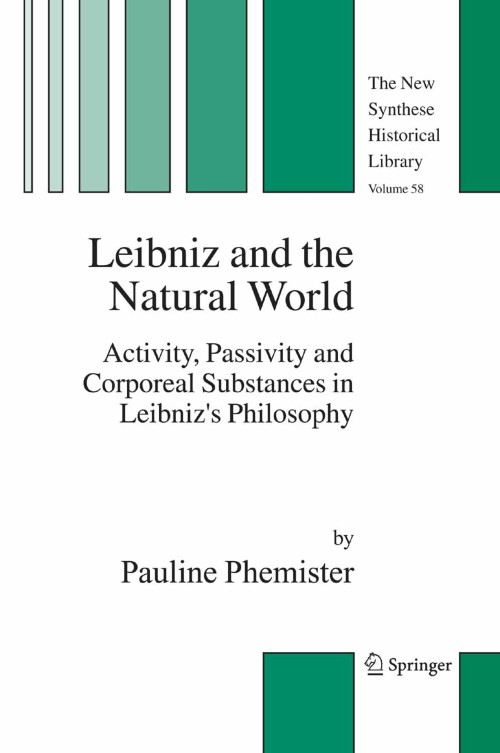
245 10|aLeibniz and the Natural World|h[electronic resource] :|bActivity, Passivity and Corporeal Substances in Leibniz's Philosophy /|cby Pauline Phemister.
250 |a1st ed. 2005.
264 1|aDordrecht :|bSpringer Netherlands :|bImprint: Springer,|c2005.
300 |aXVI, 298 p.|bonline resource.
336 |atext|btxt|2rdacontent
337 |acomputer|bc|2rdamedia
338 |aonline resource|bcr|2rdacarrier
347 |atext file|bPDF|2rda
490 1 |aThe New Synthese Historical Library, Texts and Studies in the History of Philosophy,|x2352-2585 ;|v58
505 0 |aSubstances: Public and Private -- Primary Matter -- Extension -- The Composition of Bodies -- The Composition of the Continuum -- Perceptions and Perceivers -- Phenomenal Bodies -- Derivative Forces -- Pre-Established Harmony -- Freedom.
520 |aIn the present book, Pauline Phemister argues against traditional Anglo-American interpretations of Leibniz as an idealist who conceives ultimate reality as a plurality of mind-like immaterial beings and for whom physical bodies are ultimately unreal and our perceptions of them illusory. Re-reading the texts without the prior assumption of idealism allows the more material aspects of Leibniz's metaphysics to emerge. Leibniz is found to advance a synthesis of idealism and materialism. His ontology posits indivisible, living, animal-like corporeal substances as the real metaphysical constituents of the universe; his epistemology combines sense-experience and reason; and his ethics fuses confused perceptions and insensible appetites with distinct perceptions and rational choice. In the light of his sustained commitment to the reality of bodies, Phemister re-examines his dynamics, the doctrine of pre-established harmony and his views on freedom. The image of Leibniz as a rationalist philosopher who values activity and reason over passivity and sense-experience is replaced by the one of a philosopher who recognises that, in the created world, there can only be activity if there is also passivity; minds, souls and forms if there is also matter; good if there is evil; perfection if there is imperfection.
650 0|aPhilosophy.
650 0|aPhilosophy|xHistory.
650 0|aPhilosophy of nature.
650 14|aPhilosophy.
650 24|aHistory of Philosophy.
650 24|aPhilosophy of Nature.
710 2 |aSpringerLink (Online service)
773 0 |tSpringer Nature eBook
776 08|iPrinted edition:|z9781402034008
776 08|iPrinted edition:|z9789048102990
776 08|iPrinted edition:|z9789048168552
830 0|aThe New Synthese Historical Library, Texts and Studies in the History of Philosophy,|x2352-2585 ;|v58
856 40|uhttps://doi.org/10.1007/1-4020-3401-6
912 |aZDB-2-SHU
912 |aZDB-2-SXPR
950 |aHumanities, Social Sciences and Law (SpringerNature-11648)
950 |aPhilosophy and Religion (R0) (SpringerNature-43725)