

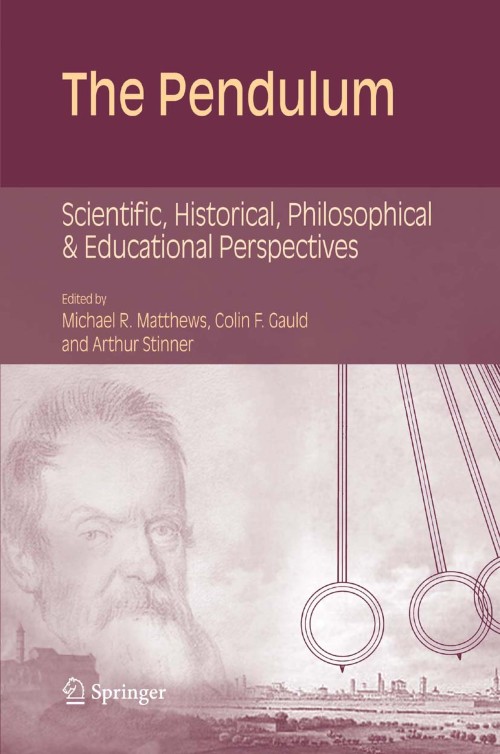
The Pendulum [electronic resource] : Scientific, Historical, Philosophical and Educational Perspectives / edited by Michael Matthews, Colin F. Gauld, Arthur Stinner.
Erişim Adresi
ISBN
9781402035265
Dil Kodu
İngilizce
Yer Numarası
DK/12576
Basım Bildirimi
1st ed. 2005.
Yayın Bilgisi
Dordrecht : Springer Netherlands : Imprint: Springer, 2005.
Fiziksel Niteleme
VIII, 542 p. online resource.
İçindekiler Notu
The Pendulum: Its Place in Science, Culture and Pedagogy -- The Pendulum in the 21st Century-Relic or Trendsetter -- The Pendulum: A Paradigm for the Linear Oscillator -- to the Treatment of Non-Linear Effects Using a Gravitational Pendulum -- Experimental Control of Simple Pendulum Model -- Soup-can Pendulum -- What Makes the Foucault Pendulum Move among the Stars? -- Galileo and the Pendulum: Latching on to Time -- The Treatment of Cycloidal Pendulum Motion in Newton’s Principia -- Pendulums, Pedagogy, and Matter: Lessons from the Editing of Newton’s Principia -- The Treatment of the Motion of a Simple Pendulum in Some Early 18th Century Newtonian Textbooks -- Newton’s Path to Universal Gravitation: The Role of the Pendulum -- Léon Foucault: His Life, Times and Achievements -- The Pendulum: From Constrained Fall to the Concept of Potential -- Idealisation and Galileo’s Pendulum Discoveries: Historical, Philosophical and Pedagogical Considerations -- Pendula, Models, Constructivism and Reality -- The Poet and the Pendulum -- Methodology and Politics: A Proposal to Teach the Structuring Ideas of the Philosophy of Science through the Pendulum -- Degree of Influence on Perception of Belief and Social Setting: Its Relevance to Understanding Pendulum Motion -- Piaget and the Pendulum -- What the Pendulum Can Tell Educators about Children’s Scientific Reasoning -- Pendulum Phenomena and the Assessment of Scientific Inquiry Capabilities -- Roles of Abductive Reasoning and Prior Belief in Children’s Generation of Hypotheses about Pendulum Motion -- Types of Two-Dimensional Pendulums and Their Uses in Education -- The Pendulum as a Vehicle for Transitioning from Classical to Quantum Physics: History, Quantum Concepts, and Educational Challenges -- Analyzing Dynamic Pendulum Motion in anInteractive Online Environment Using Flash -- Pendulum Activities in the Israeli Physics Curriculum: Used and Missed Opportunities -- The Pendulum as Presented in School Science Textbooks of Greece and Cyprus -- The Public Understanding of Pendulum Motion: From 5 to 88 Years Old -- Using Excel to Simulate Pendulum Motion and Maybe Understand Calculus a Little Better -- Teaching Cultural History from Primary Events -- Pendulums in The Physics Education Literature: A Bibliography.
Özet, vb.
The pendulum is a universal topic in primary and secondary schools, but its full potential for learning about physics, the nature of science, and the relationships between science, mathematics, technology, society and culture is seldom realised. Contributions to this 32-chapter anthology deal with the science, history, methodology and pedagogy of pendulum motion. There is ample material for the richer and more cross-disciplinary treatment of the pendulum from elementary school, to high school, and through to advanced university classes. Scientists will value the studies on the physics of the pendulum; historians will appreciate the detailed treatment of Galileo, Huygens, Newton and Foucault’s pendulum investigations; psychologists and educators will learn from the papers on Piaget; teachers will welcome the many contributions to pendulum pedagogy. All readers will come away with a new awareness of the importance of the pendulum in the foundation and development of modern science; and for its centrality in so many facets of society and culture. .
Konu
Science __ Study and teaching.
Mathematics __ Study and teaching .
Teachers __ Training of.
Educational sociology.
Mechanics.
Physics __ Philosophy.
Science Education.
Mathematics Education.
Teaching and Teacher Education.
Sociology of Education.
Classical Mechanics.
Philosophical Foundations of Physics and Astronomy.
Mathematics __ Study and teaching .
Teachers __ Training of.
Educational sociology.
Mechanics.
Physics __ Philosophy.
Science Education.
Mathematics Education.
Teaching and Teacher Education.
Sociology of Education.
Classical Mechanics.
Philosophical Foundations of Physics and Astronomy.
Diğer Yazarlar
Kurum Adı
Eseri Alıntıla
Referansları kullanmadan önce gözden geçirmeniz ve varsa gerekli düzeltmeleri yapmanız önerilir.
Dijital Kaynak
MARC Görünümü
LEADER 05569nam a22006015i 4500
001 811313
003 TR_AnAIT
005 20260131011203
007 cr nn 008mamaa
008 100301s2005 ne | s |||| 0|eng d
020 |a9781402035265|9978-1-4020-3526-5
024 7 |a10.1007/1-4020-3526-8|2doi
041 |aeng
049 |aTürk Tarih Kurumu Kütüphanesi
050 4|aQ181-183.4
072 7|aJNU|2bicssc
072 7|aPD|2bicssc
072 7|aSCI063000|2bisacsh
072 7|aJNU|2thema
072 7|aPD|2thema
082 04|a507.1|223
090 |aDK/12576
245 14|aThe Pendulum|h[electronic resource] :|bScientific, Historical, Philosophical and Educational Perspectives /|cedited by Michael Matthews, Colin F. Gauld, Arthur Stinner.
250 |a1st ed. 2005.
264 1|aDordrecht :|bSpringer Netherlands :|bImprint: Springer,|c2005.
300 |aVIII, 542 p.|bonline resource.
336 |atext|btxt|2rdacontent
337 |acomputer|bc|2rdamedia
338 |aonline resource|bcr|2rdacarrier
347 |atext file|bPDF|2rda
505 0 |aThe Pendulum: Its Place in Science, Culture and Pedagogy -- The Pendulum in the 21st Century-Relic or Trendsetter -- The Pendulum: A Paradigm for the Linear Oscillator -- to the Treatment of Non-Linear Effects Using a Gravitational Pendulum -- Experimental Control of Simple Pendulum Model -- Soup-can Pendulum -- What Makes the Foucault Pendulum Move among the Stars? -- Galileo and the Pendulum: Latching on to Time -- The Treatment of Cycloidal Pendulum Motion in Newton’s Principia -- Pendulums, Pedagogy, and Matter: Lessons from the Editing of Newton’s Principia -- The Treatment of the Motion of a Simple Pendulum in Some Early 18th Century Newtonian Textbooks -- Newton’s Path to Universal Gravitation: The Role of the Pendulum -- Léon Foucault: His Life, Times and Achievements -- The Pendulum: From Constrained Fall to the Concept of Potential -- Idealisation and Galileo’s Pendulum Discoveries: Historical, Philosophical and Pedagogical Considerations -- Pendula, Models, Constructivism and Reality -- The Poet and the Pendulum -- Methodology and Politics: A Proposal to Teach the Structuring Ideas of the Philosophy of Science through the Pendulum -- Degree of Influence on Perception of Belief and Social Setting: Its Relevance to Understanding Pendulum Motion -- Piaget and the Pendulum -- What the Pendulum Can Tell Educators about Children’s Scientific Reasoning -- Pendulum Phenomena and the Assessment of Scientific Inquiry Capabilities -- Roles of Abductive Reasoning and Prior Belief in Children’s Generation of Hypotheses about Pendulum Motion -- Types of Two-Dimensional Pendulums and Their Uses in Education -- The Pendulum as a Vehicle for Transitioning from Classical to Quantum Physics: History, Quantum Concepts, and Educational Challenges -- Analyzing Dynamic Pendulum Motion in anInteractive Online Environment Using Flash -- Pendulum Activities in the Israeli Physics Curriculum: Used and Missed Opportunities -- The Pendulum as Presented in School Science Textbooks of Greece and Cyprus -- The Public Understanding of Pendulum Motion: From 5 to 88 Years Old -- Using Excel to Simulate Pendulum Motion and Maybe Understand Calculus a Little Better -- Teaching Cultural History from Primary Events -- Pendulums in The Physics Education Literature: A Bibliography.
520 |aThe pendulum is a universal topic in primary and secondary schools, but its full potential for learning about physics, the nature of science, and the relationships between science, mathematics, technology, society and culture is seldom realised. Contributions to this 32-chapter anthology deal with the science, history, methodology and pedagogy of pendulum motion. There is ample material for the richer and more cross-disciplinary treatment of the pendulum from elementary school, to high school, and through to advanced university classes. Scientists will value the studies on the physics of the pendulum; historians will appreciate the detailed treatment of Galileo, Huygens, Newton and Foucault’s pendulum investigations; psychologists and educators will learn from the papers on Piaget; teachers will welcome the many contributions to pendulum pedagogy. All readers will come away with a new awareness of the importance of the pendulum in the foundation and development of modern science; and for its centrality in so many facets of society and culture. .
650 0|aScience|xStudy and teaching.
650 0|aMathematics|xStudy and teaching .
650 0|aTeachers|xTraining of.
650 0|aEducational sociology.
650 0|aMechanics.
650 0|aPhysics|xPhilosophy.
650 14|aScience Education.
650 24|aMathematics Education.
650 24|aTeaching and Teacher Education.
650 24|aSociology of Education.
650 24|aClassical Mechanics.
650 24|aPhilosophical Foundations of Physics and Astronomy.
700 1 |aMatthews, Michael.|eeditor.|4edt|4http://id.loc.gov/vocabulary/relators/edt
700 1 |aGauld, Colin F.|eeditor.|4edt|4http://id.loc.gov/vocabulary/relators/edt
700 1 |aStinner, Arthur.|eeditor.|4edt|4http://id.loc.gov/vocabulary/relators/edt
710 2 |aSpringerLink (Online service)
773 0 |tSpringer Nature eBook
776 08|iPrinted edition:|z9781402035258
776 08|iPrinted edition:|z9789048103577
856 40|uhttps://doi.org/10.1007/1-4020-3526-8
912 |aZDB-2-SHU
912 |aZDB-2-SXED
950 |aHumanities, Social Sciences and Law (SpringerNature-11648)
950 |aEducation (R0) (SpringerNature-43721)
001 811313
003 TR_AnAIT
005 20260131011203
007 cr nn 008mamaa
008 100301s2005 ne | s |||| 0|eng d
020 |a9781402035265|9978-1-4020-3526-5
024 7 |a10.1007/1-4020-3526-8|2doi
041 |aeng
049 |aTürk Tarih Kurumu Kütüphanesi
050 4|aQ181-183.4
072 7|aJNU|2bicssc
072 7|aPD|2bicssc
072 7|aSCI063000|2bisacsh
072 7|aJNU|2thema
072 7|aPD|2thema
082 04|a507.1|223
090 |aDK/12576
245 14|aThe Pendulum|h[electronic resource] :|bScientific, Historical, Philosophical and Educational Perspectives /|cedited by Michael Matthews, Colin F. Gauld, Arthur Stinner.
250 |a1st ed. 2005.
264 1|aDordrecht :|bSpringer Netherlands :|bImprint: Springer,|c2005.
300 |aVIII, 542 p.|bonline resource.
336 |atext|btxt|2rdacontent
337 |acomputer|bc|2rdamedia
338 |aonline resource|bcr|2rdacarrier
347 |atext file|bPDF|2rda
505 0 |aThe Pendulum: Its Place in Science, Culture and Pedagogy -- The Pendulum in the 21st Century-Relic or Trendsetter -- The Pendulum: A Paradigm for the Linear Oscillator -- to the Treatment of Non-Linear Effects Using a Gravitational Pendulum -- Experimental Control of Simple Pendulum Model -- Soup-can Pendulum -- What Makes the Foucault Pendulum Move among the Stars? -- Galileo and the Pendulum: Latching on to Time -- The Treatment of Cycloidal Pendulum Motion in Newton’s Principia -- Pendulums, Pedagogy, and Matter: Lessons from the Editing of Newton’s Principia -- The Treatment of the Motion of a Simple Pendulum in Some Early 18th Century Newtonian Textbooks -- Newton’s Path to Universal Gravitation: The Role of the Pendulum -- Léon Foucault: His Life, Times and Achievements -- The Pendulum: From Constrained Fall to the Concept of Potential -- Idealisation and Galileo’s Pendulum Discoveries: Historical, Philosophical and Pedagogical Considerations -- Pendula, Models, Constructivism and Reality -- The Poet and the Pendulum -- Methodology and Politics: A Proposal to Teach the Structuring Ideas of the Philosophy of Science through the Pendulum -- Degree of Influence on Perception of Belief and Social Setting: Its Relevance to Understanding Pendulum Motion -- Piaget and the Pendulum -- What the Pendulum Can Tell Educators about Children’s Scientific Reasoning -- Pendulum Phenomena and the Assessment of Scientific Inquiry Capabilities -- Roles of Abductive Reasoning and Prior Belief in Children’s Generation of Hypotheses about Pendulum Motion -- Types of Two-Dimensional Pendulums and Their Uses in Education -- The Pendulum as a Vehicle for Transitioning from Classical to Quantum Physics: History, Quantum Concepts, and Educational Challenges -- Analyzing Dynamic Pendulum Motion in anInteractive Online Environment Using Flash -- Pendulum Activities in the Israeli Physics Curriculum: Used and Missed Opportunities -- The Pendulum as Presented in School Science Textbooks of Greece and Cyprus -- The Public Understanding of Pendulum Motion: From 5 to 88 Years Old -- Using Excel to Simulate Pendulum Motion and Maybe Understand Calculus a Little Better -- Teaching Cultural History from Primary Events -- Pendulums in The Physics Education Literature: A Bibliography.
520 |aThe pendulum is a universal topic in primary and secondary schools, but its full potential for learning about physics, the nature of science, and the relationships between science, mathematics, technology, society and culture is seldom realised. Contributions to this 32-chapter anthology deal with the science, history, methodology and pedagogy of pendulum motion. There is ample material for the richer and more cross-disciplinary treatment of the pendulum from elementary school, to high school, and through to advanced university classes. Scientists will value the studies on the physics of the pendulum; historians will appreciate the detailed treatment of Galileo, Huygens, Newton and Foucault’s pendulum investigations; psychologists and educators will learn from the papers on Piaget; teachers will welcome the many contributions to pendulum pedagogy. All readers will come away with a new awareness of the importance of the pendulum in the foundation and development of modern science; and for its centrality in so many facets of society and culture. .
650 0|aScience|xStudy and teaching.
650 0|aMathematics|xStudy and teaching .
650 0|aTeachers|xTraining of.
650 0|aEducational sociology.
650 0|aMechanics.
650 0|aPhysics|xPhilosophy.
650 14|aScience Education.
650 24|aMathematics Education.
650 24|aTeaching and Teacher Education.
650 24|aSociology of Education.
650 24|aClassical Mechanics.
650 24|aPhilosophical Foundations of Physics and Astronomy.
700 1 |aMatthews, Michael.|eeditor.|4edt|4http://id.loc.gov/vocabulary/relators/edt
700 1 |aGauld, Colin F.|eeditor.|4edt|4http://id.loc.gov/vocabulary/relators/edt
700 1 |aStinner, Arthur.|eeditor.|4edt|4http://id.loc.gov/vocabulary/relators/edt
710 2 |aSpringerLink (Online service)
773 0 |tSpringer Nature eBook
776 08|iPrinted edition:|z9781402035258
776 08|iPrinted edition:|z9789048103577
856 40|uhttps://doi.org/10.1007/1-4020-3526-8
912 |aZDB-2-SHU
912 |aZDB-2-SXED
950 |aHumanities, Social Sciences and Law (SpringerNature-11648)
950 |aEducation (R0) (SpringerNature-43721)
Materyaller
Depodan talep edilen materyal sadece kütüphane içerisinde kullanılmaktadır.
Materyal dışarıya ödünç verilmemektedir.
Materyal dışarıya ödünç verilmemektedir.
