

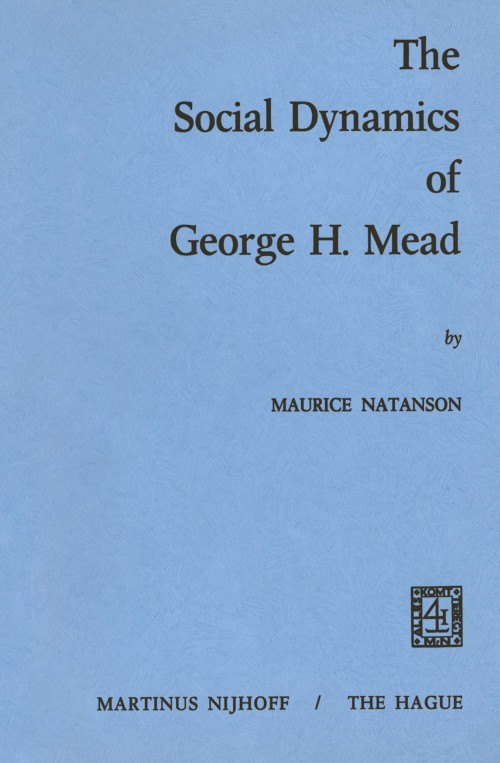
The Social Dynamics of George H. Mead [electronic resource] / by M.A. Natanson.
Erişim Adresi
ISBN
9789401024082
Dil Kodu
İngilizce
Yer Numarası
DK/12592
Yazar
Basım Bildirimi
1st ed. 1973.
Yayın Bilgisi
Dordrecht : Springer Netherlands : Imprint: Springer, 1973.
Fiziksel Niteleme
122 p. online resource.
İçindekiler Notu
I: Prologue -- II: The Development Of Mead’S Thought -- “Mind, Self, and Society”—The First Phase -- Mind -- Self -- Society -- “The Philosophy of the act”—The Second Phase -- The Act -- The Object -- Process -- “The Philosophy of the Present”—The Third Phase -- Temporality -- Emergence -- Perspectives -- The Object -- III: Critical Examination of Major Themes in Mead’s Thought -- The Self -- The Body and the Self -- The “I”— “Me” Dialectic -- Other Selves -- Proto-linguistic Awareness of the Other -- “Being-with” Others -- The Generalized Other -- The Act -- Temporality -- Sociality -- IV: Epilogue -- Additional Bibliography.
Özet, vb.
Twelve years after his Origin of Species, Charles Darwin published his Descent of Man. If the first book brought the gases of philosophi cal controversy to fever heat, the second exploded them in fiery roars. The issue was the nature, the condition, and the destiny of genus humanum. According to the prevailing Genteel Tradition mankind was a congregation of embodied immortal souls, each with its fixed identity, rights and duties, living together with its immortal neigh bors under conditions imposed by "the laws of nature and of nature's God." Obedience or disobedience of these laws destined all to eternal bliss or eternal damnation. What had come to be called "evolution" was assimilated to the Tradition in diverse interpretations such as John Fiske's, Henry Drummond's and Charles Pierce's. Their common ten dency was to establish "evolution" as somehow the method whereby divine providence ordains the conditions under which man accom plishes his destiny. The most productive competitor of the Genteel Tradition went by various names, with positivism, materialism and naturalism the most telling. Its success as competitor was not due to its theological or metaphysical import. Its success flowed from its mode of observing how effects or results, those undesired as well as those desired, got produced. Unified and generalized, these observations were taken for notations of causal sequences always and everywhere the same, thus for laws of "nature" to whose workings "the providence of God" added nothing productive and could be and was dispensed with.
Konu
Sociology.
Sociology.
Sociology.
Kurum Adı
Eseri Alıntıla
Referansları kullanmadan önce gözden geçirmeniz ve varsa gerekli düzeltmeleri yapmanız önerilir.
Dijital Kaynak
MARC Görünümü
LEADER 04508nam a22005175i 4500
001 811329
003 TR_AnAIT
005 20260131011119
007 cr nn 008mamaa
008 121227s1973 ne | s |||| 0|eng d
020 |a9789401024082|9978-94-010-2408-2
024 7 |a10.1007/978-94-010-2408-2|2doi
041 |aeng
049 |aTürk Tarih Kurumu Kütüphanesi
050 4|aHM
072 7|aJHB|2bicssc
072 7|aJHB|2bicssc
072 7|aSOC026000|2bisacsh
072 7|aJHB|2thema
072 7|aJHB|2thema
082 04|a301|223
090 |aDK/12592
100 1 |aNatanson, M.A.|eauthor.|4aut|4http://id.loc.gov/vocabulary/relators/aut
245 14|aThe Social Dynamics of George H. Mead|h[electronic resource] /|cby M.A. Natanson.
250 |a1st ed. 1973.
264 1|aDordrecht :|bSpringer Netherlands :|bImprint: Springer,|c1973.
300 |a122 p.|bonline resource.
336 |atext|btxt|2rdacontent
337 |acomputer|bc|2rdamedia
338 |aonline resource|bcr|2rdacarrier
347 |atext file|bPDF|2rda
505 0 |aI: Prologue -- II: The Development Of Mead’S Thought -- “Mind, Self, and Society”—The First Phase -- Mind -- Self -- Society -- “The Philosophy of the act”—The Second Phase -- The Act -- The Object -- Process -- “The Philosophy of the Present”—The Third Phase -- Temporality -- Emergence -- Perspectives -- The Object -- III: Critical Examination of Major Themes in Mead’s Thought -- The Self -- The Body and the Self -- The “I”— “Me” Dialectic -- Other Selves -- Proto-linguistic Awareness of the Other -- “Being-with” Others -- The Generalized Other -- The Act -- Temporality -- Sociality -- IV: Epilogue -- Additional Bibliography.
520 |aTwelve years after his Origin of Species, Charles Darwin published his Descent of Man. If the first book brought the gases of philosophi cal controversy to fever heat, the second exploded them in fiery roars. The issue was the nature, the condition, and the destiny of genus humanum. According to the prevailing Genteel Tradition mankind was a congregation of embodied immortal souls, each with its fixed identity, rights and duties, living together with its immortal neigh bors under conditions imposed by "the laws of nature and of nature's God." Obedience or disobedience of these laws destined all to eternal bliss or eternal damnation. What had come to be called "evolution" was assimilated to the Tradition in diverse interpretations such as John Fiske's, Henry Drummond's and Charles Pierce's. Their common ten dency was to establish "evolution" as somehow the method whereby divine providence ordains the conditions under which man accom plishes his destiny. The most productive competitor of the Genteel Tradition went by various names, with positivism, materialism and naturalism the most telling. Its success as competitor was not due to its theological or metaphysical import. Its success flowed from its mode of observing how effects or results, those undesired as well as those desired, got produced. Unified and generalized, these observations were taken for notations of causal sequences always and everywhere the same, thus for laws of "nature" to whose workings "the providence of God" added nothing productive and could be and was dispensed with.
532 8 |aAccessibility summary: This PDF is not accessible. It is based on scanned pages and does not support features such as screen reader compatibility or described non-text content (images, graphs etc). However, it likely supports searchable and selectable text based on OCR (Optical Character Recognition). Users with accessibility needs may not be able to use this content effectively. Please contact us at accessibilitysupport@springernature.com if you require assistance or an alternative format.
532 8 |aInaccessible, or known limited accessibility
532 8 |aNo reading system accessibility options actively disabled
532 8 |aPublisher contact for further accessibility information: accessibilitysupport@springernature.com
650 0|aSociology.
650 14|aSociology.
710 2 |aSpringerLink (Online service)
773 0 |tSpringer Nature eBook
776 08|iPrinted edition:|z9789024714896
776 08|iPrinted edition:|z9789401024099
856 40|uhttps://doi.org/10.1007/978-94-010-2408-2
912 |aZDB-2-SHU
912 |aZDB-2-SXS
912 |aZDB-2-BAE
950 |aHumanities, Social Sciences and Law (SpringerNature-11648)
950 |aSocial Sciences (R0) (SpringerNature-43726)
001 811329
003 TR_AnAIT
005 20260131011119
007 cr nn 008mamaa
008 121227s1973 ne | s |||| 0|eng d
020 |a9789401024082|9978-94-010-2408-2
024 7 |a10.1007/978-94-010-2408-2|2doi
041 |aeng
049 |aTürk Tarih Kurumu Kütüphanesi
050 4|aHM
072 7|aJHB|2bicssc
072 7|aJHB|2bicssc
072 7|aSOC026000|2bisacsh
072 7|aJHB|2thema
072 7|aJHB|2thema
082 04|a301|223
090 |aDK/12592
100 1 |aNatanson, M.A.|eauthor.|4aut|4http://id.loc.gov/vocabulary/relators/aut
245 14|aThe Social Dynamics of George H. Mead|h[electronic resource] /|cby M.A. Natanson.
250 |a1st ed. 1973.
264 1|aDordrecht :|bSpringer Netherlands :|bImprint: Springer,|c1973.
300 |a122 p.|bonline resource.
336 |atext|btxt|2rdacontent
337 |acomputer|bc|2rdamedia
338 |aonline resource|bcr|2rdacarrier
347 |atext file|bPDF|2rda
505 0 |aI: Prologue -- II: The Development Of Mead’S Thought -- “Mind, Self, and Society”—The First Phase -- Mind -- Self -- Society -- “The Philosophy of the act”—The Second Phase -- The Act -- The Object -- Process -- “The Philosophy of the Present”—The Third Phase -- Temporality -- Emergence -- Perspectives -- The Object -- III: Critical Examination of Major Themes in Mead’s Thought -- The Self -- The Body and the Self -- The “I”— “Me” Dialectic -- Other Selves -- Proto-linguistic Awareness of the Other -- “Being-with” Others -- The Generalized Other -- The Act -- Temporality -- Sociality -- IV: Epilogue -- Additional Bibliography.
520 |aTwelve years after his Origin of Species, Charles Darwin published his Descent of Man. If the first book brought the gases of philosophi cal controversy to fever heat, the second exploded them in fiery roars. The issue was the nature, the condition, and the destiny of genus humanum. According to the prevailing Genteel Tradition mankind was a congregation of embodied immortal souls, each with its fixed identity, rights and duties, living together with its immortal neigh bors under conditions imposed by "the laws of nature and of nature's God." Obedience or disobedience of these laws destined all to eternal bliss or eternal damnation. What had come to be called "evolution" was assimilated to the Tradition in diverse interpretations such as John Fiske's, Henry Drummond's and Charles Pierce's. Their common ten dency was to establish "evolution" as somehow the method whereby divine providence ordains the conditions under which man accom plishes his destiny. The most productive competitor of the Genteel Tradition went by various names, with positivism, materialism and naturalism the most telling. Its success as competitor was not due to its theological or metaphysical import. Its success flowed from its mode of observing how effects or results, those undesired as well as those desired, got produced. Unified and generalized, these observations were taken for notations of causal sequences always and everywhere the same, thus for laws of "nature" to whose workings "the providence of God" added nothing productive and could be and was dispensed with.
532 8 |aAccessibility summary: This PDF is not accessible. It is based on scanned pages and does not support features such as screen reader compatibility or described non-text content (images, graphs etc). However, it likely supports searchable and selectable text based on OCR (Optical Character Recognition). Users with accessibility needs may not be able to use this content effectively. Please contact us at accessibilitysupport@springernature.com if you require assistance or an alternative format.
532 8 |aInaccessible, or known limited accessibility
532 8 |aNo reading system accessibility options actively disabled
532 8 |aPublisher contact for further accessibility information: accessibilitysupport@springernature.com
650 0|aSociology.
650 14|aSociology.
710 2 |aSpringerLink (Online service)
773 0 |tSpringer Nature eBook
776 08|iPrinted edition:|z9789024714896
776 08|iPrinted edition:|z9789401024099
856 40|uhttps://doi.org/10.1007/978-94-010-2408-2
912 |aZDB-2-SHU
912 |aZDB-2-SXS
912 |aZDB-2-BAE
950 |aHumanities, Social Sciences and Law (SpringerNature-11648)
950 |aSocial Sciences (R0) (SpringerNature-43726)
Materyaller
Depodan talep edilen materyal sadece kütüphane içerisinde kullanılmaktadır.
Materyal dışarıya ödünç verilmemektedir.
Materyal dışarıya ödünç verilmemektedir.
