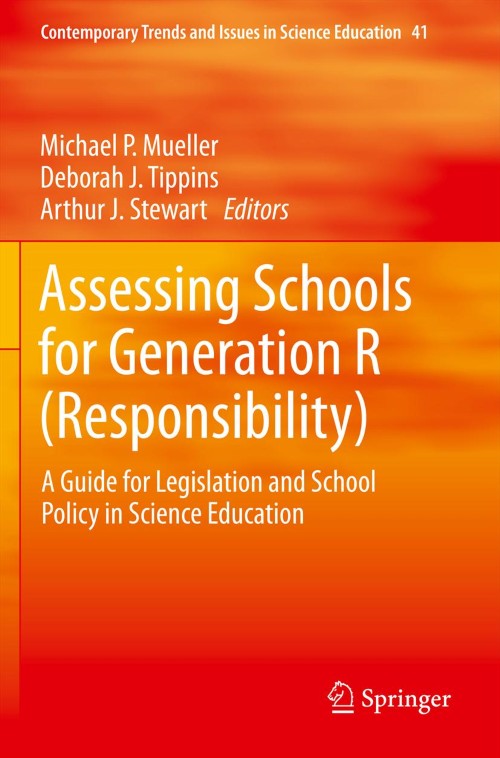
Assessing Schools for Generation R (Responsibility) [electronic resource] : A Guide for Legislation and School Policy in Science Education / edited by Michael P. Mueller, Deborah J. Tippins, Arthur J. Stewart.
Erişim Adresi
ISBN
9789400727489
Dil Kodu
İngilizce
Yer Numarası
DK/12603
Basım Bildirimi
1st ed. 2014.
Yayın Bilgisi
Dordrecht : Springer Netherlands : Imprint: Springer, 2014.
Fiziksel Niteleme
XXI, 449 p. online resource.
Dizi
Contemporary Trends and Issues in Science Education, 1878-0784
İçindekiler Notu
Chapter 1 Reclaiming Community As We Rethink Assessment By Deborah J. Tippins, Arthur J. Stewart, and Michael P. Mueller -- GENERATION R (RESPONSIBILITY) -- Chapter 2 Introducing Generation R By Michael P. Mueller and Rachel A. Luther -- Chapter 3 Civic Responsibility and Science Education By Paul Theobald and John Siskar -- Chapter 4 Critical Civic Literacy and the Limits of Consumer-Based Citizenship By Cori Jakubiak and Michael P. Mueller -- Chapter 5 Fostering Independence: Assessing Student Development By Danielle V. Dennis -- Chapter 6 Assessing for Interdependent Responsibility By Molly Lawrence and Rosalie Romano -- RESPONSIBILITY WITH SCIENTIFIC LITERACY, ENVIRONMENTAL LITERACY AND EXPERIENTIAL LEARNING -- Chapter 7 Thinking (Scientifically) Responsibly: The Cultivation of Character in a Global Science Education Community By Dana L. Zeidler, Marvin W. Berkowitz and Kory Bennett -- Chapter 8 Assessment of Socio-scientific Reasoning: Linking Progressive Aims of Science Education to the Realities of Modern Education By Troy D. Sadler -- Chapter 9 Assessment Across Boundaries: How High-Quality Student Work Demonstrates Achievement, Shapes Practice, and Improves Communities By Alison Rheingold, Jayson Seaman and Ron Berger -- Chapter 10 The View from the Top of the Plateau By Fred N. Finley, Brad Johnson, and Hallie Kamesch -- Chapter 11 Benefits of Elementary Environmental Education By Ryan J. Brock and David T. Crowther -- Chapter 12 Teaching Earth Smarts: Equipping the Next Generation with the Capacity to Adapt By Bryan H. Nichols -- RESPONSIBILITY WITH DIGITAL TECHNOLOGIES -- Chapter 13 Digital Technologies and Assessment in the 21st Century Schooling By Jing Lei, Ji Shen and Laurene Johnson -- Chapter 14 New Interoperable Web Tools to Facilitate Decision-making to Support Community Sustainability By Elizabeth R. Smith, Anne C. Neale, C. Richard Ziegler, and Laura E. Jackson -- Chapter 15 Is There an App For That? Connecting Local Knowledge with Scientific Literacy By GeorgeE. Glasson -- Chapter 16 Developing Collective Decision-making through Future Learning Environments By Gillian Roehrig, David Groos and S. Selcen Guzey -- Chapter 17 GameWerks Camp: Using Gaming to Foster Learning by Design By Lucas John Jensen, Gregory M. Francom, Deborah J. Tippins and Michael Orey -- Chapter 18 The Power of the Globe and Geospatial Technologies to Empower Teachers and Students in the Digital Age By Rita A. Hagevik -- RESPONSIBILITY WITH DEVELOPING LIFELONG RELATIONSHIPS -- Chapter 19 The Importance of Cultural Studies for Education: For Teachers and Policymakers in America By Barbara J. Thayer-Bacon -- Chapter 20 Culture, Environment, and Education in the Anthropocene By David A. Greenwood -- Chapter 21 Science Education in and for Turbulent Times By Kenneth Tobin -- Chapter 22 Free Choice Science Learning and Generation R By Lynn Dierking -- Chapter 23 Educating for Scientific Literacy, Citizenship, and Sustainability: Learning from Native Hawaiian Perspectives By PaulineW.U. Chinn -- Chapter 24 From Local Observations to Global Relationships By Xavier Fazio and Doug Karrow -- Chapter 25 Our Shared Forests—Ecuador and Southeast US Migratory Bird Partnership By Anne M. Shenk -- RESPONSIBILITY WITH DECISIONS, POLICYMAKING, AND LEGISLATION -- Chapter 26 Frankenstein, Monsters, and Science Education: The Need for Broad-based Educational Policy By Bradley D. Rowe -- Chapter 27 School Policy in Science Education By George E. DeBoer -- Chapter 28 Some Challenges in Planning Educational Programs for Generation R By J Myron Atkin -- Chapter 29 Re-imaging the Goals of Science Education: What Role Should Assessment Play? By Maria Rivera-Maulucci.
Özet, vb.
Today’s youth will face global environmental changes, as well as complex personal and social challenges. To address these issues this collection of essays provides vital insights on how science education can be designed to better engage students and help them solve important problems in the world around them. Assessing Schools for Generation R (Responsibility) includes theories, research, and practices for envisioning how science and environmental education can promote personal, social, and civic responsibility. It brings together inspiring stories, creative practices, and theoretical work to make the case that science education can be reformed so that students learn to meaningfully apply the concepts they learn in science classes across America and grow into civically engaged citizens. The book calls for a curriculum that equips students with the knowledge, skills, attitudes and values to confront the complex and often ill-defined socioscientific issues of daily life. The authors are all experienced educators and top experts in the fields of science and environmental education, ecology, experiential education, educational philosophy, policy and history. They examine what has to happen in the domains of teacher preparation and public education to effect a transition of the youth of America. This exciting, informative, sophisticated and sometimes provocative book will stimulate much debate about the future direction of science education in America, and the rest of the world. It is ideal reading for all school superintendents, deans, faculty, and policymakers looking for a way to implement a curriculum that helps builds students into responsible and engaged citizens.
Konu
Science __ Study and teaching.
Environmental Law.
Education and state.
Science Education.
Environmental Law.
Educational Policy and Politics.
Environmental Law.
Education and state.
Science Education.
Environmental Law.
Educational Policy and Politics.
Diğer Yazarlar
Kurum Adı

Eseri Alıntıla
Referansları kullanmadan önce gözden geçirmeniz ve varsa gerekli düzeltmeleri yapmanız önerilir.
Dijital Kaynak
MARC Görünümü
LEADER 07600nam a22005655i 4500
001 811340
003 TR_AnAIT
005 20260131010956
007 cr nn 008mamaa
008 130717s2014 ne | s |||| 0|eng d
020 |a9789400727489|9978-94-007-2748-9
024 7 |a10.1007/978-94-007-2748-9|2doi
041 |aeng
049 |aTürk Tarih Kurumu Kütüphanesi
050 4|aQ181-183.4
072 7|aJNU|2bicssc
072 7|aPD|2bicssc
072 7|aSCI063000|2bisacsh
072 7|aJNU|2thema
072 7|aPD|2thema
082 04|a507.1|223
090 |aDK/12603
245 10|aAssessing Schools for Generation R (Responsibility)|h[electronic resource] :|bA Guide for Legislation and School Policy in Science Education /|cedited by Michael P. Mueller, Deborah J. Tippins, Arthur J. Stewart.
250 |a1st ed. 2014.
264 1|aDordrecht :|bSpringer Netherlands :|bImprint: Springer,|c2014.
300 |aXXI, 449 p.|bonline resource.
336 |atext|btxt|2rdacontent
337 |acomputer|bc|2rdamedia
338 |aonline resource|bcr|2rdacarrier
347 |atext file|bPDF|2rda
490 1 |aContemporary Trends and Issues in Science Education,|x1878-0784
505 0 |aChapter 1 Reclaiming Community As We Rethink Assessment By Deborah J. Tippins, Arthur J. Stewart, and Michael P. Mueller -- GENERATION R (RESPONSIBILITY) -- Chapter 2 Introducing Generation R By Michael P. Mueller and Rachel A. Luther -- Chapter 3 Civic Responsibility and Science Education By Paul Theobald and John Siskar -- Chapter 4 Critical Civic Literacy and the Limits of Consumer-Based Citizenship By Cori Jakubiak and Michael P. Mueller -- Chapter 5 Fostering Independence: Assessing Student Development By Danielle V. Dennis -- Chapter 6 Assessing for Interdependent Responsibility By Molly Lawrence and Rosalie Romano -- RESPONSIBILITY WITH SCIENTIFIC LITERACY, ENVIRONMENTAL LITERACY AND EXPERIENTIAL LEARNING -- Chapter 7 Thinking (Scientifically) Responsibly: The Cultivation of Character in a Global Science Education Community By Dana L. Zeidler, Marvin W. Berkowitz and Kory Bennett -- Chapter 8 Assessment of Socio-scientific Reasoning: Linking Progressive Aims of Science Education to the Realities of Modern Education By Troy D. Sadler -- Chapter 9 Assessment Across Boundaries: How High-Quality Student Work Demonstrates Achievement, Shapes Practice, and Improves Communities By Alison Rheingold, Jayson Seaman and Ron Berger -- Chapter 10 The View from the Top of the Plateau By Fred N. Finley, Brad Johnson, and Hallie Kamesch -- Chapter 11 Benefits of Elementary Environmental Education By Ryan J. Brock and David T. Crowther -- Chapter 12 Teaching Earth Smarts: Equipping the Next Generation with the Capacity to Adapt By Bryan H. Nichols -- RESPONSIBILITY WITH DIGITAL TECHNOLOGIES -- Chapter 13 Digital Technologies and Assessment in the 21st Century Schooling By Jing Lei, Ji Shen and Laurene Johnson -- Chapter 14 New Interoperable Web Tools to Facilitate Decision-making to Support Community Sustainability By Elizabeth R. Smith, Anne C. Neale, C. Richard Ziegler, and Laura E. Jackson -- Chapter 15 Is There an App For That? Connecting Local Knowledge with Scientific Literacy By GeorgeE. Glasson -- Chapter 16 Developing Collective Decision-making through Future Learning Environments By Gillian Roehrig, David Groos and S. Selcen Guzey -- Chapter 17 GameWerks Camp: Using Gaming to Foster Learning by Design By Lucas John Jensen, Gregory M. Francom, Deborah J. Tippins and Michael Orey -- Chapter 18 The Power of the Globe and Geospatial Technologies to Empower Teachers and Students in the Digital Age By Rita A. Hagevik -- RESPONSIBILITY WITH DEVELOPING LIFELONG RELATIONSHIPS -- Chapter 19 The Importance of Cultural Studies for Education: For Teachers and Policymakers in America By Barbara J. Thayer-Bacon -- Chapter 20 Culture, Environment, and Education in the Anthropocene By David A. Greenwood -- Chapter 21 Science Education in and for Turbulent Times By Kenneth Tobin -- Chapter 22 Free Choice Science Learning and Generation R By Lynn Dierking -- Chapter 23 Educating for Scientific Literacy, Citizenship, and Sustainability: Learning from Native Hawaiian Perspectives By PaulineW.U. Chinn -- Chapter 24 From Local Observations to Global Relationships By Xavier Fazio and Doug Karrow -- Chapter 25 Our Shared Forests—Ecuador and Southeast US Migratory Bird Partnership By Anne M. Shenk -- RESPONSIBILITY WITH DECISIONS, POLICYMAKING, AND LEGISLATION -- Chapter 26 Frankenstein, Monsters, and Science Education: The Need for Broad-based Educational Policy By Bradley D. Rowe -- Chapter 27 School Policy in Science Education By George E. DeBoer -- Chapter 28 Some Challenges in Planning Educational Programs for Generation R By J Myron Atkin -- Chapter 29 Re-imaging the Goals of Science Education: What Role Should Assessment Play? By Maria Rivera-Maulucci.
520 |aToday’s youth will face global environmental changes, as well as complex personal and social challenges. To address these issues this collection of essays provides vital insights on how science education can be designed to better engage students and help them solve important problems in the world around them. Assessing Schools for Generation R (Responsibility) includes theories, research, and practices for envisioning how science and environmental education can promote personal, social, and civic responsibility. It brings together inspiring stories, creative practices, and theoretical work to make the case that science education can be reformed so that students learn to meaningfully apply the concepts they learn in science classes across America and grow into civically engaged citizens. The book calls for a curriculum that equips students with the knowledge, skills, attitudes and values to confront the complex and often ill-defined socioscientific issues of daily life. The authors are all experienced educators and top experts in the fields of science and environmental education, ecology, experiential education, educational philosophy, policy and history. They examine what has to happen in the domains of teacher preparation and public education to effect a transition of the youth of America. This exciting, informative, sophisticated and sometimes provocative book will stimulate much debate about the future direction of science education in America, and the rest of the world. It is ideal reading for all school superintendents, deans, faculty, and policymakers looking for a way to implement a curriculum that helps builds students into responsible and engaged citizens.
650 0|aScience|xStudy and teaching.
650 0|aEnvironmental Law.
650 0|aEducation and state.
650 14|aScience Education.
650 24|aEnvironmental Law.
650 24|aEducational Policy and Politics.
700 1 |aMueller, Michael P.|eeditor.|4edt|4http://id.loc.gov/vocabulary/relators/edt
700 1 |aTippins, Deborah J.|eeditor.|4edt|4http://id.loc.gov/vocabulary/relators/edt
700 1 |aStewart, Arthur J.|eeditor.|4edt|4http://id.loc.gov/vocabulary/relators/edt
710 2 |aSpringerLink (Online service)
773 0 |tSpringer Nature eBook
776 08|iPrinted edition:|z9789400727472
776 08|iPrinted edition:|z9789400727496
776 08|iPrinted edition:|z9789400794023
830 0|aContemporary Trends and Issues in Science Education,|x1878-0784
856 40|uhttps://doi.org/10.1007/978-94-007-2748-9
912 |aZDB-2-SHU
912 |aZDB-2-SXED
950 |aHumanities, Social Sciences and Law (SpringerNature-11648)
950 |aEducation (R0) (SpringerNature-43721)
001 811340
003 TR_AnAIT
005 20260131010956
007 cr nn 008mamaa
008 130717s2014 ne | s |||| 0|eng d
020 |a9789400727489|9978-94-007-2748-9
024 7 |a10.1007/978-94-007-2748-9|2doi
041 |aeng
049 |aTürk Tarih Kurumu Kütüphanesi
050 4|aQ181-183.4
072 7|aJNU|2bicssc
072 7|aPD|2bicssc
072 7|aSCI063000|2bisacsh
072 7|aJNU|2thema
072 7|aPD|2thema
082 04|a507.1|223
090 |aDK/12603
245 10|aAssessing Schools for Generation R (Responsibility)|h[electronic resource] :|bA Guide for Legislation and School Policy in Science Education /|cedited by Michael P. Mueller, Deborah J. Tippins, Arthur J. Stewart.
250 |a1st ed. 2014.
264 1|aDordrecht :|bSpringer Netherlands :|bImprint: Springer,|c2014.
300 |aXXI, 449 p.|bonline resource.
336 |atext|btxt|2rdacontent
337 |acomputer|bc|2rdamedia
338 |aonline resource|bcr|2rdacarrier
347 |atext file|bPDF|2rda
490 1 |aContemporary Trends and Issues in Science Education,|x1878-0784
505 0 |aChapter 1 Reclaiming Community As We Rethink Assessment By Deborah J. Tippins, Arthur J. Stewart, and Michael P. Mueller -- GENERATION R (RESPONSIBILITY) -- Chapter 2 Introducing Generation R By Michael P. Mueller and Rachel A. Luther -- Chapter 3 Civic Responsibility and Science Education By Paul Theobald and John Siskar -- Chapter 4 Critical Civic Literacy and the Limits of Consumer-Based Citizenship By Cori Jakubiak and Michael P. Mueller -- Chapter 5 Fostering Independence: Assessing Student Development By Danielle V. Dennis -- Chapter 6 Assessing for Interdependent Responsibility By Molly Lawrence and Rosalie Romano -- RESPONSIBILITY WITH SCIENTIFIC LITERACY, ENVIRONMENTAL LITERACY AND EXPERIENTIAL LEARNING -- Chapter 7 Thinking (Scientifically) Responsibly: The Cultivation of Character in a Global Science Education Community By Dana L. Zeidler, Marvin W. Berkowitz and Kory Bennett -- Chapter 8 Assessment of Socio-scientific Reasoning: Linking Progressive Aims of Science Education to the Realities of Modern Education By Troy D. Sadler -- Chapter 9 Assessment Across Boundaries: How High-Quality Student Work Demonstrates Achievement, Shapes Practice, and Improves Communities By Alison Rheingold, Jayson Seaman and Ron Berger -- Chapter 10 The View from the Top of the Plateau By Fred N. Finley, Brad Johnson, and Hallie Kamesch -- Chapter 11 Benefits of Elementary Environmental Education By Ryan J. Brock and David T. Crowther -- Chapter 12 Teaching Earth Smarts: Equipping the Next Generation with the Capacity to Adapt By Bryan H. Nichols -- RESPONSIBILITY WITH DIGITAL TECHNOLOGIES -- Chapter 13 Digital Technologies and Assessment in the 21st Century Schooling By Jing Lei, Ji Shen and Laurene Johnson -- Chapter 14 New Interoperable Web Tools to Facilitate Decision-making to Support Community Sustainability By Elizabeth R. Smith, Anne C. Neale, C. Richard Ziegler, and Laura E. Jackson -- Chapter 15 Is There an App For That? Connecting Local Knowledge with Scientific Literacy By GeorgeE. Glasson -- Chapter 16 Developing Collective Decision-making through Future Learning Environments By Gillian Roehrig, David Groos and S. Selcen Guzey -- Chapter 17 GameWerks Camp: Using Gaming to Foster Learning by Design By Lucas John Jensen, Gregory M. Francom, Deborah J. Tippins and Michael Orey -- Chapter 18 The Power of the Globe and Geospatial Technologies to Empower Teachers and Students in the Digital Age By Rita A. Hagevik -- RESPONSIBILITY WITH DEVELOPING LIFELONG RELATIONSHIPS -- Chapter 19 The Importance of Cultural Studies for Education: For Teachers and Policymakers in America By Barbara J. Thayer-Bacon -- Chapter 20 Culture, Environment, and Education in the Anthropocene By David A. Greenwood -- Chapter 21 Science Education in and for Turbulent Times By Kenneth Tobin -- Chapter 22 Free Choice Science Learning and Generation R By Lynn Dierking -- Chapter 23 Educating for Scientific Literacy, Citizenship, and Sustainability: Learning from Native Hawaiian Perspectives By PaulineW.U. Chinn -- Chapter 24 From Local Observations to Global Relationships By Xavier Fazio and Doug Karrow -- Chapter 25 Our Shared Forests—Ecuador and Southeast US Migratory Bird Partnership By Anne M. Shenk -- RESPONSIBILITY WITH DECISIONS, POLICYMAKING, AND LEGISLATION -- Chapter 26 Frankenstein, Monsters, and Science Education: The Need for Broad-based Educational Policy By Bradley D. Rowe -- Chapter 27 School Policy in Science Education By George E. DeBoer -- Chapter 28 Some Challenges in Planning Educational Programs for Generation R By J Myron Atkin -- Chapter 29 Re-imaging the Goals of Science Education: What Role Should Assessment Play? By Maria Rivera-Maulucci.
520 |aToday’s youth will face global environmental changes, as well as complex personal and social challenges. To address these issues this collection of essays provides vital insights on how science education can be designed to better engage students and help them solve important problems in the world around them. Assessing Schools for Generation R (Responsibility) includes theories, research, and practices for envisioning how science and environmental education can promote personal, social, and civic responsibility. It brings together inspiring stories, creative practices, and theoretical work to make the case that science education can be reformed so that students learn to meaningfully apply the concepts they learn in science classes across America and grow into civically engaged citizens. The book calls for a curriculum that equips students with the knowledge, skills, attitudes and values to confront the complex and often ill-defined socioscientific issues of daily life. The authors are all experienced educators and top experts in the fields of science and environmental education, ecology, experiential education, educational philosophy, policy and history. They examine what has to happen in the domains of teacher preparation and public education to effect a transition of the youth of America. This exciting, informative, sophisticated and sometimes provocative book will stimulate much debate about the future direction of science education in America, and the rest of the world. It is ideal reading for all school superintendents, deans, faculty, and policymakers looking for a way to implement a curriculum that helps builds students into responsible and engaged citizens.
650 0|aScience|xStudy and teaching.
650 0|aEnvironmental Law.
650 0|aEducation and state.
650 14|aScience Education.
650 24|aEnvironmental Law.
650 24|aEducational Policy and Politics.
700 1 |aMueller, Michael P.|eeditor.|4edt|4http://id.loc.gov/vocabulary/relators/edt
700 1 |aTippins, Deborah J.|eeditor.|4edt|4http://id.loc.gov/vocabulary/relators/edt
700 1 |aStewart, Arthur J.|eeditor.|4edt|4http://id.loc.gov/vocabulary/relators/edt
710 2 |aSpringerLink (Online service)
773 0 |tSpringer Nature eBook
776 08|iPrinted edition:|z9789400727472
776 08|iPrinted edition:|z9789400727496
776 08|iPrinted edition:|z9789400794023
830 0|aContemporary Trends and Issues in Science Education,|x1878-0784
856 40|uhttps://doi.org/10.1007/978-94-007-2748-9
912 |aZDB-2-SHU
912 |aZDB-2-SXED
950 |aHumanities, Social Sciences and Law (SpringerNature-11648)
950 |aEducation (R0) (SpringerNature-43721)
Materyaller
Depodan talep edilen materyal sadece kütüphane içerisinde kullanılmaktadır.
Materyal dışarıya ödünç verilmemektedir.
