

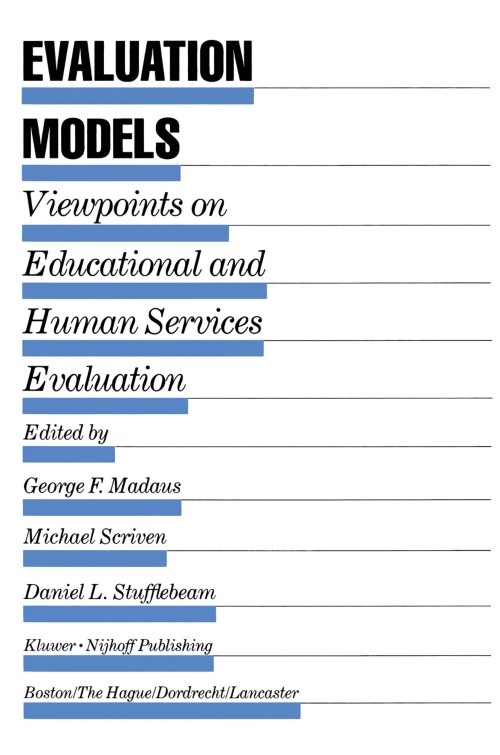
Evaluation Models [electronic resource] : Viewpoints on Educational and Human Services Evaluation / edited by George F. Madaus, M. Scriven, D.L. Stufflebeam.
Erişim Adresi
ISBN
9789400966697
Dil Kodu
İngilizce
Yer Numarası
DK/12620
Basım Bildirimi
1st ed. 1983.
Yayın Bilgisi
Dordrecht : Springer Netherlands : Imprint: Springer, 1983.
Fiziksel Niteleme
385 p. online resource.
Dizi
Evaluation in Education and Human Services ; 6
İçindekiler Notu
I An Overview of Models and Conceptualizations -- 1 Program Evaluation: A Historical Overview -- 2 An Analysis of Alternative Approaches to Evaluation -- 3 Assumptions Underlying Evaluation Models -- II Models and Conceptualizations -- 4 A Rationale for Program Evaluation -- 5 The Discrepancy Evaluation Model -- 6 Course Improvement through Evaluation -- 7 The CIPP Model for Program Evaluation -- 8 The Evaluation of Broad-Aim Programs: Experimental Design, Its Difficulties, and an Alternative -- 9 Societal Experimentation -- 10 Rationality to Ritual: The Multiple Roles of Evaluation in Governmental Processes -- 11 The Use of Judicial Evaluation Methods in the Formulation of Educational Policy -- 12 Deep Dark Deficits of the Adversary Evaluation Model -- 13 The Clarification Hearing: A Personal View of the Process -- 14 Evaluation Ideologies -- 15 Flexner, Accreditation, and Evaluation -- 16 The Case Study Method in Social Inquiry -- 17 Program Evaluation, Particularly Responsive Evaluation -- 18 Epistemological and Methodological Bases of Naturalistic Inquiry -- 19 Educational Connoisseurship and Criticism: Their Form and Functions in Educational Evaluation -- 20 The Explication Model: An Anthropological Approach to Program Evaluation -- 21 Designing Evaluations of Educational and Social Progress by Lee J. Cronbach: A Synopsis -- 22 The Progress of Educational Evaluation: Rounding the First Bends in the River -- III The Standards and the Ninety-five Theses -- 23 The Standards for Evaluation of Educational Programs, Projects, and Materials: A Description and Summary -- 24 Ninety-five Theses for Reforming Program Evaluation -- Contributing Authors.
Özet, vb.
Attempting fonnally to evaluate something involves the evaluator coming to grips with a number of abstract concepts such as value, merit, worth, growth, criteria, standards, objectives, needs, nonns, client, audience, validity, reliability, objectivity, practical significance, accountability, improvement, process, pro duct, fonnative, summative, costs, impact, infonnation, credibility, and - of course - with the tenn evaluation itself. To communicate with colleagues and clients, evaluators need to clarify what they mean when they use such tenns to denote important concepts central to their work. Moreover, evaluators need to integrate these concepts and their meanings into a coherent framework that guides all aspects of their work. If evaluation is to lay claim to the mantle of a profession, then these conceptualizations of evaluation must lead to the conduct of defensible evaluations. The conceptualization of evaluation can never be a one-time activity nor can any conceptualization be static. Conceptualizations that guide evaluation work must keep pace with the growth of theory and practice in the field. Further, the design and conduct of any particular study involves a good deal of localized conceptualization.
Konu
Educational tests and measurements.
Assessment and Testing.
Assessment and Testing.
Diğer Yazarlar
Kurum Adı
Eseri Alıntıla
Referansları kullanmadan önce gözden geçirmeniz ve varsa gerekli düzeltmeleri yapmanız önerilir.
Dijital Kaynak
MARC Görünümü
LEADER 05600nam a22005535i 4500
001 811357
003 TR_AnAIT
005 20260131010758
007 cr nn 008mamaa
008 121227s1983 ne | s |||| 0|eng d
020 |a9789400966697|9978-94-009-6669-7
024 7 |a10.1007/978-94-009-6669-7|2doi
041 |aeng
049 |aTürk Tarih Kurumu Kütüphanesi
050 4|aLB3050-3060.87
072 7|aJNKD|2bicssc
072 7|aEDU030000|2bisacsh
072 7|aJNDH|2thema
082 04|a371.26|223
090 |aDK/12620
245 10|aEvaluation Models|h[electronic resource] :|bViewpoints on Educational and Human Services Evaluation /|cedited by George F. Madaus, M. Scriven, D.L. Stufflebeam.
250 |a1st ed. 1983.
264 1|aDordrecht :|bSpringer Netherlands :|bImprint: Springer,|c1983.
300 |a385 p.|bonline resource.
336 |atext|btxt|2rdacontent
337 |acomputer|bc|2rdamedia
338 |aonline resource|bcr|2rdacarrier
347 |atext file|bPDF|2rda
490 1 |aEvaluation in Education and Human Services ;|v6
505 0 |aI An Overview of Models and Conceptualizations -- 1 Program Evaluation: A Historical Overview -- 2 An Analysis of Alternative Approaches to Evaluation -- 3 Assumptions Underlying Evaluation Models -- II Models and Conceptualizations -- 4 A Rationale for Program Evaluation -- 5 The Discrepancy Evaluation Model -- 6 Course Improvement through Evaluation -- 7 The CIPP Model for Program Evaluation -- 8 The Evaluation of Broad-Aim Programs: Experimental Design, Its Difficulties, and an Alternative -- 9 Societal Experimentation -- 10 Rationality to Ritual: The Multiple Roles of Evaluation in Governmental Processes -- 11 The Use of Judicial Evaluation Methods in the Formulation of Educational Policy -- 12 Deep Dark Deficits of the Adversary Evaluation Model -- 13 The Clarification Hearing: A Personal View of the Process -- 14 Evaluation Ideologies -- 15 Flexner, Accreditation, and Evaluation -- 16 The Case Study Method in Social Inquiry -- 17 Program Evaluation, Particularly Responsive Evaluation -- 18 Epistemological and Methodological Bases of Naturalistic Inquiry -- 19 Educational Connoisseurship and Criticism: Their Form and Functions in Educational Evaluation -- 20 The Explication Model: An Anthropological Approach to Program Evaluation -- 21 Designing Evaluations of Educational and Social Progress by Lee J. Cronbach: A Synopsis -- 22 The Progress of Educational Evaluation: Rounding the First Bends in the River -- III The Standards and the Ninety-five Theses -- 23 The Standards for Evaluation of Educational Programs, Projects, and Materials: A Description and Summary -- 24 Ninety-five Theses for Reforming Program Evaluation -- Contributing Authors.
520 |aAttempting fonnally to evaluate something involves the evaluator coming to grips with a number of abstract concepts such as value, merit, worth, growth, criteria, standards, objectives, needs, nonns, client, audience, validity, reliability, objectivity, practical significance, accountability, improvement, process, pro duct, fonnative, summative, costs, impact, infonnation, credibility, and - of course - with the tenn evaluation itself. To communicate with colleagues and clients, evaluators need to clarify what they mean when they use such tenns to denote important concepts central to their work. Moreover, evaluators need to integrate these concepts and their meanings into a coherent framework that guides all aspects of their work. If evaluation is to lay claim to the mantle of a profession, then these conceptualizations of evaluation must lead to the conduct of defensible evaluations. The conceptualization of evaluation can never be a one-time activity nor can any conceptualization be static. Conceptualizations that guide evaluation work must keep pace with the growth of theory and practice in the field. Further, the design and conduct of any particular study involves a good deal of localized conceptualization.
532 8 |aAccessibility summary: This PDF is not accessible. It is based on scanned pages and does not support features such as screen reader compatibility or described non-text content (images, graphs etc). However, it likely supports searchable and selectable text based on OCR (Optical Character Recognition). Users with accessibility needs may not be able to use this content effectively. Please contact us at accessibilitysupport@springernature.com if you require assistance or an alternative format.
532 8 |aInaccessible, or known limited accessibility
532 8 |aNo reading system accessibility options actively disabled
532 8 |aPublisher contact for further accessibility information: accessibilitysupport@springernature.com
650 0|aEducational tests and measurements.
650 14|aAssessment and Testing.
700 1 |aMadaus, George F.|eeditor.|4edt|4http://id.loc.gov/vocabulary/relators/edt
700 1 |aScriven, M.|eeditor.|4edt|4http://id.loc.gov/vocabulary/relators/edt
700 1 |aStufflebeam, D.L.|eeditor.|4edt|4http://id.loc.gov/vocabulary/relators/edt
710 2 |aSpringerLink (Online service)
773 0 |tSpringer Nature eBook
776 08|iPrinted edition:|z9780898381238
776 08|iPrinted edition:|z9789400966703
776 08|iPrinted edition:|z9789400966710
830 0|aEvaluation in Education and Human Services ;|v6
856 40|uhttps://doi.org/10.1007/978-94-009-6669-7
912 |aZDB-2-SHU
912 |aZDB-2-SXED
912 |aZDB-2-BAE
950 |aHumanities, Social Sciences and Law (SpringerNature-11648)
950 |aEducation (R0) (SpringerNature-43721)
001 811357
003 TR_AnAIT
005 20260131010758
007 cr nn 008mamaa
008 121227s1983 ne | s |||| 0|eng d
020 |a9789400966697|9978-94-009-6669-7
024 7 |a10.1007/978-94-009-6669-7|2doi
041 |aeng
049 |aTürk Tarih Kurumu Kütüphanesi
050 4|aLB3050-3060.87
072 7|aJNKD|2bicssc
072 7|aEDU030000|2bisacsh
072 7|aJNDH|2thema
082 04|a371.26|223
090 |aDK/12620
245 10|aEvaluation Models|h[electronic resource] :|bViewpoints on Educational and Human Services Evaluation /|cedited by George F. Madaus, M. Scriven, D.L. Stufflebeam.
250 |a1st ed. 1983.
264 1|aDordrecht :|bSpringer Netherlands :|bImprint: Springer,|c1983.
300 |a385 p.|bonline resource.
336 |atext|btxt|2rdacontent
337 |acomputer|bc|2rdamedia
338 |aonline resource|bcr|2rdacarrier
347 |atext file|bPDF|2rda
490 1 |aEvaluation in Education and Human Services ;|v6
505 0 |aI An Overview of Models and Conceptualizations -- 1 Program Evaluation: A Historical Overview -- 2 An Analysis of Alternative Approaches to Evaluation -- 3 Assumptions Underlying Evaluation Models -- II Models and Conceptualizations -- 4 A Rationale for Program Evaluation -- 5 The Discrepancy Evaluation Model -- 6 Course Improvement through Evaluation -- 7 The CIPP Model for Program Evaluation -- 8 The Evaluation of Broad-Aim Programs: Experimental Design, Its Difficulties, and an Alternative -- 9 Societal Experimentation -- 10 Rationality to Ritual: The Multiple Roles of Evaluation in Governmental Processes -- 11 The Use of Judicial Evaluation Methods in the Formulation of Educational Policy -- 12 Deep Dark Deficits of the Adversary Evaluation Model -- 13 The Clarification Hearing: A Personal View of the Process -- 14 Evaluation Ideologies -- 15 Flexner, Accreditation, and Evaluation -- 16 The Case Study Method in Social Inquiry -- 17 Program Evaluation, Particularly Responsive Evaluation -- 18 Epistemological and Methodological Bases of Naturalistic Inquiry -- 19 Educational Connoisseurship and Criticism: Their Form and Functions in Educational Evaluation -- 20 The Explication Model: An Anthropological Approach to Program Evaluation -- 21 Designing Evaluations of Educational and Social Progress by Lee J. Cronbach: A Synopsis -- 22 The Progress of Educational Evaluation: Rounding the First Bends in the River -- III The Standards and the Ninety-five Theses -- 23 The Standards for Evaluation of Educational Programs, Projects, and Materials: A Description and Summary -- 24 Ninety-five Theses for Reforming Program Evaluation -- Contributing Authors.
520 |aAttempting fonnally to evaluate something involves the evaluator coming to grips with a number of abstract concepts such as value, merit, worth, growth, criteria, standards, objectives, needs, nonns, client, audience, validity, reliability, objectivity, practical significance, accountability, improvement, process, pro duct, fonnative, summative, costs, impact, infonnation, credibility, and - of course - with the tenn evaluation itself. To communicate with colleagues and clients, evaluators need to clarify what they mean when they use such tenns to denote important concepts central to their work. Moreover, evaluators need to integrate these concepts and their meanings into a coherent framework that guides all aspects of their work. If evaluation is to lay claim to the mantle of a profession, then these conceptualizations of evaluation must lead to the conduct of defensible evaluations. The conceptualization of evaluation can never be a one-time activity nor can any conceptualization be static. Conceptualizations that guide evaluation work must keep pace with the growth of theory and practice in the field. Further, the design and conduct of any particular study involves a good deal of localized conceptualization.
532 8 |aAccessibility summary: This PDF is not accessible. It is based on scanned pages and does not support features such as screen reader compatibility or described non-text content (images, graphs etc). However, it likely supports searchable and selectable text based on OCR (Optical Character Recognition). Users with accessibility needs may not be able to use this content effectively. Please contact us at accessibilitysupport@springernature.com if you require assistance or an alternative format.
532 8 |aInaccessible, or known limited accessibility
532 8 |aNo reading system accessibility options actively disabled
532 8 |aPublisher contact for further accessibility information: accessibilitysupport@springernature.com
650 0|aEducational tests and measurements.
650 14|aAssessment and Testing.
700 1 |aMadaus, George F.|eeditor.|4edt|4http://id.loc.gov/vocabulary/relators/edt
700 1 |aScriven, M.|eeditor.|4edt|4http://id.loc.gov/vocabulary/relators/edt
700 1 |aStufflebeam, D.L.|eeditor.|4edt|4http://id.loc.gov/vocabulary/relators/edt
710 2 |aSpringerLink (Online service)
773 0 |tSpringer Nature eBook
776 08|iPrinted edition:|z9780898381238
776 08|iPrinted edition:|z9789400966703
776 08|iPrinted edition:|z9789400966710
830 0|aEvaluation in Education and Human Services ;|v6
856 40|uhttps://doi.org/10.1007/978-94-009-6669-7
912 |aZDB-2-SHU
912 |aZDB-2-SXED
912 |aZDB-2-BAE
950 |aHumanities, Social Sciences and Law (SpringerNature-11648)
950 |aEducation (R0) (SpringerNature-43721)
Materyaller
Depodan talep edilen materyal sadece kütüphane içerisinde kullanılmaktadır.
Materyal dışarıya ödünç verilmemektedir.
Materyal dışarıya ödünç verilmemektedir.
