

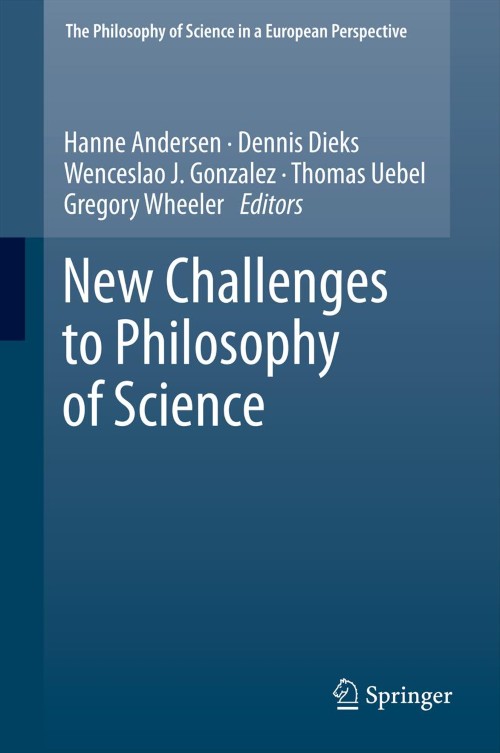
New Challenges to Philosophy of Science [electronic resource] / edited by Hanne Andersen, Dennis Dieks, Wenceslao J. Gonzalez, Thomas Uebel, Gregory Wheeler.
Erişim Adresi
ISBN
9789400758452
Dil Kodu
İngilizce
Yer Numarası
DK/12635
Basım Bildirimi
1st ed. 2013.
Yayın Bilgisi
Dordrecht : Springer Netherlands : Imprint: Springer, 2013.
Fiziksel Niteleme
VII, 512 p. online resource.
Dizi
The Philosophy of Science in a European Perspective
İçindekiler Notu
Wenceslao J. Gonzalez, Preface,- Teams A and D: The Philosophy of Computer Science and Artificial Intelligence -- Jesse Alama, Reinhard Kahle, Computing with Mathematical Arguments -- Dennis Dieks, Is There a Unique Physical Entropy? Micro versus Macro -- Luciano Floridi, A Defence of the Principle of Information Closure against the Sceptical Objection -- Roberto Giuntini, Hector Freytes, Antonio Ledda, Giuseppe Sergioli, Probabilistic Logics in Quantum Computation -- Alexei Grinbaum, Quantum Observer, Information Theory and Kolmogorov Complexity -- Leon Horsten, Mathematical Philosophy? -- Ulriche Pompe, The Value of Computer Science for Brain Research -- Sam Sanders, On Algorithm and Robustness in a Non-standard Sense.- Francisco C. Santos, Jorge M. Pacheco, Behavioral Dynamics under Climate Change Dilemmas -- Sonja Smets, Reasoning about Quantum Actions: A Logician's Perspective -- Leszek Wroński, Branching Space-Times and Parallel Processing -- Team B: Philosophy of Systems Biology -- Gabriele Gramelsberger, Simulation and System Understanding -- Tarja Knuuttila, Andrea Loettgers, Synthetic Biology as an Engineering Science? Analogical Reasoning, Synthetic Modeling, and Integration.- Anders Strand, Gry Oftedal, Causation and Counterfactual Dependence in Robust Biological Systems.- Melinda Bonnie Fagan, Experimenting Communities in Stem Cell Biology: Exemplars and Interdisciplinarity -- William Bechtel, From Molecules to Networks: Adoption of Systems Approaches in Circadian Rhythm Research.- Olaf Wolkenhauer, Jan-Hendrik Hofmeyr, Interdisciplinarity as both Necessity and Hurdle for Progress in the Life Sciences -- Team C: The Sciences of the Artificial vs. the Cultural and Social Sciences.- Amparo Gómez, Archaeology and Scientific Explanation: Naturalism, Interpretivism and ‘A Third Way’.- Demetris Portides, Idealization in Economics Modeling -- Ilkka Niiniluoto, On the Philosophy of Applied Social Sciences -- Arto Siitonen, The Status of Library Science: From Classification to Digitalization -- Paolo Garbolino, The Scientification of Forensic Practice -- Wenceslao J. Gonzalez, The Sciences of Design as Sciences of Complexity: The Dynamic Trait -- Subrata Dasgupta, Epistemic Complexity and the Sciences of the Artificial -- María José Arrojo, Communication Sciences as Sciences of the Artificial: The Analysis of the Digital Terrestrial Television.- Team E: The Philosophy of the Sciences that Received Philosophy of Science Neglected: Historical Perspective -- Elisabeth Nemeth, The Philosophy of the Other Austrian Economics -- Veronika Hofer, Philosophy of Biology in Early Logical Empiricism -- Julie Zahle, Participant Observation and Objectivity in Anthropology -- Jean-Marc Drouin, Three Philosophical Approaches to Entomology -- Anastasios Brenner, François Henn, Chemistry and French Philosophy of Science. A Comparison of Historical and Contemporary Views -- Cristina Chimisso, The Life Sciences and French Philosophy of Science: Georges Canguilhem on Norms -- Massimo Ferrari, Neglected History: Giulio Preti, the Italian Philosophy of Science, and the Neo-Kantian Tradition -- Thomas Mormann, Topology as an Issue for History of Philosophy of Science -- Graham Stevens, Philosophy, Linguistics, and the Philosophy of Linguistics -- PSE Symposium at EPSA 2011: New Challenges to Philosophy of Science.- Olav Gjelsvik, Philosophy as Interdisciplinary Research -- Theo Kuipers, Philosophy of Design Research -- Raffaella Campaner, Philosophy of Medicine and Model Design -- Roman Frigg, Seamus Bradley, Reason L. Machete, Leonard A. Smith, Probabilistic Forecasting: Why Model Imperfection Is a Poison Pill -- Daniel Andler, Dissensus in Science as a Fact and as a Norm. .
Özet, vb.
This volume is a serious attempt to open up the subject of European philosophy of science to real thought, and provide the structural basis for the interdisciplinary development of its specialist fields, but also to provoke reflection on the idea of ‘European philosophy of science’. This efforts should foster a contemporaneous reflection on what might be meant by philosophy of science in Europe and European philosophy of science, and how in fact awareness of it could assist philosophers interpret and motivate their research through a stronger collective identity. The overarching aim is to set the background for a collaborative project organising, systematising, and ultimately forging an identity for, European philosophy of science by creating research structures and developing research networks across Europe to promote its development.
Konu
Science __ Philosophy.
Philosophy of Science.
Philosophy of Science.
Kurum Adı
Eseri Alıntıla
Referansları kullanmadan önce gözden geçirmeniz ve varsa gerekli düzeltmeleri yapmanız önerilir.
Dijital Kaynak
MARC Görünümü
LEADER 06712nam a22005295i 4500
001 811372
003 TR_AnAIT
005 20260131010648
007 cr nn 008mamaa
008 130530s2013 ne | s |||| 0|eng d
020 |a9789400758452|9978-94-007-5845-2
024 7 |a10.1007/978-94-007-5845-2|2doi
041 |aeng
049 |aTürk Tarih Kurumu Kütüphanesi
050 4|aQ174-175.3
050 4|aB67
072 7|aPDA|2bicssc
072 7|aSCI075000|2bisacsh
072 7|aPDA|2thema
082 04|a501|223
090 |aDK/12635
245 10|aNew Challenges to Philosophy of Science|h[electronic resource] /|cedited by Hanne Andersen, Dennis Dieks, Wenceslao J. Gonzalez, Thomas Uebel, Gregory Wheeler.
250 |a1st ed. 2013.
264 1|aDordrecht :|bSpringer Netherlands :|bImprint: Springer,|c2013.
300 |aVII, 512 p.|bonline resource.
336 |atext|btxt|2rdacontent
337 |acomputer|bc|2rdamedia
338 |aonline resource|bcr|2rdacarrier
347 |atext file|bPDF|2rda
490 1 |aThe Philosophy of Science in a European Perspective
505 0 |aWenceslao J. Gonzalez, Preface,- Teams A and D: The Philosophy of Computer Science and Artificial Intelligence -- Jesse Alama, Reinhard Kahle, Computing with Mathematical Arguments -- Dennis Dieks, Is There a Unique Physical Entropy? Micro versus Macro -- Luciano Floridi, A Defence of the Principle of Information Closure against the Sceptical Objection -- Roberto Giuntini, Hector Freytes, Antonio Ledda, Giuseppe Sergioli, Probabilistic Logics in Quantum Computation -- Alexei Grinbaum, Quantum Observer, Information Theory and Kolmogorov Complexity -- Leon Horsten, Mathematical Philosophy? -- Ulriche Pompe, The Value of Computer Science for Brain Research -- Sam Sanders, On Algorithm and Robustness in a Non-standard Sense.- Francisco C. Santos, Jorge M. Pacheco, Behavioral Dynamics under Climate Change Dilemmas -- Sonja Smets, Reasoning about Quantum Actions: A Logician's Perspective -- Leszek Wroński, Branching Space-Times and Parallel Processing -- Team B: Philosophy of Systems Biology -- Gabriele Gramelsberger, Simulation and System Understanding -- Tarja Knuuttila, Andrea Loettgers, Synthetic Biology as an Engineering Science? Analogical Reasoning, Synthetic Modeling, and Integration.- Anders Strand, Gry Oftedal, Causation and Counterfactual Dependence in Robust Biological Systems.- Melinda Bonnie Fagan, Experimenting Communities in Stem Cell Biology: Exemplars and Interdisciplinarity -- William Bechtel, From Molecules to Networks: Adoption of Systems Approaches in Circadian Rhythm Research.- Olaf Wolkenhauer, Jan-Hendrik Hofmeyr, Interdisciplinarity as both Necessity and Hurdle for Progress in the Life Sciences -- Team C: The Sciences of the Artificial vs. the Cultural and Social Sciences.- Amparo Gómez, Archaeology and Scientific Explanation: Naturalism, Interpretivism and ‘A Third Way’.- Demetris Portides, Idealization in Economics Modeling -- Ilkka Niiniluoto, On the Philosophy of Applied Social Sciences -- Arto Siitonen, The Status of Library Science: From Classification to Digitalization -- Paolo Garbolino, The Scientification of Forensic Practice -- Wenceslao J. Gonzalez, The Sciences of Design as Sciences of Complexity: The Dynamic Trait -- Subrata Dasgupta, Epistemic Complexity and the Sciences of the Artificial -- María José Arrojo, Communication Sciences as Sciences of the Artificial: The Analysis of the Digital Terrestrial Television.- Team E: The Philosophy of the Sciences that Received Philosophy of Science Neglected: Historical Perspective -- Elisabeth Nemeth, The Philosophy of the Other Austrian Economics -- Veronika Hofer, Philosophy of Biology in Early Logical Empiricism -- Julie Zahle, Participant Observation and Objectivity in Anthropology -- Jean-Marc Drouin, Three Philosophical Approaches to Entomology -- Anastasios Brenner, François Henn, Chemistry and French Philosophy of Science. A Comparison of Historical and Contemporary Views -- Cristina Chimisso, The Life Sciences and French Philosophy of Science: Georges Canguilhem on Norms -- Massimo Ferrari, Neglected History: Giulio Preti, the Italian Philosophy of Science, and the Neo-Kantian Tradition -- Thomas Mormann, Topology as an Issue for History of Philosophy of Science -- Graham Stevens, Philosophy, Linguistics, and the Philosophy of Linguistics -- PSE Symposium at EPSA 2011: New Challenges to Philosophy of Science.- Olav Gjelsvik, Philosophy as Interdisciplinary Research -- Theo Kuipers, Philosophy of Design Research -- Raffaella Campaner, Philosophy of Medicine and Model Design -- Roman Frigg, Seamus Bradley, Reason L. Machete, Leonard A. Smith, Probabilistic Forecasting: Why Model Imperfection Is a Poison Pill -- Daniel Andler, Dissensus in Science as a Fact and as a Norm. .
520 |aThis volume is a serious attempt to open up the subject of European philosophy of science to real thought, and provide the structural basis for the interdisciplinary development of its specialist fields, but also to provoke reflection on the idea of ‘European philosophy of science’. This efforts should foster a contemporaneous reflection on what might be meant by philosophy of science in Europe and European philosophy of science, and how in fact awareness of it could assist philosophers interpret and motivate their research through a stronger collective identity. The overarching aim is to set the background for a collaborative project organising, systematising, and ultimately forging an identity for, European philosophy of science by creating research structures and developing research networks across Europe to promote its development.
650 0|aScience|xPhilosophy.
650 14|aPhilosophy of Science.
700 1 |aAndersen, Hanne.|eeditor.|4edt|4http://id.loc.gov/vocabulary/relators/edt
700 1 |aDieks, Dennis.|eeditor.|4edt|4http://id.loc.gov/vocabulary/relators/edt
700 1 |aGonzalez, Wenceslao J.|eeditor.|4edt|4http://id.loc.gov/vocabulary/relators/edt
700 1 |aUebel, Thomas.|eeditor.|4edt|4http://id.loc.gov/vocabulary/relators/edt
700 1 |aWheeler, Gregory.|eeditor.|4edt|4http://id.loc.gov/vocabulary/relators/edt
710 2 |aSpringerLink (Online service)
773 0 |tSpringer Nature eBook
776 08|iPrinted edition:|z9789400758445
776 08|iPrinted edition:|z9789400758469
776 08|iPrinted edition:|z9789400792456
830 0|aThe Philosophy of Science in a European Perspective
856 40|uhttps://doi.org/10.1007/978-94-007-5845-2
912 |aZDB-2-SHU
912 |aZDB-2-SXPR
950 |aHumanities, Social Sciences and Law (SpringerNature-11648)
950 |aPhilosophy and Religion (R0) (SpringerNature-43725)
001 811372
003 TR_AnAIT
005 20260131010648
007 cr nn 008mamaa
008 130530s2013 ne | s |||| 0|eng d
020 |a9789400758452|9978-94-007-5845-2
024 7 |a10.1007/978-94-007-5845-2|2doi
041 |aeng
049 |aTürk Tarih Kurumu Kütüphanesi
050 4|aQ174-175.3
050 4|aB67
072 7|aPDA|2bicssc
072 7|aSCI075000|2bisacsh
072 7|aPDA|2thema
082 04|a501|223
090 |aDK/12635
245 10|aNew Challenges to Philosophy of Science|h[electronic resource] /|cedited by Hanne Andersen, Dennis Dieks, Wenceslao J. Gonzalez, Thomas Uebel, Gregory Wheeler.
250 |a1st ed. 2013.
264 1|aDordrecht :|bSpringer Netherlands :|bImprint: Springer,|c2013.
300 |aVII, 512 p.|bonline resource.
336 |atext|btxt|2rdacontent
337 |acomputer|bc|2rdamedia
338 |aonline resource|bcr|2rdacarrier
347 |atext file|bPDF|2rda
490 1 |aThe Philosophy of Science in a European Perspective
505 0 |aWenceslao J. Gonzalez, Preface,- Teams A and D: The Philosophy of Computer Science and Artificial Intelligence -- Jesse Alama, Reinhard Kahle, Computing with Mathematical Arguments -- Dennis Dieks, Is There a Unique Physical Entropy? Micro versus Macro -- Luciano Floridi, A Defence of the Principle of Information Closure against the Sceptical Objection -- Roberto Giuntini, Hector Freytes, Antonio Ledda, Giuseppe Sergioli, Probabilistic Logics in Quantum Computation -- Alexei Grinbaum, Quantum Observer, Information Theory and Kolmogorov Complexity -- Leon Horsten, Mathematical Philosophy? -- Ulriche Pompe, The Value of Computer Science for Brain Research -- Sam Sanders, On Algorithm and Robustness in a Non-standard Sense.- Francisco C. Santos, Jorge M. Pacheco, Behavioral Dynamics under Climate Change Dilemmas -- Sonja Smets, Reasoning about Quantum Actions: A Logician's Perspective -- Leszek Wroński, Branching Space-Times and Parallel Processing -- Team B: Philosophy of Systems Biology -- Gabriele Gramelsberger, Simulation and System Understanding -- Tarja Knuuttila, Andrea Loettgers, Synthetic Biology as an Engineering Science? Analogical Reasoning, Synthetic Modeling, and Integration.- Anders Strand, Gry Oftedal, Causation and Counterfactual Dependence in Robust Biological Systems.- Melinda Bonnie Fagan, Experimenting Communities in Stem Cell Biology: Exemplars and Interdisciplinarity -- William Bechtel, From Molecules to Networks: Adoption of Systems Approaches in Circadian Rhythm Research.- Olaf Wolkenhauer, Jan-Hendrik Hofmeyr, Interdisciplinarity as both Necessity and Hurdle for Progress in the Life Sciences -- Team C: The Sciences of the Artificial vs. the Cultural and Social Sciences.- Amparo Gómez, Archaeology and Scientific Explanation: Naturalism, Interpretivism and ‘A Third Way’.- Demetris Portides, Idealization in Economics Modeling -- Ilkka Niiniluoto, On the Philosophy of Applied Social Sciences -- Arto Siitonen, The Status of Library Science: From Classification to Digitalization -- Paolo Garbolino, The Scientification of Forensic Practice -- Wenceslao J. Gonzalez, The Sciences of Design as Sciences of Complexity: The Dynamic Trait -- Subrata Dasgupta, Epistemic Complexity and the Sciences of the Artificial -- María José Arrojo, Communication Sciences as Sciences of the Artificial: The Analysis of the Digital Terrestrial Television.- Team E: The Philosophy of the Sciences that Received Philosophy of Science Neglected: Historical Perspective -- Elisabeth Nemeth, The Philosophy of the Other Austrian Economics -- Veronika Hofer, Philosophy of Biology in Early Logical Empiricism -- Julie Zahle, Participant Observation and Objectivity in Anthropology -- Jean-Marc Drouin, Three Philosophical Approaches to Entomology -- Anastasios Brenner, François Henn, Chemistry and French Philosophy of Science. A Comparison of Historical and Contemporary Views -- Cristina Chimisso, The Life Sciences and French Philosophy of Science: Georges Canguilhem on Norms -- Massimo Ferrari, Neglected History: Giulio Preti, the Italian Philosophy of Science, and the Neo-Kantian Tradition -- Thomas Mormann, Topology as an Issue for History of Philosophy of Science -- Graham Stevens, Philosophy, Linguistics, and the Philosophy of Linguistics -- PSE Symposium at EPSA 2011: New Challenges to Philosophy of Science.- Olav Gjelsvik, Philosophy as Interdisciplinary Research -- Theo Kuipers, Philosophy of Design Research -- Raffaella Campaner, Philosophy of Medicine and Model Design -- Roman Frigg, Seamus Bradley, Reason L. Machete, Leonard A. Smith, Probabilistic Forecasting: Why Model Imperfection Is a Poison Pill -- Daniel Andler, Dissensus in Science as a Fact and as a Norm. .
520 |aThis volume is a serious attempt to open up the subject of European philosophy of science to real thought, and provide the structural basis for the interdisciplinary development of its specialist fields, but also to provoke reflection on the idea of ‘European philosophy of science’. This efforts should foster a contemporaneous reflection on what might be meant by philosophy of science in Europe and European philosophy of science, and how in fact awareness of it could assist philosophers interpret and motivate their research through a stronger collective identity. The overarching aim is to set the background for a collaborative project organising, systematising, and ultimately forging an identity for, European philosophy of science by creating research structures and developing research networks across Europe to promote its development.
650 0|aScience|xPhilosophy.
650 14|aPhilosophy of Science.
700 1 |aAndersen, Hanne.|eeditor.|4edt|4http://id.loc.gov/vocabulary/relators/edt
700 1 |aDieks, Dennis.|eeditor.|4edt|4http://id.loc.gov/vocabulary/relators/edt
700 1 |aGonzalez, Wenceslao J.|eeditor.|4edt|4http://id.loc.gov/vocabulary/relators/edt
700 1 |aUebel, Thomas.|eeditor.|4edt|4http://id.loc.gov/vocabulary/relators/edt
700 1 |aWheeler, Gregory.|eeditor.|4edt|4http://id.loc.gov/vocabulary/relators/edt
710 2 |aSpringerLink (Online service)
773 0 |tSpringer Nature eBook
776 08|iPrinted edition:|z9789400758445
776 08|iPrinted edition:|z9789400758469
776 08|iPrinted edition:|z9789400792456
830 0|aThe Philosophy of Science in a European Perspective
856 40|uhttps://doi.org/10.1007/978-94-007-5845-2
912 |aZDB-2-SHU
912 |aZDB-2-SXPR
950 |aHumanities, Social Sciences and Law (SpringerNature-11648)
950 |aPhilosophy and Religion (R0) (SpringerNature-43725)
Materyaller
Depodan talep edilen materyal sadece kütüphane içerisinde kullanılmaktadır.
Materyal dışarıya ödünç verilmemektedir.
Materyal dışarıya ödünç verilmemektedir.
