

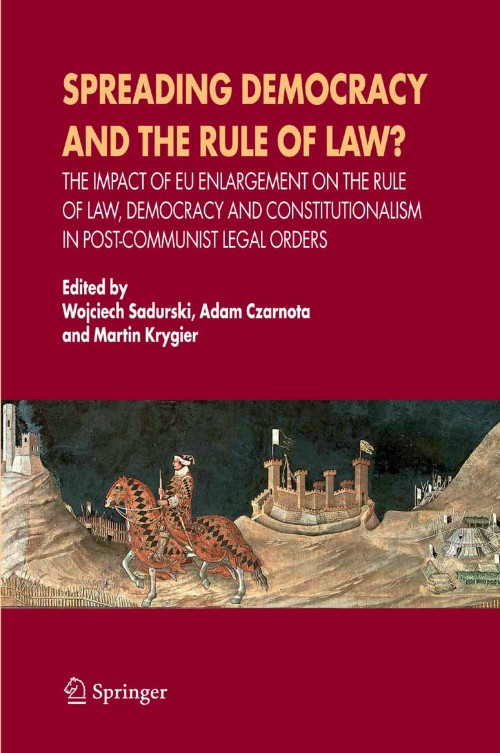
Spreading Democracy and the Rule of Law? [electronic resource] : The Impact of EU Enlargemente for the Rule of Law, Democracy and Constitutionalism in Post-Communist Legal Orders / edited by Wojciech Sadurski, Adam Czarnota, Martin Krygier.
Erişim Adresi
ISBN
9781402038426
Dil Kodu
İngilizce
Yer Numarası
DK/12643
Basım Bildirimi
1st ed. 2006.
Yayın Bilgisi
Dordrecht : Springer Netherlands : Imprint: Springer, 2006.
Fiziksel Niteleme
XII, 390 p. online resource.
İçindekiler Notu
Democratic Institutions and Practices -- EU Enlargement and Democracy in New Member States -- The Eastern EU Enlargement and the Janus-headed Nature of the Constitutional Treaty -- A Problem of their Own, Solutions of their Own: CEE Jurisdictions and the Problems of Lustration and Retroactivity -- Citizens and Foreigners in the Enlarged Europe -- Sub-National Governance in Central and Eastern Europe: Between Transition and Europeanization -- The Copenhagen Criteria and the Evolution of Popular Consent to EU Norms: From Legality to Normative Justifiability in Poland and the Czech Republic -- Constitutionalism -- Becoming “Europeans”: The Impact of EU “Constitutionalism” on Post-Communist Pre-Modernity -- Happy Returns to Europe? The Union’s Identity, Constitution-Making, and its Impact on the Central European Accession States -- An Evolutionary Approach to the Constitutionalism of an Enlarged EU: Why will Cognitive and Cultural Boundaries Matter? -- Constitutional Tolerance and EU Enlargement: The Politics of Dissent? -- Europeanization Through Judicial Activism? The Hungarian Constitutional Court’s Legitimacy and the “Return to Europe” -- The Rule of Law -- Barbarians ante portas or the Post-Communist Rule of Law in Post-Democratic European Union -- Transformation and Integration of Legal Cultures and Discourses—Poland -- EU Enlargement and the Constitutional Principle of Judicial Independence -- Post-Communist Legal Orders and the Roma: Some Implications for EU Enlargement -- A Europe of Variable Geometry: Still a Winning Model? -- Concluding Remarks -- Conclusions: The Adhesion of New Member States to the European Union and the European Constitution.
Özet, vb.
The accession of eight post-communist countries of Central and Eastern Europe (and also of Malta and Cyprus) to the European Union in 2004 has been heralded as perhaps the most important development in the history of European integration so far. While the impact of the enlargement on the constitutional structures and practices of the EU has already generated a rich scholarly literature, the influence of the accession on constitutionalism, democracy, human rights and the rule of law among the new member states has been largely ignored. This book fills this gap, and addresses the question of the consequences of the "external force" of European enlargement upon the understanding and practice of democracy and the rule of law and among both the main legal-political actors and the general public in the new member-states. A number of leading legal scholars, sociologists and political scientists, both from Central and Eastern Europe and from outside, address these issues in a systematic and critical way. Taken together, these essays help answer a fundamental question: does the European Union have the potential of promoting and consolidate democracy and human rights?
Konu
Private international law.
Conflict of laws.
International law.
Comparative law.
Political science.
Law __ Philosophy.
Political science __ Philosophy.
Private International Law, International and Foreign Law, Comparative Law.
Public International Law.
Political Science.
Philosophy of Law.
Political Philosophy.
Conflict of laws.
International law.
Comparative law.
Political science.
Law __ Philosophy.
Political science __ Philosophy.
Private International Law, International and Foreign Law, Comparative Law.
Public International Law.
Political Science.
Philosophy of Law.
Political Philosophy.
Diğer Yazarlar
Kurum Adı
Eseri Alıntıla
Referansları kullanmadan önce gözden geçirmeniz ve varsa gerekli düzeltmeleri yapmanız önerilir.
Dijital Kaynak
MARC Görünümü
LEADER 05207nam a22006135i 4500
001 811381
003 TR_AnAIT
005 20260131010553
007 cr nn 008mamaa
008 100301s2006 ne | s |||| 0|eng d
020 |a9781402038426|9978-1-4020-3842-6
024 7 |a10.1007/1-4020-3842-9|2doi
041 |aeng
049 |aTürk Tarih Kurumu Kütüphanesi
050 4|aK7000-7720.22
072 7|aLB|2bicssc
072 7|aLAM|2bicssc
072 7|aLAW051000|2bisacsh
072 7|aLB|2thema
072 7|aLAM|2thema
082 04|a340.9|223
090 |aDK/12643
245 10|aSpreading Democracy and the Rule of Law?|h[electronic resource] :|bThe Impact of EU Enlargemente for the Rule of Law, Democracy and Constitutionalism in Post-Communist Legal Orders /|cedited by Wojciech Sadurski, Adam Czarnota, Martin Krygier.
250 |a1st ed. 2006.
264 1|aDordrecht :|bSpringer Netherlands :|bImprint: Springer,|c2006.
300 |aXII, 390 p.|bonline resource.
336 |atext|btxt|2rdacontent
337 |acomputer|bc|2rdamedia
338 |aonline resource|bcr|2rdacarrier
347 |atext file|bPDF|2rda
505 0 |aDemocratic Institutions and Practices -- EU Enlargement and Democracy in New Member States -- The Eastern EU Enlargement and the Janus-headed Nature of the Constitutional Treaty -- A Problem of their Own, Solutions of their Own: CEE Jurisdictions and the Problems of Lustration and Retroactivity -- Citizens and Foreigners in the Enlarged Europe -- Sub-National Governance in Central and Eastern Europe: Between Transition and Europeanization -- The Copenhagen Criteria and the Evolution of Popular Consent to EU Norms: From Legality to Normative Justifiability in Poland and the Czech Republic -- Constitutionalism -- Becoming “Europeans”: The Impact of EU “Constitutionalism” on Post-Communist Pre-Modernity -- Happy Returns to Europe? The Union’s Identity, Constitution-Making, and its Impact on the Central European Accession States -- An Evolutionary Approach to the Constitutionalism of an Enlarged EU: Why will Cognitive and Cultural Boundaries Matter? -- Constitutional Tolerance and EU Enlargement: The Politics of Dissent? -- Europeanization Through Judicial Activism? The Hungarian Constitutional Court’s Legitimacy and the “Return to Europe” -- The Rule of Law -- Barbarians ante portas or the Post-Communist Rule of Law in Post-Democratic European Union -- Transformation and Integration of Legal Cultures and Discourses—Poland -- EU Enlargement and the Constitutional Principle of Judicial Independence -- Post-Communist Legal Orders and the Roma: Some Implications for EU Enlargement -- A Europe of Variable Geometry: Still a Winning Model? -- Concluding Remarks -- Conclusions: The Adhesion of New Member States to the European Union and the European Constitution.
520 |aThe accession of eight post-communist countries of Central and Eastern Europe (and also of Malta and Cyprus) to the European Union in 2004 has been heralded as perhaps the most important development in the history of European integration so far. While the impact of the enlargement on the constitutional structures and practices of the EU has already generated a rich scholarly literature, the influence of the accession on constitutionalism, democracy, human rights and the rule of law among the new member states has been largely ignored. This book fills this gap, and addresses the question of the consequences of the "external force" of European enlargement upon the understanding and practice of democracy and the rule of law and among both the main legal-political actors and the general public in the new member-states. A number of leading legal scholars, sociologists and political scientists, both from Central and Eastern Europe and from outside, address these issues in a systematic and critical way. Taken together, these essays help answer a fundamental question: does the European Union have the potential of promoting and consolidate democracy and human rights?
650 0|aPrivate international law.
650 0|aConflict of laws.
650 0|aInternational law.
650 0|aComparative law.
650 0|aPolitical science.
650 0|aLaw|xPhilosophy.
650 0|aPolitical science|xPhilosophy.
650 14|aPrivate International Law, International and Foreign Law, Comparative Law.
650 24|aPublic International Law.
650 24|aPolitical Science.
650 24|aPhilosophy of Law.
650 24|aPolitical Philosophy.
700 1 |aSadurski, Wojciech.|eeditor.|4edt|4http://id.loc.gov/vocabulary/relators/edt
700 1 |aCzarnota, Adam.|eeditor.|4edt|4http://id.loc.gov/vocabulary/relators/edt
700 1 |aKrygier, Martin.|eeditor.|4edt|4http://id.loc.gov/vocabulary/relators/edt
710 2 |aSpringerLink (Online service)
773 0 |tSpringer Nature eBook
776 08|iPrinted edition:|z9781402038419
776 08|iPrinted edition:|z9789048104925
776 08|iPrinted edition:|z9789048169788
856 40|uhttps://doi.org/10.1007/1-4020-3842-9
912 |aZDB-2-SHU
912 |aZDB-2-SXLC
950 |aHumanities, Social Sciences and Law (SpringerNature-11648)
950 |aLaw and Criminology (R0) (SpringerNature-43727)
001 811381
003 TR_AnAIT
005 20260131010553
007 cr nn 008mamaa
008 100301s2006 ne | s |||| 0|eng d
020 |a9781402038426|9978-1-4020-3842-6
024 7 |a10.1007/1-4020-3842-9|2doi
041 |aeng
049 |aTürk Tarih Kurumu Kütüphanesi
050 4|aK7000-7720.22
072 7|aLB|2bicssc
072 7|aLAM|2bicssc
072 7|aLAW051000|2bisacsh
072 7|aLB|2thema
072 7|aLAM|2thema
082 04|a340.9|223
090 |aDK/12643
245 10|aSpreading Democracy and the Rule of Law?|h[electronic resource] :|bThe Impact of EU Enlargemente for the Rule of Law, Democracy and Constitutionalism in Post-Communist Legal Orders /|cedited by Wojciech Sadurski, Adam Czarnota, Martin Krygier.
250 |a1st ed. 2006.
264 1|aDordrecht :|bSpringer Netherlands :|bImprint: Springer,|c2006.
300 |aXII, 390 p.|bonline resource.
336 |atext|btxt|2rdacontent
337 |acomputer|bc|2rdamedia
338 |aonline resource|bcr|2rdacarrier
347 |atext file|bPDF|2rda
505 0 |aDemocratic Institutions and Practices -- EU Enlargement and Democracy in New Member States -- The Eastern EU Enlargement and the Janus-headed Nature of the Constitutional Treaty -- A Problem of their Own, Solutions of their Own: CEE Jurisdictions and the Problems of Lustration and Retroactivity -- Citizens and Foreigners in the Enlarged Europe -- Sub-National Governance in Central and Eastern Europe: Between Transition and Europeanization -- The Copenhagen Criteria and the Evolution of Popular Consent to EU Norms: From Legality to Normative Justifiability in Poland and the Czech Republic -- Constitutionalism -- Becoming “Europeans”: The Impact of EU “Constitutionalism” on Post-Communist Pre-Modernity -- Happy Returns to Europe? The Union’s Identity, Constitution-Making, and its Impact on the Central European Accession States -- An Evolutionary Approach to the Constitutionalism of an Enlarged EU: Why will Cognitive and Cultural Boundaries Matter? -- Constitutional Tolerance and EU Enlargement: The Politics of Dissent? -- Europeanization Through Judicial Activism? The Hungarian Constitutional Court’s Legitimacy and the “Return to Europe” -- The Rule of Law -- Barbarians ante portas or the Post-Communist Rule of Law in Post-Democratic European Union -- Transformation and Integration of Legal Cultures and Discourses—Poland -- EU Enlargement and the Constitutional Principle of Judicial Independence -- Post-Communist Legal Orders and the Roma: Some Implications for EU Enlargement -- A Europe of Variable Geometry: Still a Winning Model? -- Concluding Remarks -- Conclusions: The Adhesion of New Member States to the European Union and the European Constitution.
520 |aThe accession of eight post-communist countries of Central and Eastern Europe (and also of Malta and Cyprus) to the European Union in 2004 has been heralded as perhaps the most important development in the history of European integration so far. While the impact of the enlargement on the constitutional structures and practices of the EU has already generated a rich scholarly literature, the influence of the accession on constitutionalism, democracy, human rights and the rule of law among the new member states has been largely ignored. This book fills this gap, and addresses the question of the consequences of the "external force" of European enlargement upon the understanding and practice of democracy and the rule of law and among both the main legal-political actors and the general public in the new member-states. A number of leading legal scholars, sociologists and political scientists, both from Central and Eastern Europe and from outside, address these issues in a systematic and critical way. Taken together, these essays help answer a fundamental question: does the European Union have the potential of promoting and consolidate democracy and human rights?
650 0|aPrivate international law.
650 0|aConflict of laws.
650 0|aInternational law.
650 0|aComparative law.
650 0|aPolitical science.
650 0|aLaw|xPhilosophy.
650 0|aPolitical science|xPhilosophy.
650 14|aPrivate International Law, International and Foreign Law, Comparative Law.
650 24|aPublic International Law.
650 24|aPolitical Science.
650 24|aPhilosophy of Law.
650 24|aPolitical Philosophy.
700 1 |aSadurski, Wojciech.|eeditor.|4edt|4http://id.loc.gov/vocabulary/relators/edt
700 1 |aCzarnota, Adam.|eeditor.|4edt|4http://id.loc.gov/vocabulary/relators/edt
700 1 |aKrygier, Martin.|eeditor.|4edt|4http://id.loc.gov/vocabulary/relators/edt
710 2 |aSpringerLink (Online service)
773 0 |tSpringer Nature eBook
776 08|iPrinted edition:|z9781402038419
776 08|iPrinted edition:|z9789048104925
776 08|iPrinted edition:|z9789048169788
856 40|uhttps://doi.org/10.1007/1-4020-3842-9
912 |aZDB-2-SHU
912 |aZDB-2-SXLC
950 |aHumanities, Social Sciences and Law (SpringerNature-11648)
950 |aLaw and Criminology (R0) (SpringerNature-43727)
Materyaller
Depodan talep edilen materyal sadece kütüphane içerisinde kullanılmaktadır.
Materyal dışarıya ödünç verilmemektedir.
Materyal dışarıya ödünç verilmemektedir.
